
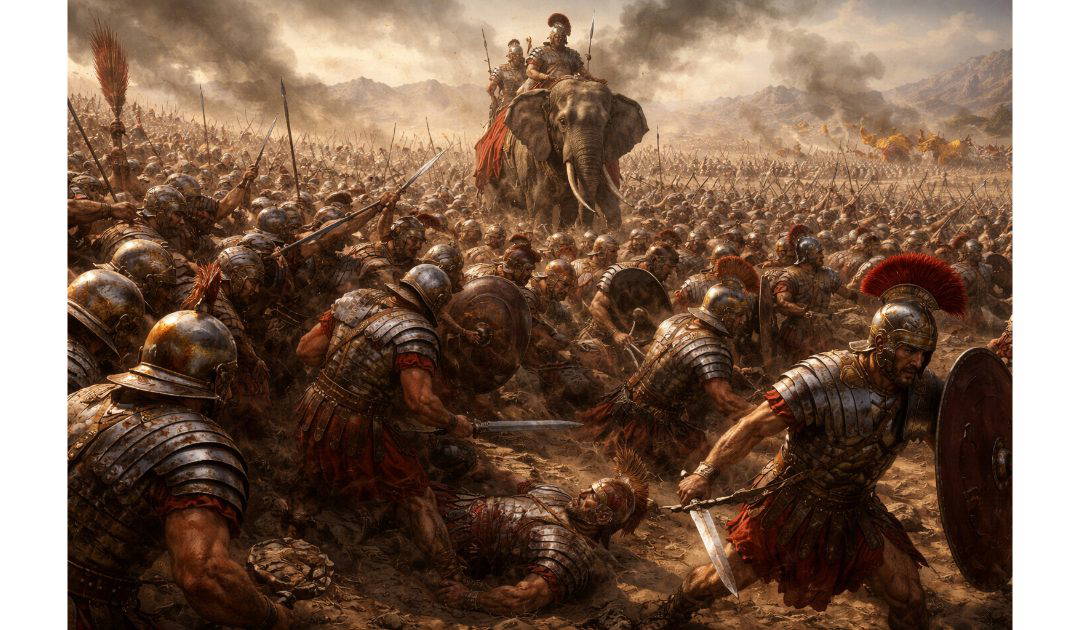
The Battle of Cannae is one of the most studied and devastating military engagements in history, a masterpiece of tactical brilliance that resulted in the near-annihilation of a Roman army at the hands of Carthage. It was fought on the 2nd of August, 216 BCE, during the Second Punic War. The battle took place in southeastern Italy near the small town of Cannae. The Carthaginian army was commanded by the brilliant general Hannibal Barca, whose daring crossing of the Alps into Italy had already stunned Rome. Opposing him were the Roman consuls Lucius Aemilius Paullus and Gaius Terentius Varro, who led one of the largest armies Rome had ever assembled.
Rome’s strategy was simple: overwhelm Hannibal with sheer numbers. Estimates vary, but the Romans fielded perhaps 80,000 infantry and 6,000 cavalry, while Hannibal’s forces numbered roughly 40,000 infantry and 10,000 cavalry. Confident in their superiority, the Romans deployed in an unusually deep formation, intending to punch through the Carthaginian centre.
Hannibal, however, devised a plan of remarkable subtlety. He arranged his troops in a convex formation, with a deliberately weakened centre composed of Gauls and Iberians, and stronger African infantry positioned on the flanks. His cavalry—superior in both number and quality—was placed on the wings. As the battle began, the Roman infantry pressed forward aggressively, driving into Hannibal’s centre, which gradually gave ground. This retreat was intentional, transforming the Carthaginian line from a bulging convex shape into a concave one.
As the Romans pushed deeper, they became compressed and lost their ability to manoeuvre effectively. At the critical moment, Hannibal’s African infantry on the flanks wheeled inward, attacking the Romans from both sides. Meanwhile, the Carthaginian cavalry had routed their Roman counterparts and returned to strike the Roman rear. The result was a complete encirclement—a double envelopment that trapped tens of thousands of Roman soldiers in a tightening ring.
What followed was slaughter on an extraordinary scale. With no room to fight or flee, Roman soldiers were cut down over several hours. Ancient sources, such as the historian Polybius, describe a grim scene of suffocation, panic, and relentless killing. Casualty estimates vary, but it is widely believed that between 50,000 and 70,000 Roman troops were killed, along with many officers and senators. The consul Paullus was among the dead, while Varro escaped with a small number of survivors.
The scale of the disaster shocked Rome to its core. Entire legions had been wiped out, and the Roman political and military elite had suffered grievous losses. In the aftermath, several of Rome’s allies in southern Italy defected to Hannibal’s side, believing Rome’s defeat inevitable.
Yet, despite his stunning victory, Hannibal did not march on Rome itself. This decision has been debated ever since. Some argue that he lacked the necessary siege equipment and reinforcements; others suggest that his strategy was never to capture Rome directly but to weaken it by breaking its alliances.
Rome’s response to Cannae demonstrated its resilience. Instead of suing for peace, the Romans adopted a more cautious strategy, often associated with the earlier general Quintus Fabius Maximus Verrucosus. Known as the “Fabian strategy,” this approach avoided large-scale confrontations with Hannibal, instead focusing on attrition and the gradual recovery of Roman strength.
Over time, Rome rebuilt its armies and regained the initiative. The war eventually shifted to other theatres, culminating in the decisive Roman victory at the Battle of Zama, where Scipio Africanus defeated Hannibal in North Africa.
The Battle of Cannae has had an enduring legacy in military thought. It is often cited as the classic example of a double envelopment, a tactic studied and admired by commanders throughout history, including Napoleon Bonaparte and Alfred von Schlieffen. The “Cannae model” has influenced military planning for centuries, symbolising the ideal of decisive battlefield encirclement.
In essence, Cannae was more than just a battle; it was a demonstration of how intelligence, discipline, and tactical innovation can overcome numerical superiority. Hannibal’s victory remains one of the most remarkable feats in the annals of warfare, a grim testament to both the possibilities of military genius and the catastrophic consequences of strategic miscalculation.