
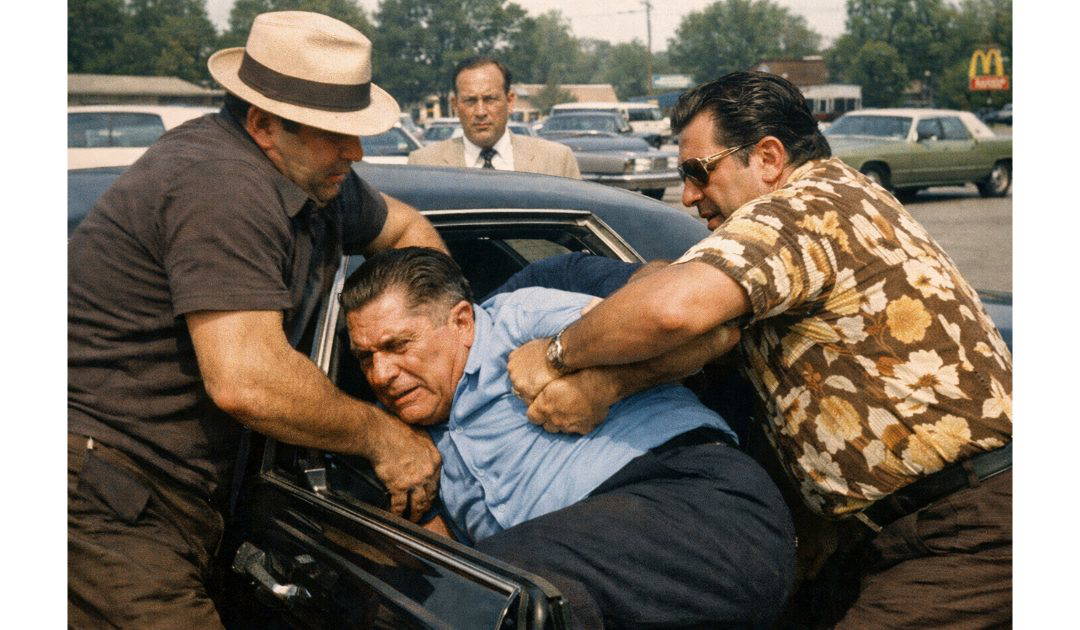
Jimmy Hoffa, an American union leader, disappeared on the 30th of July 1975, and was declared dead on the 30th of July 1982. Jimmy Hoffa remains one of the most intriguing and controversial figures in twentieth-century American labour history—a man whose rise to power, influence over millions of workers, and mysterious disappearance have cemented his place in both political history and popular culture.
Born James Riddle Hoffa on the 14th of February 1913 in Brazil, Indiana, he grew up in modest circumstances. His father, a coal miner, died when Hoffa was young, leaving the family to struggle financially. This early exposure to economic hardship helped shape Hoffa’s lifelong commitment to improving conditions for working people. As a teenager, he moved with his family to Detroit, Michigan, where he left school early and began working manual jobs.
Hoffa’s introduction to organised labour came in the 1930s when he joined efforts to unionise warehouse workers. He quickly distinguished himself through his energy, toughness, and willingness to confront employers. He became involved with the International Brotherhood of Teamsters—commonly known simply as the Teamsters—a union representing truck drivers and other transport workers. At a time when trucking was becoming vital to the American economy, the Teamsters were gaining power, and Hoffa saw an opportunity.
Through a combination of relentless organising and strategic negotiation, Hoffa rose rapidly through the union’s ranks. By the 1950s, he had become one of its most prominent leaders, and in 1957 he was elected president. Under his leadership, the Teamsters expanded dramatically, becoming one of the largest and most powerful unions in the United States. Hoffa negotiated national contracts that standardised wages and working conditions across the trucking industry, significantly improving pay and job security for hundreds of thousands of workers.
However, Hoffa’s success was accompanied by persistent allegations of corruption. Critics accused him of using intimidation, bribery, and connections with organised crime figures to consolidate power. His leadership style was often described as combative and authoritarian, and his willingness to deal with dubious associates drew increasing scrutiny from the government.
This scrutiny reached its peak during investigations led by Robert F. Kennedy, who served as chief counsel to a Senate committee examining labour racketeering before becoming U.S. Attorney General. Kennedy and Hoffa developed a fierce personal rivalry, with Kennedy determined to expose corruption within the Teamsters and Hoffa equally determined to resist him. Their clashes became a defining feature of labour politics in the late 1950s and early 1960s.
In 1964, Hoffa was convicted on charges of jury tampering and fraud related to misuse of the union’s pension fund. He was sentenced to 13 years in prison, marking a dramatic fall from power. Despite his incarceration, Hoffa remained a potent symbol within the labour movement, and he continued to exert influence behind the scenes.
In 1971, Hoffa’s sentence was commuted by President Richard Nixon, who imposed a controversial condition: Hoffa was barred from participating in union activities until 1980. Hoffa, however, was determined to regain control of the Teamsters and began manoeuvring to re-enter union leadership. This ambition may have placed him at odds with both union officials and organised crime figures who had benefited from his absence.
On the 30th of July, 1975, Hoffa disappeared under mysterious circumstances. He was last seen outside a restaurant in suburban Detroit, reportedly waiting for a meeting with individuals connected to both the union and organised crime. Despite extensive investigations, his body was never found, and the case remains one of America’s most enduring mysteries. In 1982, Hoffa was legally declared dead.
Numerous theories have emerged regarding Hoffa’s fate, many involving the Mafia. Some suggest he was murdered to prevent his return to power, while others propose more elaborate scenarios. Over the decades, alleged confessions, FBI investigations, and media speculation have kept the story alive, but no definitive answer has ever been established.
Hoffa’s legacy is complex. On one hand, he is remembered as a champion of working-class Americans who helped secure better wages and conditions for millions. His leadership transformed the Teamsters into a formidable force capable of negotiating on equal terms with major corporations. On the other hand, his career was marred by corruption, criminal associations, and a style of leadership that often blurred ethical lines.
In popular culture, Hoffa has become a symbol of both labour power and organised crime intrigue. His life has been depicted in books, documentaries, and films, reflecting ongoing fascination with his story. Actors such as Jack Nicholson and Al Pacino have portrayed him on screen, each emphasising different aspects of his personality—from charismatic leader to embattled outsider.
Ultimately, Jimmy Hoffa’s story encapsulates the tensions at the heart of twentieth-century American labour history: the struggle for workers’ rights, the concentration of power within unions, and the dangers of corruption. His achievements cannot be separated from the controversies that surrounded him, nor can his disappearance be fully explained. More than half a century later, Hoffa remains an enduring enigma—a man whose life shaped an era and whose fate continues to provoke speculation.