
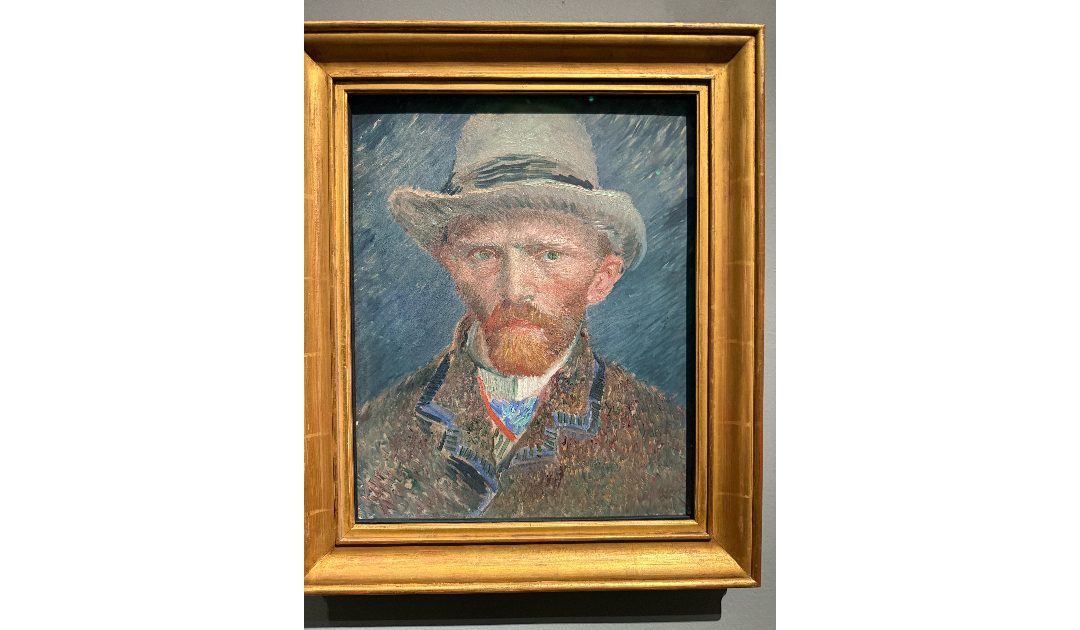
On the 27th of July, 1890, Vincent Van Gogh shot himself and died two days later. I have posted about the artists of Sir Anthony Standen’s lifetime, but I don’t think I have written about any more recent artists. My work in progress, Cade’s Point, the sixth book in the Sir Anthony Standen Adventures, features a scene where Anthony admires Murder of the Innocents, by Michele Alberti.
Vincent van Gogh was born on the 30th of March, 1853, in the village of Zundert in the southern Netherlands. He was the eldest son of a Protestant minister and grew up in a serious, religious household. As a boy he was quiet and thoughtful, and often preferred walking in the countryside to playing with other children. The fields, trees and skies of rural Holland made a deep impression on him and later became important subjects in his paintings.
At the age of sixteen, Van Gogh began work for the art dealers Goupil & Co. in The Hague. He later worked for the firm in London and Paris. Although he was surrounded by paintings and developed a love of art, he disliked the commercial side of the business. While living in London he fell in love with a woman who did not return his feelings, and this left him increasingly lonely and unhappy. After leaving the art trade in 1876, he tried several occupations, including teacher, bookseller and preacher.
Van Gogh then turned strongly towards religion. He hoped to become a minister like his father and studied theology for a time. Eventually he went to the Borinage, a poor coal-mining district in Belgium, where he worked as a missionary among miners and their families. He lived in extreme poverty, giving away his clothes and possessions to the poor. Church authorities believed he had become too extreme and dismissed him. Although this was a painful experience, it led him towards the career for which he is remembered. Around 1880, at the age of twenty-seven, he decided to become an artist.
He taught himself to draw and paint, studying books and copying the work of artists he admired, especially Jean-François Millet. His early paintings were dark in colour and often showed peasants and labourers. He admired ordinary working people and wanted to show the hardship and dignity of their lives. One of his first great works was The Potato Eaters, painted in 1885. It shows a peasant family sitting around a table under dim light, eating the food they had worked hard to grow.
Throughout his life, Van Gogh was supported financially and emotionally by his younger brother, Theo van Gogh. Theo worked as an art dealer in Paris and believed strongly in Vincent’s talent. The brothers wrote hundreds of letters to each other, and these letters are now one of the most important sources of information about Van Gogh’s thoughts, struggles and ambitions.
In 1886 Van Gogh moved to Paris to live with Theo. There he met many of the leading artists of the day, including Paul Gauguin and Émile Bernard. He discovered the bright colours and freer brushwork of Impressionist painting, and his own style changed dramatically. Instead of the dark browns and greys of his earlier work, he began to use vivid yellows, blues and greens.
In 1888 Van Gogh left Paris for Arles in the south of France. He hoped to create a community of artists there. The bright sunlight and countryside of Provence inspired him, and in a short time he produced some of his most famous paintings. These included Sunflowers, The Bedroom and Starry Night Over the Rhône. He invited Gauguin to join him in Arles, but the two men argued frequently. In December 1888, after a violent quarrel, Van Gogh suffered a mental breakdown and cut off part of his left ear.
After this incident, Van Gogh’s mental health worsened. He suffered attacks of confusion, hallucinations and deep depression. In 1889 he entered an asylum at Saint-Rémy-de-Provence. Even there he continued to paint. During this period he created perhaps his most famous work, The Starry Night, with its swirling sky and brilliant stars.
In May 1890 Van Gogh left the asylum and moved to Auvers-sur-Oise near Paris, where he came under the care of the doctor Paul Gachet. For a short time he painted with extraordinary energy, completing many landscapes and portraits. Yet he remained deeply troubled. On the 27th of July, 1890, he shot himself in a field. He died two days later, aged only thirty-seven, with Theo at his side.
During his lifetime Van Gogh sold very few paintings and was almost unknown. After his death, however, his work gradually became famous, thanks largely to Theo’s widow, Johanna van Gogh-Bonger, who preserved and promoted his paintings and letters. Today Vincent van Gogh is regarded as one of the greatest artists in history. His powerful colours, emotional honesty and energetic brushwork influenced many later painters and helped to shape modern art.