
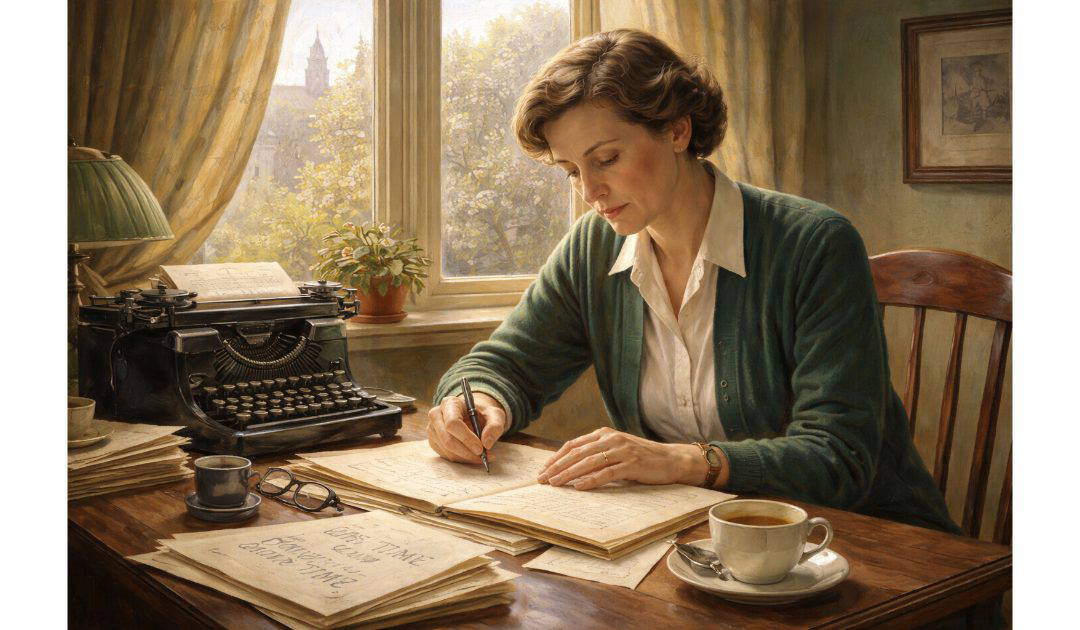
On the 25th of July, 1896, Elizabeth MacKintosh was born. She is better known By her pen name Josephine Tey. She was one of the most original crime writers of the twentieth century.
Probably ten or so years ago I read an article in which crime writers nominated their favourite crime writer. I expected Arthur Conan Doyle, Agatha Christie or Dorothy L Sayers, but almost all of them chose Josephine Tey. Neither my wife nor I had heard of her, so we set about reading her work. We were impressed to the point that we set about writing a screenplay of Brat Farrar. We haven’t been able to identify who owns the screen rights, so it’s on the shelf, but we had great fun collaborating on it, and we think it’s rather good.
She grew up in a respectable middle-class Scottish family. Her father was a fruit merchant and her mother had been a teacher. From an early age she loved reading and writing, but she was also practical and energetic. After attending Inverness Royal Academy, she trained as a physical education teacher at Anstey Physical Training College and then taught in schools in both England and Scotland.
Her teaching career shaped much of her later fiction. Tey observed the tensions, ambitions and rivalries of young people with great sharpness, and she later used these experiences in her novels. An accident in a school gymnasium, when a heavy boom struck her in the face, was remembered years later and transformed into a murder method in her novel Miss Pym Disposes.
In the early 1920s her life changed dramatically. Her mother became ill, and MacKintosh returned to Inverness to care for her and later for her father. Living quietly at home gave her time to write. She was a very private person and disliked publicity throughout her life. She published poems and short stories in newspapers and magazines under the pen name Gordon Daviot, a name taken from a place near Inverness that she loved.
Her first published book was Kif: An Unvarnished History, a novel about a young man and the First World War. It was followed in the same year by her first detective novel, The Man in the Queue. This book introduced Inspector Alan Grant of Scotland Yard, the detective who would appear in most of her crime novels. The novel won a prize in America and established her as a promising mystery writer.
However, MacKintosh’s real ambition at first was the theatre. Under the name Gordon Daviot she wrote historical plays. Her great breakthrough came in 1932 with Richard of Bordeaux, a drama about King Richard II. The play was an enormous success in London and later in New York. It made the young actor John Gielgud famous and began a lifelong friendship between him and MacKintosh. For a time she was better known as a playwright than as a novelist.
Although she continued to write plays, she gradually turned back to crime fiction. Her novels were unusual because they concentrated less on complicated clues and more on character and psychology. She was interested in why people behaved as they did and how appearances could be misleading. This made her work very different from the more conventional detective stories of the period.
Among her finest novels was A Shilling for Candles, in which Inspector Grant investigates the apparent drowning of a glamorous actress. The Franchise Affair dealt with two respectable women falsely accused of kidnapping, while Brat Farrar told the story of a young man who pretends to be the missing heir to a wealthy family. Both novels showed her remarkable ability to create suspense and believable characters.
Her masterpiece is generally considered to be The Daughter of Time. In this novel Inspector Grant, confined to a hospital bed, becomes fascinated by the mystery of whether Richard III really murdered the Princes in the Tower. Instead of solving a modern crime, Grant studies portraits, books and documents and concludes that Richard may have been innocent. The book was revolutionary because it mixed historical research with detective fiction. In 1990 the Crime Writers’ Association voted it the greatest crime novel ever written.
Tey wrote only eight mystery novels, yet their quality gave her a lasting reputation. Her last book published during her lifetime was The Daughter of Time. She was already seriously ill when it appeared. She suffered from liver cancer but told almost nobody. She died in London on the 13th of February, 1952, at the age of fifty-five. Her final novel, The Singing Sands, was published after her death.
Today Josephine Tey is remembered as one of the great innovators of detective fiction. Later writers admired the way she combined mystery with intelligence, humour and psychological insight. Though she lived quietly and avoided fame, her books continue to be read and loved, especially by those who want crime novels that are as thoughtful as they are exciting.