
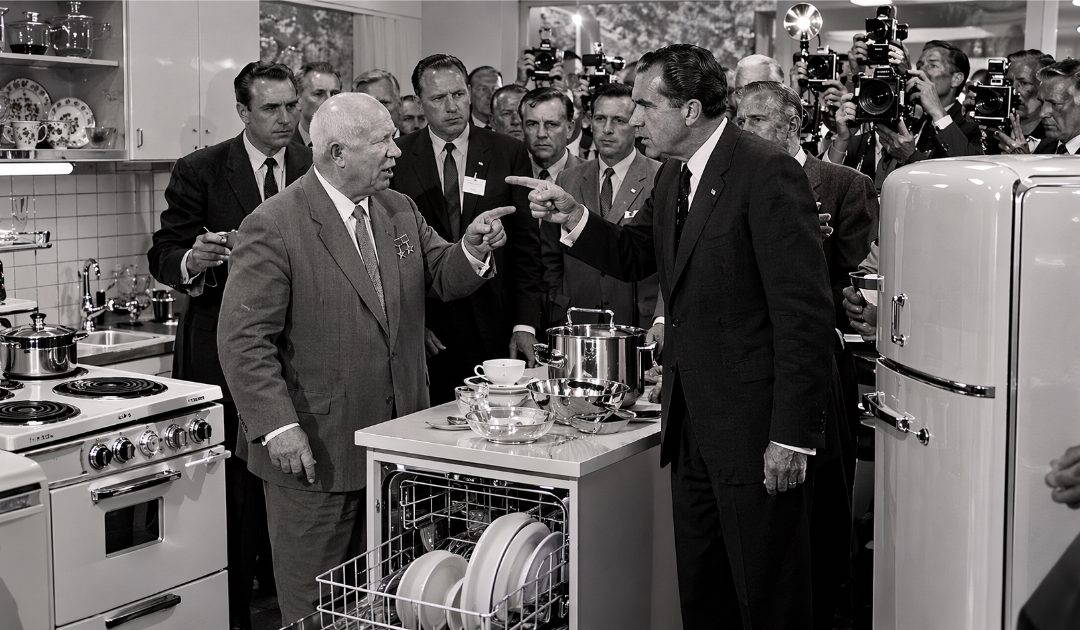
On the 24th of July, 1959, a kitchen debate took place between the then vice president of the United States, Richard Nixon, and the soviet premier, Nikita Khrushchev. It was one of the most memorable confrontations of the Cold War and took place not in a conference chamber, or at a summit table, but in the kitchen of a model American home in Moscow. The encounter became known as the “Kitchen Debate”, an unscripted argument between Richard Nixon and Nikita Khrushchev over the relative merits of capitalism and communism.
The debate occurred during the opening of the American National Exhibition at Sokolniki Park in Moscow. The exhibition had been arranged under the 1958 cultural agreement between the United States and the Soviet Union, which aimed to reduce tension by allowing each side to display its achievements in the other’s country. Earlier in the summer, the Soviet Union had held an exhibition in New York. Now it was America’s turn to show Soviet citizens what life in the United States looked like.
The American exhibition was designed to demonstrate the abundance and technological sophistication of American consumer life. More than 450 American companies displayed televisions, washing machines, refrigerators, cars and modern household gadgets. The centrepiece was a full-sized suburban house, cut in half so that visitors could see inside. It contained a bright, modern kitchen equipped with the latest labour-saving appliances. American organisers claimed that an ordinary American family could afford such a house.
As Vice President, Nixon acted as host and took Khrushchev on a tour of the exhibition. At first the two men exchanged polite remarks, but tension soon developed. Khrushchev had a reputation for bluntness and enjoyed verbal sparring. Nixon, equally combative, was determined to defend the American way of life.
The first clash came when Nixon showed Khrushchev a colour television studio. Nixon remarked that the programme was being recorded on videotape, which he presented as an example of American technological leadership. Khrushchev retorted that Soviet technology would soon equal or surpass that of the United States. He insisted that the Soviet Union did not care for “gadgets” merely for the sake of luxury, but concentrated on heavy industry and scientific progress.
The argument intensified when the two entered the model kitchen. Nixon pointed proudly to the dishwasher, stove and refrigerator and said that such appliances made life easier for ordinary Americans, especially housewives. He explained that the house cost about $14,000 and that many American workers could afford one.
Khrushchev dismissed this claim. He said that the Soviet Union also produced household appliances and would soon catch up. He mocked what he regarded as the American obsession with convenience, jokingly asking whether the Americans had invented “a machine that puts food into the mouth and pushes it down”. Nixon replied that the real strength of the American system was that people had a choice: they could buy different products and live as they wished.
The debate then moved beyond kitchens and consumer goods into a wider argument about ideology. Nixon claimed that capitalism gave ordinary people freedom, prosperity and a higher standard of living. Khrushchev answered that communism would eventually provide even more. He declared that history was on the side of the Soviet Union and famously told Nixon, “Your grandchildren will live under communism.” Nixon shot back that Khrushchev’s grandchildren would live in freedom instead.
Both men spoke through interpreters, but their emotions were obvious. Photographs show them standing face to face, pointing fingers and speaking heatedly. Reporters and photographers followed them through the exhibition, turning what might have been a private argument into an international spectacle.
At one point Nixon warned that constant Soviet threats involving missiles and nuclear weapons could lead to disaster. Khrushchev accused Nixon of threatening the Soviet Union and warned of “very bad consequences”. Yet neither man wanted the exchange to spiral out of control. Eventually Khrushchev said that what he really wanted was peace with America, and Nixon admitted that he had perhaps not been “a very good host”.
The importance of the Kitchen Debate lay not in any agreement reached, but in what it revealed about the Cold War. Until then, most competition between the United States and the Soviet Union had focused on military power, especially nuclear weapons. In Moscow, however, the contest shifted to everyday life. The two superpowers argued not over tanks and bombs, but over washing machines, kitchens and consumer choice.
The debate was also remarkable because it was filmed and shown in both countries. Nixon insisted that the videotape should be broadcast in the United States and the Soviet Union, allowing millions of viewers to see the argument for themselves. It was one of the first occasions on which Cold War rivalry unfolded before a mass international audience.
For Nixon personally, the Kitchen Debate was a political success. Many Americans thought he had stood up firmly to Khrushchev. His performance helped strengthen his reputation as a tough and capable statesman, which aided his campaign for the presidency in 1960. Khrushchev, meanwhile, remained convinced that communism would triumph, though history would eventually prove otherwise.