
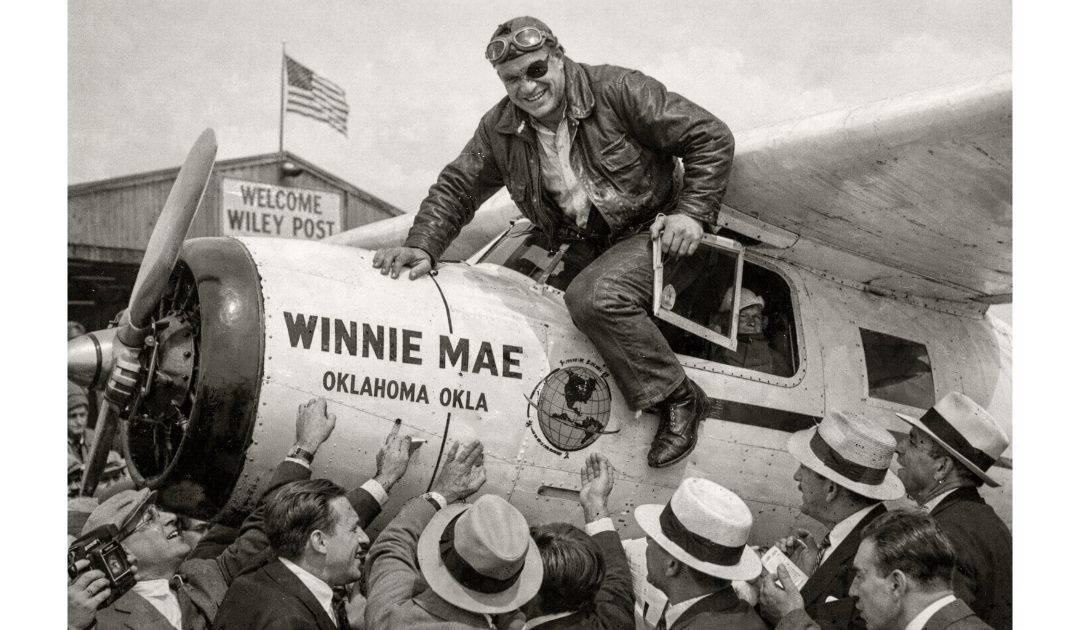
Today I write a post about Wiley Post. I have shared my interest in aviation several times. I have recorded the feats of the Wright brothers, Charles Lindburgh, Amy Johnson and Amelia Earhart. On the 22nd of July, 1933, Wiley Post completed the first solo flight around the world. I confess that I hadn’t heard of him before writing the post.
Wiley Post was one of the most remarkable figures of the early age of aviation. In little more than a decade he rose from poverty and obscurity. As well as his solo flight around the world he pioneered a precursor to the modern pressure suit.
Post was born on the 22nd of November 1898 in either Grand Saline, or nearby Corinth, accounts differ. His family later moved to Oklahoma. He had little formal education and left school after the sixth grade, but he was naturally gifted with machinery and spent his youth repairing engines and farm equipment.
His interest in flying began in 1913 when he saw an aeroplane at a county fair in Lawton. During the final years of the First World War he trained with the American military, hoping to become a pilot, but the war ended before he could complete his training.
After the war Post worked in the Oklahoma oil fields. Life was difficult and, for a time, he drifted into crime. In 1921 he was convicted of robbery and spent more than a year in prison. After his release he rebuilt his life, returned to work in the oil industry and later joined a travelling flying circus, where he learned to fly and parachute.
A turning point came in 1926 when an accident in an oil field cost him the sight in his left eye. From then on he wore the black eye patch for which he became famous. Using the compensation money from the accident, he bought his first aeroplane. The loss of an eye would have ended another man’s career, but Post simply adapted and continued flying.
By 1930 Post was flying for the wealthy oilman F. C. Hall, who owned a Lockheed Vega called Winnie Mae. The aircraft was named after Hall’s daughter. Post first gained national fame by flying the aircraft in the National Air Race Derby from Los Angeles to Chicago in record time.
His greatest achievements came in 1931 and 1933. In June 1931 Post and his navigator, Harold Gatty, set off on a journey around the world in the Winnie Mae. They completed the flight in just over eight days, breaking the previous record. Their route took them across the Atlantic, through Europe and the Soviet Union, across Alaska and back to New York.
Two years later Post attempted something even more daring: to fly around the world alone. He modified the Winnie Mae with an automatic pilot and a radio direction finder, both of them new and largely untested. Leaving Floyd Bennett Field on the 15th of July, 1933, he flew across the Atlantic to Berlin, then on through the Soviet Union, Alaska and Canada before returning to New York.
He landed again at Floyd Bennett Field on the 22nd of July after 7 days, 18 hours and 49 minutes, becoming the first person in history to fly solo around the world. Thousands of people gathered to greet him.
Post was not only a daring pilot but also an inventor. He became interested in flying at great heights, where thinner air allowed aircraft to travel faster. To make such flights possible he helped design one of the world’s first practical pressure suits. Wearing this strange rubber-and-metal suit, he flew above 50,000 feet and helped identify the fast-moving high-altitude winds later known as the jet stream.
In 1935 Post set out to explore a possible air route between America and Russia across Alaska. Travelling with his friend, the writer and humourist Will Rogers, he flew north in a modified aircraft. On the 15th of August, 1935, near Point Barrow in Alaska, the aircraft crashed during take-off and both men were killed. Post was only thirty-six years old.
Despite his short life, Wiley Post transformed aviation. He proved that one pilot, aided by technology and courage, could circle the globe alone, and his work on high-altitude flight helped make later developments in aviation and even space travel possible.