
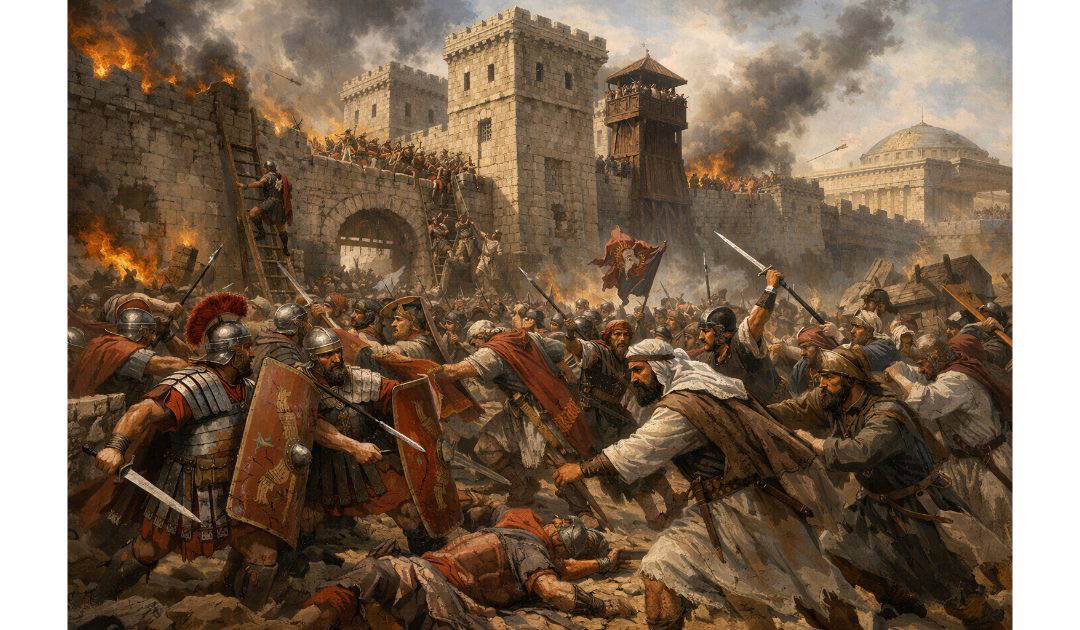
On the 20th of July, 70 CE, during the siege of Jerusalem, Titus (son of Emperor Vespasian) stormed the Fortress of Antonia, north of the Temple Mount, and engaged in street fighting with the Zealots.
Now I’m ashamed to say that I hadn’t previously known the source of the words zeal or zealot. Well, every day is a school day, as they say.
The fortress of Antonia, built by Herod the Great and named after Mark Antony, overlooked the courts of the Temple and was connected to them by covered passages. Whoever controlled Antonia controlled access to the Temple itself. During the final stages of the siege of Jerusalem in 70 CE, it became the key battleground between the Roman army and the Jewish defenders.
By the summer of 70 CE, the Roman army under Titus had already surrounded Jerusalem. Titus commanded four legions together with auxiliary troops from Syria and elsewhere. The Romans had broken through the outer and middle walls of the city, but the Temple Mount and the fortress of Antonia still held out. The defenders knew that if Antonia fell, the Temple itself would soon be exposed.
The fortress was defended chiefly by the Zealots and their allies. They had fortified the passages between Antonia and the Temple courts, erected barricades and prepared for close combat. Roman siege engines and battering rams repeatedly attacked the walls, but the defenders fought back fiercely. According to the historian Flavius Josephus, the defenders even dug tunnels beneath the Roman siege works and set fire to the supports, causing several Roman engines to collapse.
Titus responded by ordering new siege ramps to be built. Roman soldiers worked day and night under constant missile fire from the defenders above. Once the ramps were completed, the Romans brought up their rams again. Eventually the lower part of the fortress wall weakened and collapsed. The Zealots, however, had built a second wall behind the first during the night. This meant that the Romans had to fight through yet another line of defence.
At last a picked force of Roman legionaries made a surprise night attack. Climbing through the breach and over the walls in darkness, they killed the sentries and opened the way for the rest of the army. Fierce fighting followed inside the fortress. Romans and Zealots fought hand to hand with swords, spears and shields in the narrow passages and streets between Antonia and the Temple. Josephus described the combat as savage and confused because the confined space prevented either side from forming proper battle lines. Men slipped on blood and rubble, while smoke and darkness made it difficult to distinguish friend from foe.
Once the fortress itself had been taken, the Romans demolished much of it to create a broad approach to the Temple Mount. Titus ordered his men to tear down the remains of Antonia so that the whole Roman army could advance. Over seven days the Romans levelled the fortress and built an easier route to the Temple courts. The defenders retreated into the Temple enclosure and continued to resist from there.
The capture of Antonia was the turning point in the siege. Without the fortress, the Temple was no longer protected on its northern side. Only a few days later the Romans stormed the Temple precincts themselves, and the Second Temple was burned and destroyed. The fall of Antonia therefore led directly to one of the greatest disasters in Jewish history.
The men who defended the fortress were generally known as the Zealots. The Zealots were a radical Jewish movement that believed the Jews should accept no ruler except God. They emerged in the early first century CE, especially after the Roman authorities imposed taxes and tighter control over Judaea. According to Josephus, the movement began with Judas of Galilee in 6 CE, when he opposed a Roman census. Judas taught that paying tribute to Rome was an insult to God, because God alone was the true king of Israel.
The Zealots were not merely a religious group. They were also revolutionaries who wished to drive the Romans out of Judaea by force. Many ordinary Jews disliked Roman rule, but most hoped for compromise or peaceful resistance. The Zealots rejected compromise entirely. They believed that violent struggle and complete faith in divine help would bring victory.
During the great revolt against Rome from 66 to 70 CE, the Zealots seized power in Jerusalem. Yet they were divided among themselves. Rival leaders such as John of Gischala and Simon bar Giora fought one another as well as the Romans. Their infighting weakened the city’s defences and made the Roman conquest easier.
One particularly extreme branch of the Zealots was the Sicarii, whose name came from the curved daggers, or sicae, that they carried. They murdered Romans and also fellow Jews whom they considered traitors. Later writers blamed the Zealots and the Sicarii not only for resisting Rome but also for bringing ruin upon Jerusalem through fanaticism and civil war. Yet to later generations they could also appear as desperate patriots who fought for freedom against overwhelming odds.