
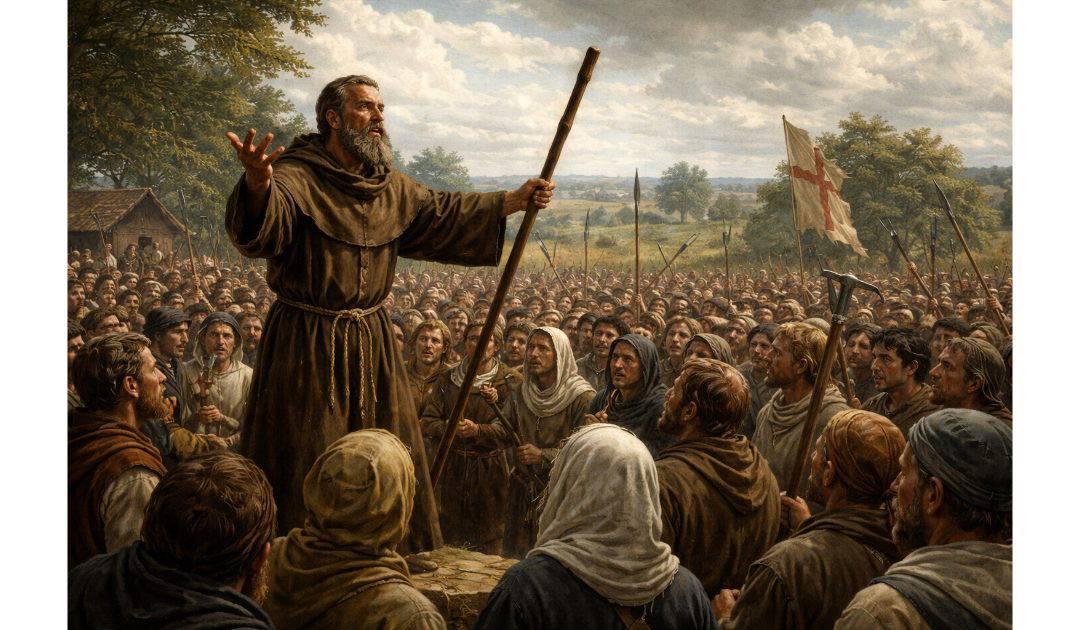
John Ball was one of the most striking and controversial figures associated with the Peasants’ Revolt of 1381, remembered less as a military leader than as a powerful voice of radical social and religious protest. A priest by training, Ball became famous for sermons that challenged the social hierarchy of medieval England and helped inspire one of the most dramatic popular uprisings in English history, the Peasants’ Revolt. I have written about Jack Cade and his role in the later Cade’s Rebellion against King Henry VI. Shakespeare imbued Cade with a hatred of education for the masses which I understand to be untrue, and borrowed from the earlier Peasants’ revolt. The tax collectors were not nobility, but they had to be educated at least in reading, writing, and arithmatic, to function as tax collectors. Education of the poor is the theme of my work in progress, Cade’s Point, the sixth book in the Sir Anthony Standen Adventures.
Little is known with certainty about John Ball’s early life, though he is thought to have been born in the mid-14th century, probably in south-east England. He was ordained as a priest, but his career within the Church quickly became troubled. Ball gained a reputation for preaching outside official structures, often delivering sermons in open fields rather than in parish churches.
His message brought him into repeated conflict with ecclesiastical authorities. He criticised both the wealth of the Church and the inequality embedded in feudal society. For this, he was condemned by Church leaders and imprisoned more than once, including by Archbishop Simon Sudbury, who saw Ball’s teachings as subversive and dangerous.
Ball’s significance lies largely in the ideas he expressed. His sermons attacked the rigid hierarchy that divided medieval society into those who prayed, those who fought, and those who laboured. He questioned why ordinary people — especially peasants — should be burdened with heavy taxation and feudal obligations while the nobility and clergy enjoyed privilege.
He is most famous for a line attributed to him by later chroniclers:
“When Adam delved and Eve span, who was then the gentleman?”
This rhetorical question struck at the heart of feudal ideology. By invoking the biblical figures of Adam and Eve, Ball suggested that all people were originally equal, and that social distinctions such as lordship and serfdom were human inventions rather than divine mandates.
Ball’s ideas may have been influenced, at least indirectly, by reformist religious movements such as those associated with the theologian John Wycliffe, although the extent of any direct connection is debated. What is clear is that Ball’s preaching combined religious language with a powerful critique of social injustice.
In 1381, widespread resentment over taxation — especially the poll tax — and economic hardship after the Black Death led to rebellion across parts of England. In Kent and Essex, insurgents began to organise and march toward London. During this early phase of the revolt, Ball was released from prison by rebels and quickly emerged as one of its leading voices.
Although Wat Tyler is usually regarded as the principal commander of the rebels, John Ball served as their ideological spokesman. He preached to large gatherings, urging unity and perseverance, and framing the revolt as a righteous struggle against oppression.
His sermons helped give the movement a sense of purpose that went beyond immediate grievances. He called not only for an end to unjust taxation, but also for a broader restructuring of society — including the abolition of serfdom and the reduction of aristocratic privilege.
The rebels entered London in June 1381 and briefly gained the upper hand, executing prominent officials such as Simon Sudbury. They also met the young king Richard II, who initially appeared to concede some of their demands. However, the revolt soon faltered. Wat Tyler was killed during a confrontation at Smithfield, and royal authority reasserted itself. The king withdrew earlier concessions, and the rebellion rapidly collapsed. Ball attempted to flee but was captured not long afterwards.
John Ball was taken to St Albans, where he was tried for treason. The authorities were determined to make an example of him. Unlike many ordinary rebels, Ball was seen as especially dangerous because of his ideas and his influence.
John Ball was executed on the 15th of July 1381, by hanging, drawing, and quartering — the brutal punishment reserved for traitors. His death marked the end of his direct role in events, but not the end of his reputation.
Contemporary chroniclers portrayed Ball as a dangerous agitator whose teachings encouraged disorder and rebellion. Writing from the perspective of the established order, they saw him as a threat to both Church and state.
Later interpretations have been more varied. Some historians have viewed Ball as an early advocate of social equality, even a proto-revolutionary figure. Others caution against reading modern political ideas into his words, emphasising that his view was deeply rooted in medieval religious belief.
What is beyond doubt is that Ball gave voice to grievances that were widely felt but rarely expressed so boldly. His ability to articulate a moral critique of inequality helped transform the Peasants’ Revolt from a series of local protests into a movement with a broader ideological dimension.