
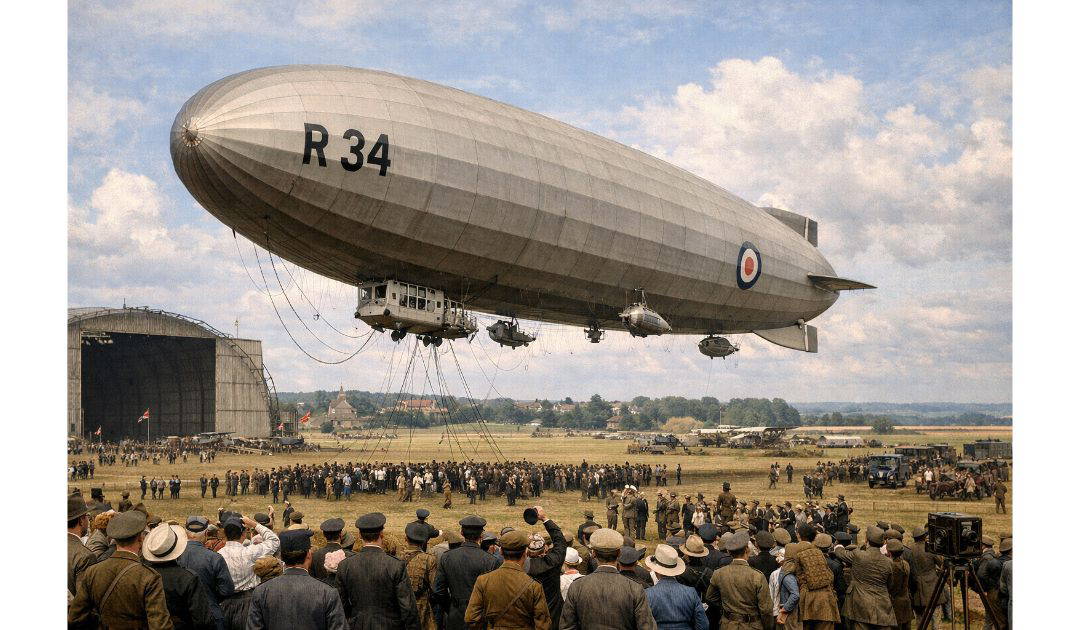
I have written about my fascination with flight, so today’s choice is fairly easy. On the 13th of July, 1919, the airship R34 landed in Norfolk having completed the first return flight across the Atlantic in 182 hours of flight.
The British rigid airships R33 airship and R34 airship were among the most remarkable aeronautical achievements of the immediate post–First World War period. Built at a time when aviation was still in its infancy, they embodied both the promise and the peril of lighter-than-air travel, and their stories illustrate the diverging paths of civil and military airship development in the early twentieth century.
The design of both airships was heavily influenced by German Zeppelin technology. During the war, Britain had captured the German airship LZ 76 (L33) after it crash-landed in Essex in 1916. Engineers carefully studied its structure, and the result was the R33-class airships. Constructed by the firm Armstrong Whitworth, R33 and R34 were near-sisters, each approximately 643 feet long, with a framework of duralumin girders and multiple gasbags filled with hydrogen. They were powered by several Sunbeam engines and had a top speed of around 60–65 miles per hour.
The R34 quickly achieved lasting fame. In July 1919, it became the first aircraft to complete a return transatlantic crossing. Flying from East Fortune in Scotland to Mineola, New York, and back again, the journey captured the public imagination. The westbound flight took over 108 hours, battling headwinds and mechanical strain, while the return journey was somewhat faster. The feat demonstrated the endurance and range of rigid airships, suggesting a future in which long-distance air travel might routinely cross oceans. For a brief moment, it seemed that airships, rather than aeroplanes, would dominate intercontinental flight.
The R33, though less celebrated, had a distinguished and dramatic career of its own. Commissioned shortly after the war, it served primarily as a test and training vessel. In 1925, it survived a near-disaster that became legendary in aviation history. While moored at Pulham in Norfolk, a sudden gale tore the airship from its mast, with only a skeleton crew aboard. Despite being dragged uncontrollably over the North Sea, the crew managed to regain command, restart the engines, and navigate the damaged airship back to safety. This episode highlighted both the vulnerability and resilience of rigid airships.
Despite these successes, the fortunes of airships—particularly in civil use—proved uneven. In the immediate postwar years, many saw airships as the future of long-distance passenger travel. Their ability to remain aloft for extended periods, carry heavy loads, and provide relatively smooth journeys made them attractive for transoceanic routes. Countries such as Britain, Germany, and the United States invested heavily in their development. The later German Zeppelins, such as the Graf Zeppelin, would successfully operate regular passenger services during the late 1920s and early 1930s.
However, civil airships were plagued by inherent risks. Hydrogen, the primary lifting gas, was highly flammable, and the enormous size of the craft made them vulnerable to weather. Catastrophes such as the crash of the British R101 in 1930 and the destruction of the Hindenburg in 1937 severely damaged public confidence. These disasters were widely publicised and had a profound psychological impact, leading to the rapid decline of airship travel as a commercial enterprise. Meanwhile, advances in fixed-wing aircraft—greater speed, reliability, and range—made aeroplanes increasingly competitive and ultimately dominant.
Military airships followed a somewhat different trajectory. During the First World War, both Britain and Germany had used airships extensively for reconnaissance, anti-submarine patrols, and strategic bombing. Their endurance made them particularly valuable for maritime surveillance, where they could patrol vast areas for long periods. The British continued to use non-rigid airships, or blimps, for coastal defence into the interwar years and beyond.
Yet rigid military airships like the R33 and R34 were ultimately overtaken by technological change. Improvements in aeroplanes reduced the need for slow, vulnerable airships. Aircraft became faster, could fly higher, and were less susceptible to interception or weather-related disasters. Moreover, the logistical demands of maintaining large rigid airships—massive hangars, ground crews, and specialised infrastructure—made them expensive and impractical for widespread military use.
In contrasting civil and military fortunes, one sees a shared arc of early optimism followed by decline, but for different reasons. Civil airships failed largely because of high-profile disasters and competition from aeroplanes, which proved safer and faster for passenger transport. Military airships, on the other hand, were rendered obsolete more gradually, as improvements in aviation technology provided more efficient alternatives for reconnaissance and patrol.
The stories of the R33 and R34 thus stand at a pivotal moment in aviation history. They represent the height of British rigid airship development and a time when the skies seemed open to vast, floating leviathans. Yet they also foreshadow the limitations that would soon curtail the airship era. In the end, while airships did not fulfil their early promise as the primary means of long-distance travel or military reconnaissance, they remain enduring symbols of ingenuity, ambition, and a fascinating chapter in the story of flight.