
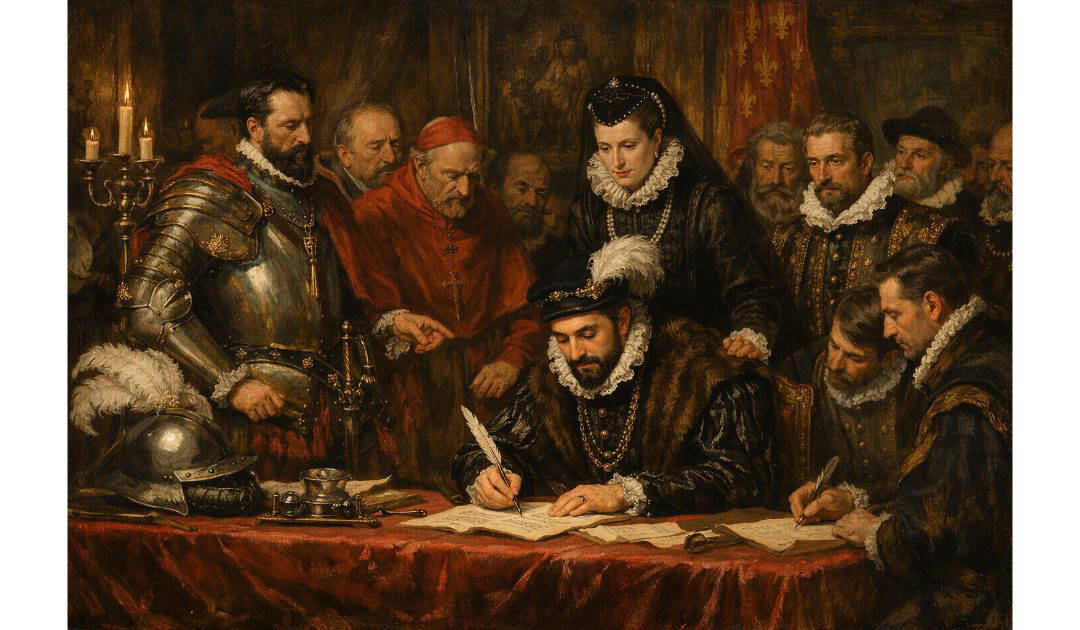
On the 7th of July in 1456 Joan of Arc was acquitted of heresy, 25 years after her execution. In 1928 sliced bread was invented, and in 1953 Che Guevara set off on his grand tour of Central and South America. But I’ve already written about those, so today I give you the Treaty of Nemours, signed this day in 1585.
The treaty was concluded between King Henry III of France and the powerful Catholic faction known as the Catholic League, led by Henry I, Duke of Guise. King Henry III was the son of Catherine de Medici, so she was the brain behind the throne. By the mid-1580s, France had endured more than two decades of intermittent civil war between Catholics and the Protestant minority, known as the Huguenots. Although several attempts at peace had been made, tensions remained high, and the fragile coexistence between the two confessions was breaking down.
The immediate background to the treaty lay in the dynastic crisis facing the French monarchy. Henry III had no heir, and the next in line to the throne was Henry of Navarre, a leading Protestant. This prospect alarmed many Catholics, who feared the accession of a Protestant king in a predominantly Catholic country. The Catholic League, under the Guise family, seized upon this anxiety to strengthen its position and rally support across France.
By 1585, the League had grown powerful enough to challenge royal authority directly. It controlled significant territories and enjoyed support from Philip II of Spain, who saw an opportunity to weaken France and advance Catholic interests in Europe. Faced with mounting pressure and the threat of open rebellion, Henry III was effectively forced into negotiations with the League.
The Treaty of Nemours was the result of this pressure and represented a major capitulation by the crown. Its terms were harsh for the Protestants. The treaty revoked all previous edicts of toleration that had granted limited religious freedoms to the Huguenots. Protestant worship was outlawed throughout the kingdom, and Huguenots were required either to convert to Catholicism or leave France. In addition, Protestant officeholders were stripped of their positions, and the Catholic League was granted substantial political and military concessions.
In effect, the treaty aligned the monarchy with the League’s hardline Catholic agenda. It also declared that no heretic could inherit the French throne, directly targeting Henry of Navarre and excluding him from the line of succession. This clause further intensified the political crisis and set the stage for renewed conflict.
Rather than bringing peace, the Treaty of Nemours reignited the wars. The Huguenots, led by Henry of Navarre, refused to accept the terms and prepared for armed resistance. This led to the outbreak of the War of the Three Henrys (1585–1589), named after the three principal figures: Henry III, Henry of Navarre, and Henry I, Duke of Guise. The conflict was marked by shifting alliances, assassinations, and increasing instability.
The treaty also had profound implications for the authority of the monarchy. By yielding to the demands of the Catholic League, Henry III appeared weak and compromised. His inability to balance the competing religious factions undermined his legitimacy and encouraged further defiance from powerful nobles. The Guise family, in particular, emerged as a dominant force, effectively rivaling the king in influence.
The consequences of the treaty unfolded rapidly. In 1588, tensions between the king and the League reached a breaking point during the Day of the Barricades in Paris, when Guise supporters rose in revolt. Henry III was forced to flee the capital. Later that year, in a dramatic turn of events, the king ordered the assassination of the Duke of Guise, an act that deepened the crisis. In 1589, Henry III himself was assassinated, bringing the Valois dynasty to an end.
Despite the Treaty of Nemours’ attempt to enforce religious unity through repression, it ultimately failed to resolve the underlying divisions in French society. Instead, it prolonged the conflict and contributed to the eventual rise of Henry of Navarre, who succeeded to the throne as Henry IV of France. In order to secure his position and restore peace, Henry IV famously converted to Catholicism and later issued the Edict of Nantes in 1598, which granted limited rights to Protestants and brought an end to the Wars of Religion.
It would be remiss of me not to mention that Catherine de Medici and the War of the Three Henrys feature in The Spy who Sank the Armada, the first book in the Sir Anthony Standen Adventures, or that King Henry IV features in The Suggested Assassin, the third book in the series.