
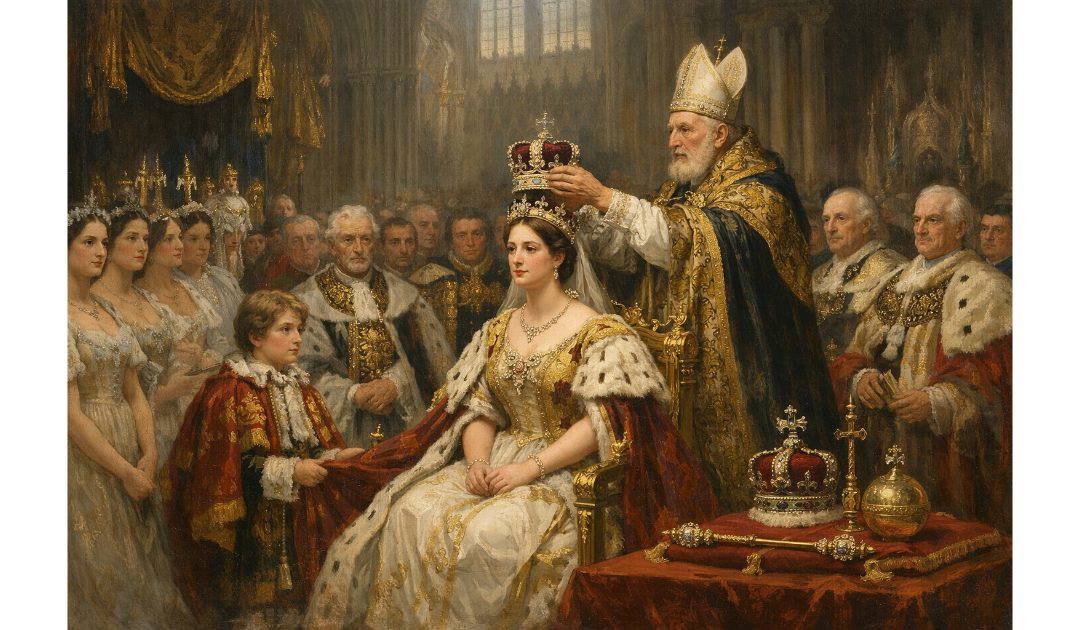
The two events which caught my eye for today’s post were Charles V being elected Holy Roman Emperor in 1519 (because there’s a connection with my ancestor the Elizabethan spy, Sir Anthony Standen), and the assassination of Franz Ferdinand. But I’ve already covered them. So I’ll opt for the coronation of Queen Victoria, on the 28th of June, 1838.
Victoria was born on the 24th of May, 1819, at Kensington Palace, she was the only child of Prince Edward, Duke of Kent, and Princess Victoria of Saxe-Coburg-Saalfeld. At the time of her birth, she was not expected to inherit the throne, but the three uncles who were ahead of her in the succession – George IV, Frederick Duke of York, and William IV – had no legitimate children who survived.
Victoria became queen at the age of just eighteen, ascending the throne on the 20th of June, 1837, upon the death of her uncle, King William IV. Her youth and inexperience initially raised concerns, but she quickly demonstrated a strong sense of duty and an ability to adapt to the responsibilities of monarchy. Her early reign was influenced by her close relationship with her first Prime Minister, Lord Melbourne, who acted as a political mentor and helped her navigate the complexities of constitutional monarchy.
In 1840, Victoria married her cousin, Prince Albert of Saxe-Coburg and Gotha. Their marriage was both a personal and political success, and Albert became an important advisor to the queen. He played a key role in promoting industry, science, and culture, most notably through his involvement in the Great Exhibition of 1851, which showcased Britain’s industrial achievements and symbolised the nation’s global dominance. Victoria and Albert had nine children, many of whom married into European royal families, earning Victoria the nickname “the grandmother of Europe.”
The period of Victoria’s reign, known as the Victorian era, was marked by dramatic social, economic, and technological transformation. Britain became the world’s leading industrial power, driven by advances in manufacturing, engineering, and transport. The expansion of the railway network, the growth of cities, and innovations such as the telegraph transformed everyday life. At the same time, the British Empire expanded to its greatest extent, encompassing vast territories across Asia, Africa, and the Americas. In 1876, Victoria was proclaimed Empress of India, reflecting Britain’s imperial dominance.
Despite these achievements, the Victorian era was also a time of stark social inequality. Industrialisation brought wealth and progress but also poverty, overcrowded cities, and harsh working conditions for many. Issues such as child labour, public health, and workers’ rights became major political concerns. Reform movements gradually led to changes, including improvements in working conditions and the expansion of voting rights through a series of Reform Acts.
Victoria’s personal life had a profound impact on her public role. The death of Prince Albert in 1861 devastated her, and she entered a prolonged period of mourning, withdrawing from public life for many years. This seclusion led to criticism and a temporary decline in the popularity of the monarchy. However, she gradually returned to public duties, and her image as a devoted widow and mother helped restore public affection.
In her later years, Victoria became a symbol of stability and continuity in a rapidly changing world. Her Golden Jubilee in 1887 and Diamond Jubilee in 1897 were celebrated across the empire, reflecting her status as a unifying figure. By the time of her death on 22 January 1901 at Osborne House on the Isle of Wight, she had reigned for over sixty-three years, the longest of any British monarch at that time, and so far eclipsed only by the late Queen Elizabeth II.
Victoria’s legacy is complex and enduring. She helped shape the modern constitutional monarchy, in which the sovereign reigns but does not rule. Her reign saw Britain reach the height of its global influence, while also grappling with the challenges of modernity. The values associated with the Victorian era—duty, respectability, and moral seriousness—left a lasting imprint on British society.
Queen Victoria remains a defining figure in British history. Her name is associated with an entire age of progress and contradiction, an era that laid many of the foundations of the modern world.