
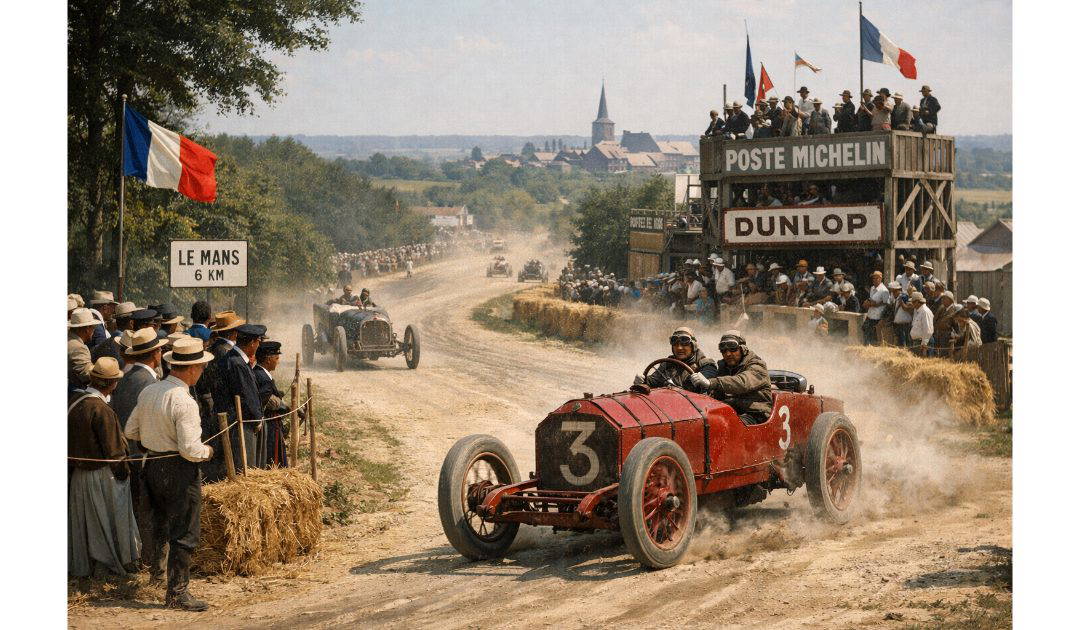
The first Grand Prix motor race was over the 26th and 27th of June 1906 on closed public roads outside the city of Les Mans. Officially known as the 1906 French Grand Prix, it marked a turning point in the development of motor racing, establishing many of the conventions and standards that would define the sport for decades to come.
The race was organised by the Automobile Club de France (ACF), which sought to replace the earlier, less structured city-to-city Gordon Bennett Cup races that had dominated the early years of motoring. These earlier contests—such as Paris–Bordeaux or Paris–Madrid—were thrilling but dangerous, often run on open roads with minimal regulation, leading to numerous accidents and fatalities. By 1906, there was a clear need for a more controlled and organised format, and the ACF responded by creating a closed-circuit race, effectively giving birth to the Grand Prix concept.
The chosen course formed a triangular loop of approximately 103 kilometres (64 miles), running through the French countryside to the east of Le Mans. The route passed through towns such as Saint-Calais and La Ferté-Bernard, and featured a mixture of long straights, tight corners, and varying road surfaces. Importantly, the roads were closed to the public for the duration of the race, making it far safer than earlier competitions and allowing for better organisation and spectator control.
The race itself was run over two days, with drivers completing six laps each day for a total distance of around 1,238 kilometres (770 miles). This format was chosen to reduce strain on both drivers and machinery, as endurance was a major factor in early motor racing. Cars were required to meet strict technical regulations, including a maximum weight limit of 1,000 kilograms (excluding tyres, fuel, and tools), which encouraged manufacturers to innovate in design and engineering.
A total of 32 cars entered the race, representing leading automobile manufacturers from France, Italy, and beyond. Among them was the French company Renault, whose vehicles were driven by notable competitors including Ferenc Szisz. Szisz, a Hungarian driver and mechanic, would go on to achieve a historic victory in this inaugural event.
The race began early in the morning on the 26th of June, with cars setting off at 90-second intervals rather than in a mass start. This staggered format was designed to reduce congestion and improve safety, though it also meant that drivers were effectively racing against the clock rather than directly against one another on the road. Conditions were challenging, with dust clouds thrown up by the cars making visibility difficult and adding to the physical strain on drivers and their riding mechanics.
Mechanical reliability proved to be one of the most decisive factors. Early racing cars were still relatively primitive, and breakdowns were common. Tyres, in particular, were a major concern, as the rough road surfaces caused frequent punctures and wear. The introduction of detachable rims—pioneered by Michelin—allowed drivers to change tyres more quickly, giving a significant advantage to those equipped with the technology.
By the end of the first day, Szisz had established a strong lead in his Renault, thanks in part to both his skill and the reliability of his car. On the second day, he maintained his advantage despite continued challenges from competitors. Ultimately, Szisz completed the race in a total time of just over 12 hours, finishing well ahead of the rest of the field and securing his place in motorsport history as the winner of the first Grand Prix.
The significance of the 1906 race cannot be overstated. It introduced the term “Grand Prix” to motor racing and set the template for modern circuit racing. The use of a closed course, strict technical regulations, timed starts, and multi-day endurance format all influenced the development of future competitions. It also highlighted the importance of teamwork, as each driver was accompanied by a mechanic who assisted with repairs and navigation during the race.
Moreover, the event underscored the growing importance of the automobile industry in the early 20th century. Manufacturers used the race as a proving ground for new technologies, and success on the track translated into prestige and commercial advantage. The innovations tested during the race—particularly in tyres, engines, and chassis design—would soon find their way into production vehicles, benefiting the wider public.
In the years that followed, the Grand Prix concept spread across Europe and eventually the world, leading to the establishment of national and international racing championships. While the cars, speeds, and safety standards have evolved dramatically since 1906, the fundamental principles established at Le Mans remain at the heart of modern motorsport.
Thus, the 1906 French Grand Prix was far more than just a race; it was the foundation of an entire sporting tradition. On those dusty roads near Le Mans, a new era of organised, competitive motor racing was born—one that continues to captivate audiences more than a century later.