
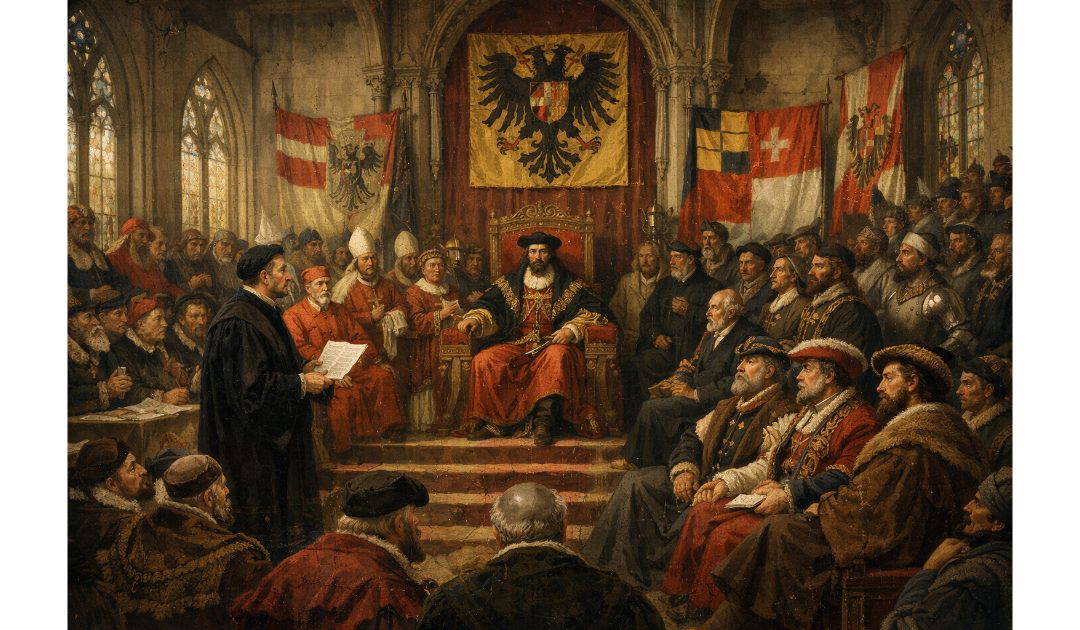
It’s not a weight loss programme. This is diet in the sense of mode of living, from the Greek diata. In particular, since in the Middle Ages living and religion were somewhat inseperable, it concerns the reformation.
The Diet of Augsburg was one of the most significant political and religious assemblies of the early Reformation era, held in the Free Imperial City of Augsburg in 1530. Convened by the Holy Roman Emperor Charles V, the gathering sought to address the growing religious divisions within the Holy Roman Empire caused by the spread of Protestant reform ideas. It marked a critical moment in the struggle between Catholic authority and the emerging Protestant movement.
By 1530, the teachings of Martin Luther had spread widely across German territories and beyond. Since Luther’s initial challenge to the Catholic Church in 1517, many princes and cities had adopted reforms, creating deep divisions within the Empire. Charles V, a devout Catholic, was determined to restore religious unity, which he believed was essential for political stability—especially as he faced external threats from the Ottoman Empire and ongoing conflicts with France.
Luther himself could not attend the Diet, as he remained under the imperial ban issued after the Diet of Worms in 1521. Instead, the Protestant position was represented by his close associate, Philip Melanchthon, a more moderate and diplomatic figure. Melanchthon played a central role in drafting the key document presented at the Diet: the Augsburg Confession.
The Augsburg Confession, formally presented on the 25th of June, 1530, was a carefully constructed summary of Lutheran beliefs. It aimed to demonstrate that the reformers were not heretics but rather faithful Christians seeking to correct abuses within the Church. The document outlined key theological positions, including justification by faith alone, the authority of Scripture, and a critique of certain Catholic practices such as the sale of indulgences. Importantly, Melanchthon’s tone was conciliatory, seeking compromise rather than confrontation.
Charles V, however, was not persuaded. While he allowed the Protestants to present their case, he ultimately rejected the Augsburg Confession. In response, Catholic theologians drafted a rebuttal known as the Confutation, which reaffirmed traditional Church doctrine and rejected Protestant teachings. The Emperor demanded that Protestant princes and cities return to the Catholic faith, but they refused.
The Diet thus failed in its primary aim of restoring religious unity. Instead, it hardened divisions within the Empire. Protestant leaders, feeling increasingly threatened, began to organise politically and militarily. This would eventually lead to the formation of defensive alliances such as the Schmalkaldic League in 1531, which sought to protect Protestant territories from imperial enforcement of Catholic orthodoxy.
Despite its failure to achieve reconciliation, the Diet of Augsburg was a turning point in the Reformation. The Augsburg Confession became the foundational statement of Lutheran doctrine and remains one of the most important confessional documents in Protestant history. It provided a clear and systematic expression of beliefs that distinguished Lutheranism from Catholicism, helping to solidify the identity of the movement.
Politically, the Diet revealed the limits of imperial authority. Charles V, despite his power, was unable to impose religious uniformity across his diverse territories. The princes of the Holy Roman Empire held significant autonomy, and many were willing to defy the Emperor in defence of their religious convictions. This balance of power would continue to shape the Empire’s development for decades.
The legacy of the Diet can also be seen in later attempts to resolve religious conflict within the Empire. Most notably, it set the stage for the Peace of Augsburg in 1555, which finally established a temporary solution by allowing rulers to determine the religion of their own territories—a principle known as cuius regio, eius religio. While this did not end religious tensions, it marked an important step toward coexistence.
In broader historical terms, the Diet of Augsburg illustrates the profound transformation of European society in the sixteenth century. It was not merely a theological dispute but a struggle over authority, governance, and identity. The clash between reformers and traditionalists reshaped political alliances and altered the relationship between church and state.
In conclusion, the Diet of Augsburg stands as a defining episode in the history of the Reformation. It demonstrated both the determination of Protestant reformers to defend their beliefs and the inability of traditional authorities to suppress them. Though it failed to achieve unity, it clarified divisions and laid the groundwork for the religious and political landscape of early modern Europe.