
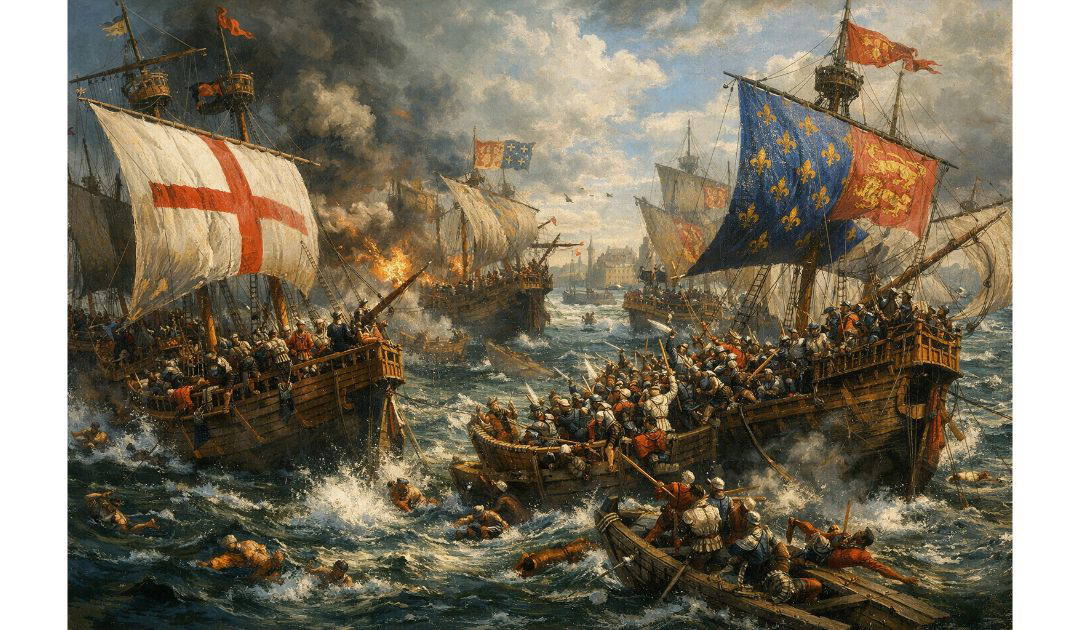
The Battle of Sluys was fought on the 24th of June 1314. The English fleet, commanded personally by King Edward III, almost completely destroyed the French fleet. It took place off the coast of Flanders near the port of Sluys (modern-day Sluis in the Netherlands) and marked a turning point in the early phase of the Hundred Years’ War between England and France.
The conflict between England and France had been simmering for years before open war broke out in 1337. At its core were competing claims to the French throne, particularly that of Edward III, who asserted his right as a grandson of the French king. The French crown, however, was held by Philip VI, and tensions escalated into full-scale war. Control of the English Channel became a crucial strategic objective, as it would determine England’s ability to transport troops and supplies to the continent.
In the years leading up to Sluys, the French had established naval superiority. They assembled a large fleet composed of royal ships, merchant vessels, and hired Genoese galleys under the command of the experienced admiral Hugh Quiéret and the treasurer Nicolas Béhuchet. Their strategy was defensive: they anchored their fleet in a tight formation across the entrance to the Zwin estuary, effectively creating a barrier to block the English.
The French fleet was formidable, possibly numbering around 200 ships, many of them lashed together in lines to form a floating fortress. While this arrangement strengthened their defensive position, it also reduced their mobility—a decision that would prove disastrous. The French believed they could repel any English assault by forcing attackers into a narrow and controlled space.
Meanwhile, Edward III assembled his own fleet, smaller but highly motivated. It consisted of English warships and requisitioned merchant vessels, crewed by sailors and soldiers eager for battle. Among them were large numbers of English longbowmen, whose presence would prove decisive. Edward himself commanded the fleet, demonstrating the importance he placed on securing naval control.
When the English fleet approached the weather and tide were initially unfavourable. However, as conditions shifted, Edward seized the opportunity to attack. The English ships advanced in organised groups, each carrying contingents of archers and men-at-arms. Rather than attempting to outmanoeuvre the French, they aimed to board and capture enemy vessels.
The battle quickly descended into brutal close-quarters combat. The English longbowmen, positioned on higher decks, unleashed volleys of arrows onto the tightly packed French ships. The confined formation of the French fleet made them easy targets, and their crossbowmen, including the Genoese mercenaries, struggled to respond effectively. The English archers’ rate of fire and accuracy gave them a significant advantage.
Once the French ships were weakened, English soldiers boarded them, turning the battle into a series of fierce hand-to-hand struggles. One by one, French vessels were overwhelmed. The lack of mobility in the French formation meant that ships could not retreat or reposition, and panic spread as the line began to collapse.
The fighting lasted for hours and was exceptionally bloody. Contemporary chroniclers describe the sea as choked with wreckage and bodies. Many French sailors and soldiers were killed, while others drowned as their ships were captured or sunk. Both Quiéret and Béhuchet were killed—Béhuchet reportedly hanged from the yardarm of his own ship on Edward’s orders, a sign of the king’s ruthlessness in securing victory.
By the end of the day, the French fleet had been almost completely destroyed. The scale of the defeat was catastrophic for France. Estimates vary, but thousands of French sailors and soldiers were killed, and the loss of ships severely weakened France’s naval capabilities for years to come.
The consequences of the Battle of Sluys were far-reaching. Most immediately, it gave England control of the English Channel, allowing Edward III to transport his army to the continent without serious opposition. This naval dominance enabled subsequent campaigns in northern France and Flanders, laying the groundwork for later English victories such as Crécy in 1346.
Beyond its immediate strategic impact, Sluys demonstrated the effectiveness of English tactics, particularly the use of longbowmen in naval warfare. It also highlighted the dangers of overly rigid defensive strategies, as the French decision to chain their ships together ultimately contributed to their defeat.
The battle also had psychological and political effects. It boosted English morale and prestige while dealing a severe blow to French confidence. For Edward III, it was a triumph that reinforced his claim to the French throne and established him as a formidable military leader.
In the broader context of medieval warfare, the Battle of Sluys stands out as a rare but decisive naval engagement. It marked the beginning of a period in which England would dominate the seas, shaping the course of the Hundred Years’ War. Though often overshadowed by famous land battles, Sluys was crucial in enabling those victories by ensuring that English armies could reach the battlefield in the first place.
In sum, the Battle of Sluys was not merely a naval clash but a pivotal moment that altered the balance of power between England and France. Its outcome underscored the importance of strategy, adaptability, and control of the seas in medieval warfare, leaving a lasting legacy in the history of the conflict.