
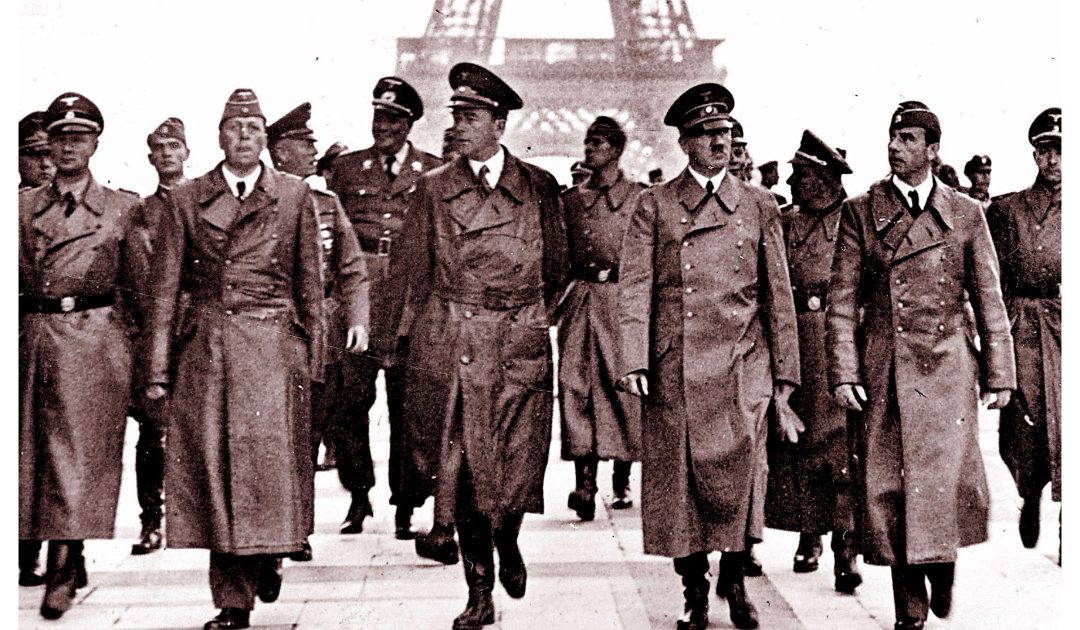
On the 23rd of June, 1940, Adolf Hitler went on a three hour tour of Paris with Albert Speer and Arno Breker. It was Hitler’s only visit to Paris.
Albert Speer and Arno Breker were two of the most prominent cultural figures associated with the regime of Adolf Hitler in Nazi Germany. Each played a different but complementary role in shaping the visual and architectural identity of the Third Reich. Speer was an architect and later a powerful government minister, while Breker was a sculptor whose monumental works embodied the regime’s ideals of strength, heroism, and classical beauty.
Albert Speer
Albert Speer was born on the 19th of March, 1905, in Mannheim, Germany, into a prosperous family of architects. His father and grandfather had both been architects, and he followed the same path, studying architecture at the technical universities of Karlsruhe and Munich before completing his studies in Berlin. Initially he showed little interest in politics, but in 1931 he attended a political rally where Adolf Hitler spoke. Impressed by the atmosphere and by Hitler’s charismatic style, Speer joined the Nazi Party later that year.
Speer’s career advanced quickly once he came to Hitler’s attention. Hitler had a strong personal interest in architecture and enjoyed working closely with architects who could translate his grand ideas into practical designs. Speer first gained prominence when he was asked to design the stage settings for Nazi Party rallies in Nuremberg. These vast gatherings were intended to demonstrate the unity and power of the regime. Speer’s designs used dramatic lighting and monumental arrangements of banners and columns. One of his most famous innovations was the “cathedral of light,” created by placing powerful searchlights vertically around the rally grounds to form towering beams of light that resembled enormous pillars.
By the mid-1930s Speer had become Hitler’s favourite architect. In 1937 he was appointed General Building Inspector for Berlin and was given the enormous task of redesigning the German capital as a monumental imperial city to be called “Germania.” The plans involved gigantic boulevards, massive domed buildings, triumphal arches, and enormous parade spaces designed to express the supposed power and permanence of the Nazi state. Although only a few of these projects were actually built before the outbreak of the Second World War, they revealed the scale of the architectural vision shared by Speer and Hitler.
Speer’s influence expanded even further during the war. In 1942 he was appointed Minister of Armaments and War Production after the death of Fritz Todt. In this role Speer reorganised Germany’s war industries and increased the output of tanks, aircraft, and other weapons. Through centralised management and more efficient use of factories, he managed to boost production even while Allied bombing campaigns were damaging German industrial centres. However, this increase in output relied heavily on forced labour from occupied territories and from concentration camps.
At the end of the war Speer was captured by Allied forces and put on trial at the Nuremberg Trials alongside other senior Nazi leaders. During the proceedings he acknowledged a degree of responsibility for the actions of the regime and expressed regret for his involvement. In 1946 he was sentenced to twenty years’ imprisonment for war crimes and crimes against humanity, largely connected with the exploitation of forced labour. He served his entire sentence in Spandau Prison in Berlin and was released in 1966. After his release he wrote several memoirs about his experiences in the Nazi leadership, including Inside the Third Reich. Speer died in 1981. I remember seeing Speer in many documentaries as a child, as he was the most senior close associate of Hitler who hadn’t been executed, and was free to speak.
Arno Breker
Arno Breker was born on the 19th of July, 1900, in Elberfeld, a city that is now part of Wuppertal in Germany. He trained as a sculptor at the Düsseldorf Academy of Art. From an early stage his work showed a strong influence from classical Greek and Roman sculpture, particularly in its emphasis on idealised human bodies and balanced proportions.
During the 1920s Breker spent several years living and working in Paris. There he encountered modern artistic movements and met many prominent artists of the period. Despite these experiences, his own style remained largely classical. When he returned to Germany in the early 1930s, the cultural policies of the Nazi regime were beginning to take shape. The regime rejected modern art as “degenerate” and instead promoted works that reflected what it considered traditional and racially pure values.
Breker’s style fitted these ideals perfectly. His sculptures often portrayed muscular, heroic male figures with idealised physiques and calm, powerful expressions. Adolf Hitler personally admired Breker’s work and soon became one of his most enthusiastic supporters. As a result Breker received numerous important commissions from the government.
One of Breker’s most notable contributions was his work for the new Reich Chancellery in Berlin, the vast government building designed by Albert Speer. Two monumental sculptures titled The Party and The Army stood at the entrance to the building. These statues were intended to symbolise the unity between the Nazi Party and the German armed forces. Breker also created sculptures for exhibitions, stadiums, and public monuments that celebrated athleticism, heroism, and the supposed ideals of the regime.
During the Second World War Breker enjoyed considerable privileges. He was provided with a large studio, numerous assistants, and access to scarce materials that were unavailable to most artists during wartime. His works were widely promoted by the government as examples of the artistic vision of the Third Reich.
After the defeat of Germany in 1945, Breker’s close association with the Nazi leadership brought him under investigation during the Allied denazification process. However, he was ultimately classified as a “follower” rather than a major offender. This allowed him to continue working as an artist in the post-war period. Although his reputation remained controversial, he produced sculptures and portrait busts for many years and received commissions both in Germany and abroad. Breker died in 1991.
Their Shared Cultural Role
Speer and Breker worked in different artistic fields, but their work complemented one another in shaping the monumental visual culture of Nazi Germany. Speer’s massive buildings and ceremonial spaces created the settings in which Breker’s sculptures could stand as symbols of power, discipline, and idealised strength. Together they helped produce the imposing aesthetic that the regime used to project authority and permanence. Their careers remain powerful examples of how art and architecture can be closely connected to political ideology and state propaganda.