
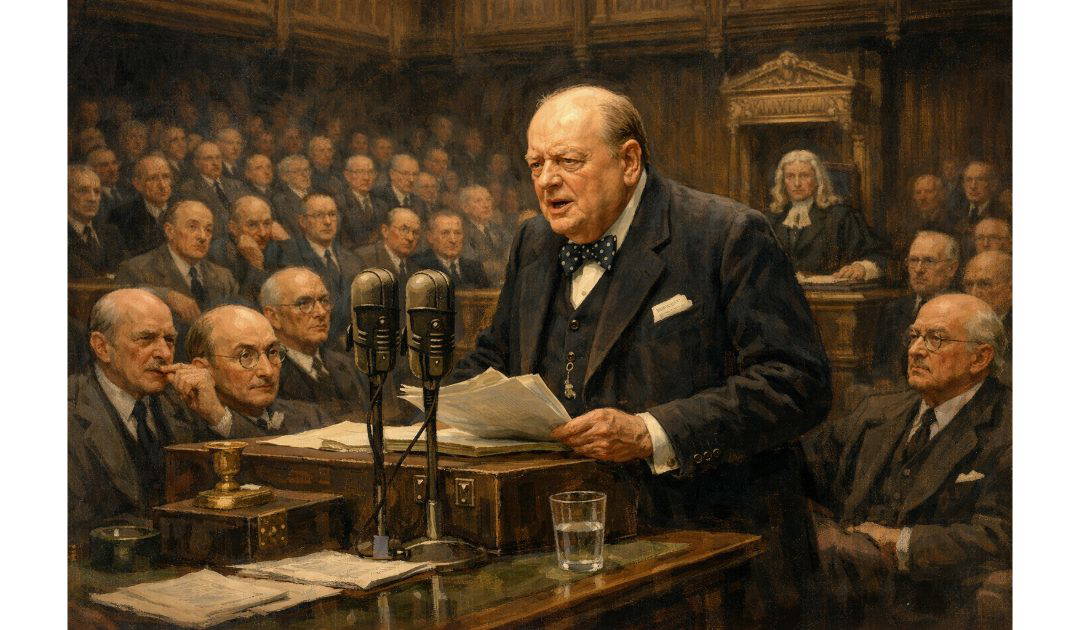
On the 18th of June, 1940, Winston Churchill delivered his “Finest Hour” speech in the House of Commons. It came at a moment when the fate of Britain appeared extremely uncertain. Europe had largely fallen under the control of Adolf Hitler, and Britain faced the prospect of standing alone against Nazi Germany.
Background to the Speech
The speech must be understood in the context of the dramatic military collapse that had taken place in Western Europe in the spring of 1940. Germany had launched a lightning offensive on 10 May 1940 against the Low Countries and France. Within weeks, German forces had smashed through Allied defences using their fast-moving strategy known as blitzkrieg.
As the German army advanced, the British Expeditionary Force and large numbers of French troops were pushed back to the Channel coast. This led to the evacuation of more than 330,000 Allied soldiers during the Dunkirk evacuation between the 26th of May and the 4th of June 1940. The operation saved a large portion of Britain’s trained army, but it also meant abandoning heavy equipment and leaving France dangerously exposed.
Churchill had already addressed Parliament on the 4th of June with the famous “We shall fight on the beaches” speech, praising the rescue but warning that the war was far from won. Just two weeks later, the situation became even worse. France, Britain’s principal ally on the continent, collapsed rapidly under German assault. On the 14th of June German troops entered Paris, and on the 17th of June the French government sought an armistice with Germany.
The armistice was signed on the 22nd of June, 1940, effectively removing France from the war. Britain now faced the possibility of invasion. German air power dominated much of Western Europe, and the threat of an attack across the English Channel seemed very real. It was against this alarming background that Churchill rose in the House of Commons to explain the situation and prepare the nation for what might come next.
The Content of the Speech
Churchill’s speech was formally about the fall of France and the changing strategic situation. However, its deeper purpose was psychological: to steel Britain for a long and difficult struggle.
He began by outlining the military disaster in France, describing how the French army had been overwhelmed despite its courage and determination. Churchill did not try to hide the severity of the crisis. Instead, he spoke bluntly about the reality Britain faced.
He then turned to the possibility of invasion. Germany, he explained, might attempt to cross the Channel and defeat Britain in order to secure complete dominance of Europe. The country therefore had to prepare for a new phase of the war in which the survival of Britain itself would be at stake.
Churchill emphasised that the coming battle would likely be fought in the air. The Royal Air Force would need to defend the country against German air attacks and prevent the Luftwaffe from gaining control of the skies. This prediction would soon prove accurate during the Battle of Britain.
The speech built steadily toward its powerful conclusion. Churchill argued that the outcome of the conflict would determine the future of civilisation. If Britain were defeated, he warned, the whole world—including the United States—might fall under the shadow of Nazi tyranny. But if Britain held firm, the war could still end in victory. He closed with the famous line:
“Let us therefore brace ourselves to our duties, and so bear ourselves that, if the British Empire and its Commonwealth last for a thousand years, men will still say, ‘This was their finest hour.’”
The Immediate Impact
The speech was delivered in Parliament rather than directly to the public, but its message quickly spread through newspapers and radio reports. It became one of Churchill’s most celebrated wartime statements.
Its immediate effect was to frame the crisis not as a prelude to defeat but as a defining moment of courage and endurance. Churchill transformed what could have been a narrative of disaster into one of defiance. Britain might be isolated, but it would not surrender.
The speech also helped clarify the stakes of the war. Churchill presented the conflict not merely as a struggle between nations but as a fight for freedom and civilisation against tyranny. This moral framing strengthened public resolve and helped justify the enormous sacrifices that lay ahead.
Long-Term Significance
The “Finest Hour” speech became a key part of Britain’s wartime mythology. Along with Churchill’s earlier and later speeches, it helped shape the narrative of national resistance during 1940, a period sometimes called Britain’s “darkest hour.”
Within weeks of the speech, the German air campaign against Britain intensified. The Royal Air Force successfully resisted the Luftwaffe during the Battle of Britain, preventing Germany from gaining air superiority and forcing Hitler to postpone any invasion plans.
In retrospect, Churchill’s speech captured the moment when Britain prepared to face the war alone. Although the United States had not yet entered the conflict, Churchill believed that British resistance would eventually draw greater support from abroad.
Today the “Finest Hour” speech is remembered as a masterpiece of wartime leadership. By honestly acknowledging the dangers while inspiring confidence and determination, Churchill helped rally Britain during one of the most perilous moments in its history.