
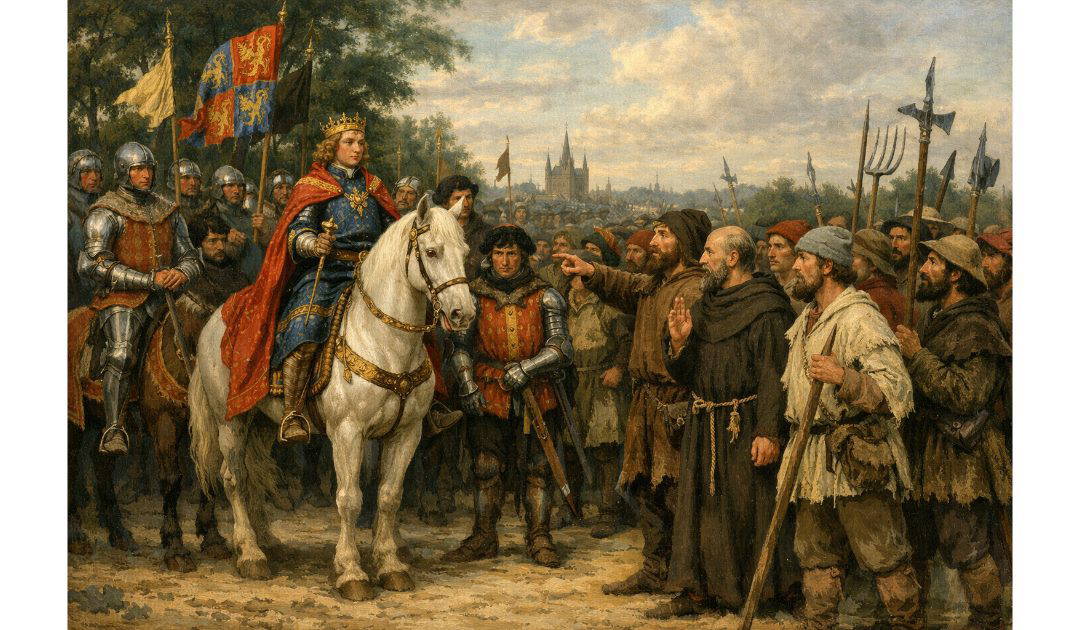
On the 14th of June, 1381, King Richard II met leaders of the Peasants’ Revolt at Mile End, and the Tower of London was stormed by rebels without resistance. This has caught my eye this morning as it has a connection to my work in progress, Cade’s Point, the sixth book in the Sir Anthony Standen Adventures. I have posted about the Peasants’ Revolt but not King Richard II, so let’s have a look at him.
Richard II of England (1367–1400) was King of England from 1377 until he was deposed in 1399. His reign was marked by political conflict, social unrest, and struggles with powerful nobles. Though intelligent and cultured, Richard’s rule became increasingly authoritarian, ultimately leading to his downfall.
Richard was born on the 6th of January, 1367, at Bordeaux in Aquitaine, the son of Edward of Woodstock (the Black Prince) and Joan of Kent. His father was the famous heir to the English throne and a celebrated military leader during the Hundred Years’ War. However, the Black Prince died in 1376, leaving the young Richard as heir to his grandfather, Edward III of England. When Edward III died the following year, Richard became king at only ten years old.
Because of his youth, the government was effectively run by councils of powerful nobles and royal officials. England was experiencing economic and social strain in the late fourteenth century. The devastation caused by the Black Death had reduced the population, disrupting labour and agriculture. In addition, the ongoing war with France placed heavy financial demands on the kingdom.
These pressures contributed to one of the most dramatic events of Richard’s early reign: the Peasants’ Revolt. The revolt was triggered by resentment over taxation and attempts to control wages and labour. Rebels from Kent and Essex marched on London, led by figures such as Wat Tyler and the radical priest John Ball. At just fourteen years old, Richard confronted the rebels personally. During meetings at Mile End and later at Smithfield, the king attempted to negotiate with them. After Wat Tyler was killed by the Lord Mayor of London, Richard famously addressed the rebels, declaring, “I am your captain.” The revolt soon collapsed, and many of its leaders were executed. Although Richard initially promised reforms, most were later revoked.
As Richard grew older, tensions developed between the king and a group of powerful nobles known as the Lords Appellant. These included men such as Thomas of Woodstock and Henry Bolingbroke, the son of John of Gaunt. They accused Richard’s close advisers of corruption and misrule. The conflict came to a head in the Merciless Parliament of 1388, when several of the king’s favourites were condemned and executed. For a time, Richard’s authority was severely limited.
In the 1390s, however, Richard gradually regained control. Determined to avoid the mistakes of his early reign, he sought to rule more independently and strengthen royal authority. He also pursued peace abroad, negotiating a truce with France and marrying Isabella of Valois, the young daughter of the French king.
Richard was also notable for his interest in culture and kingship. He promoted a more elaborate and ceremonial style of monarchy, emphasising the sacred nature of royal authority. His court patronised art and literature, including the work of the poet Geoffrey Chaucer. Richard also commissioned major building works, particularly at Westminster Hall, where the magnificent hammerbeam roof still stands today.
Despite these achievements, Richard’s rule became increasingly autocratic. He punished opponents harshly and demanded strong loyalty from the nobility. In 1397 he moved decisively against the Lords Appellant who had earlier challenged him. Thomas of Woodstock was arrested and later died in captivity, while others were exiled or executed.
The turning point came in 1398 when Richard quarrelled with Henry Bolingbroke. After a dispute between Bolingbroke and Thomas de Mowbray, Richard exiled both men. When John of Gaunt died in 1399, the king confiscated the Lancastrian estates that should have passed to Bolingbroke. This action angered many nobles and undermined support for the king.
Later that year Bolingbroke returned to England while Richard was campaigning in Ireland. Initially claiming only his inheritance, Bolingbroke quickly gained widespread backing. Richard found himself isolated and was forced to surrender. In September 1399 he was formally deposed, and Bolingbroke was crowned king as Henry IV of England.
Richard was imprisoned in Pontefract Castle, where he died in February 1400, probably from starvation, though the exact circumstances remain uncertain. His death marked a dramatic end to a troubled reign and began the Lancastrian dynasty.
Richard II remains one of the most fascinating figures in medieval English history. His reign highlighted tensions between monarchy and nobility and showed how fragile royal authority could be. His life also inspired one of the greatest historical plays by William Shakespeare, titled Richard II, which explores the dramatic fall of a king who believed deeply in the divine right of monarchy.