
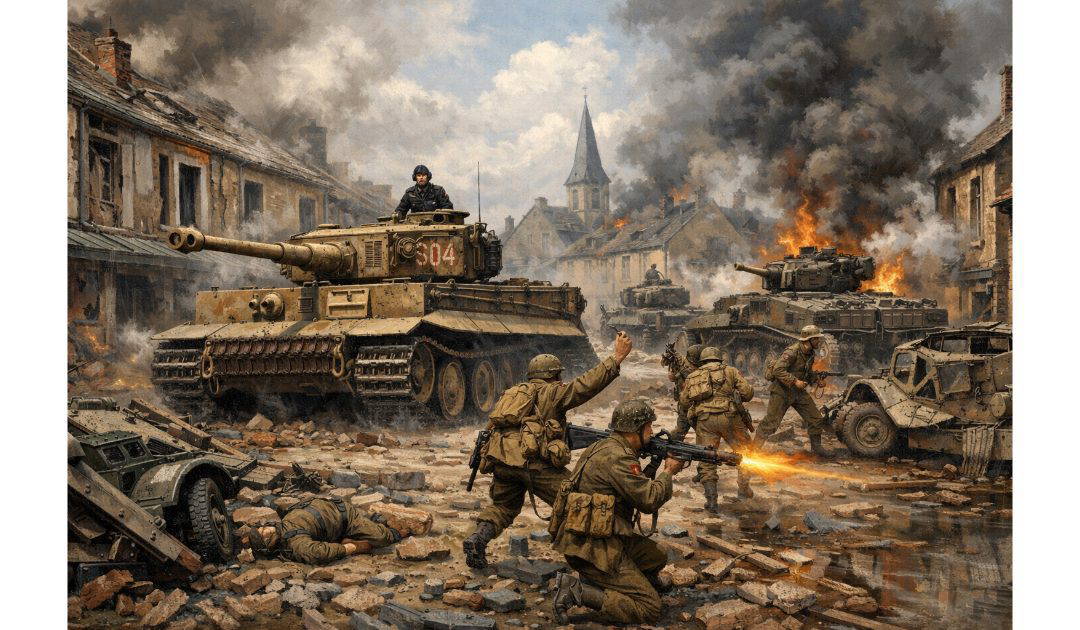
The Battle of Villers-Bocage was fought on the 13th of June 1944 and my father fought in it. It was one of the most dramatic armoured engagements of the early Battle of Normandy following the Allied landings in Operation Overlord. Taking place in and around the small Norman town of Villers-Bocage, about 20 kilometres southwest of Caen, the battle became famous for a sudden German counterattack led by the Waffen-SS tank commander Michael Wittmann.
Strategic Background
After the Allied landings on Normandy on the 6th of June 1944, British and Canadian forces aimed to capture Caen, a key road and communication hub. The city had not fallen on D-Day as planned, so British commanders sought alternative ways to outflank German defences.
One such attempt was Operation Perch, launched by the British 7th Armoured Division, famously known as the “Desert Rats.” Their plan was to move around the western flank of Caen and seize Villers-Bocage, thereby threatening German positions from the rear.
On the 13th of June the British armoured columns advanced along narrow roads bordered by thick hedgerows typical of the Norman bocage countryside. These hedgerows restricted visibility and movement, making large armoured formations vulnerable to ambush.
The British Advance
Early that morning, elements of the 7th Armoured Division entered Villers-Bocage with little resistance. The leading formation included tanks of the 4th County of London Yeomanry supported by infantry. British forces pushed through the town and along a nearby ridge known as Point 213, an important high ground controlling the surrounding roads.
Initially the advance seemed successful. However, British commanders did not realise that powerful German armoured units were nearby. These included elements of the elite 101st SS Heavy Panzer Battalion, equipped with the formidable Tiger I heavy tanks.
Wittmann’s Counterattack
One of these Tigers was commanded by Michael Wittmann, already a celebrated German tank ace. When Wittmann discovered the British column stretched along the road outside Villers-Bocage, he saw an opportunity for a sudden attack.
Acting largely on his own initiative, Wittmann drove his Tiger directly into the British column during the morning of the 13th of June. The surprise was devastating. The Tiger’s powerful 88 mm gun could destroy Allied tanks at long range, while its heavy armour made it extremely difficult to penetrate.
In a rapid and chaotic engagement, Wittmann destroyed several British vehicles in quick succession. Tanks, half-tracks, and armoured cars were hit as the German tank moved down the road firing at close range. Many British crews were caught completely off guard.
Within about fifteen minutes, Wittmann’s attack had wrecked a large portion of the British column on the road to Point 213. Estimates vary, but around 14 tanks, 15 personnel carriers, and several anti-tank guns were destroyed or disabled. The road became littered with burning vehicles.
Fighting in the Town
After smashing the column, Wittmann drove into Villers-Bocage itself, where fighting erupted in the narrow streets. British tanks attempted to respond, and some German vehicles were knocked out during the fighting.
Eventually Wittmann’s Tiger was disabled by British anti-tank fire. He and his crew escaped on foot and returned to German lines. Meanwhile, additional German units moved in to reinforce the area.
Throughout the day the battle intensified. German forces, including tanks and infantry from nearby divisions, launched coordinated attacks against the British positions in the town and surrounding ridge.
British Withdrawal
Although British forces initially held parts of Villers-Bocage, the situation became increasingly precarious. The Germans were bringing in more armour and artillery, while the British position was exposed and difficult to reinforce.
During the night of 13th –14th of June, British commanders decided to withdraw from the town and nearby high ground. The 7th Armoured Division pulled back several kilometres to more defensible positions. This withdrawal effectively ended the British attempt to outflank Caen through Operation Perch.
Consequences and Historical Debate
The Battle of Villers-Bocage became famous partly because of the dramatic actions attributed to Michael Wittmann. German propaganda portrayed the event as a heroic feat in which a single tank destroyed an entire column. In reality, while Wittmann’s ambush was highly effective, other German tanks and anti-tank guns also played important roles in the battle.
For the British, the engagement exposed the dangers of operating armoured columns in the bocage terrain without adequate reconnaissance and infantry support. The hedgerow landscape would continue to complicate Allied operations throughout the Normandy campaign.
Strategically, the battle delayed the Allied advance toward Caen, though it did not change the overall course of the war. The Allies eventually captured the city during Battle for Caen in July 1944 after several major offensives.
Legacy
Today the Battle of Villers-Bocage remains one of the most studied armoured clashes of the Normandy campaign. The destroyed vehicles along the narrow Norman roads became a powerful symbol of how quickly the fortunes of war could change.
The small town of Villers-Bocage has since rebuilt and commemorates the events of June 1944, reminding visitors of the intense fighting that once engulfed its streets during the liberation of Western Europe.