
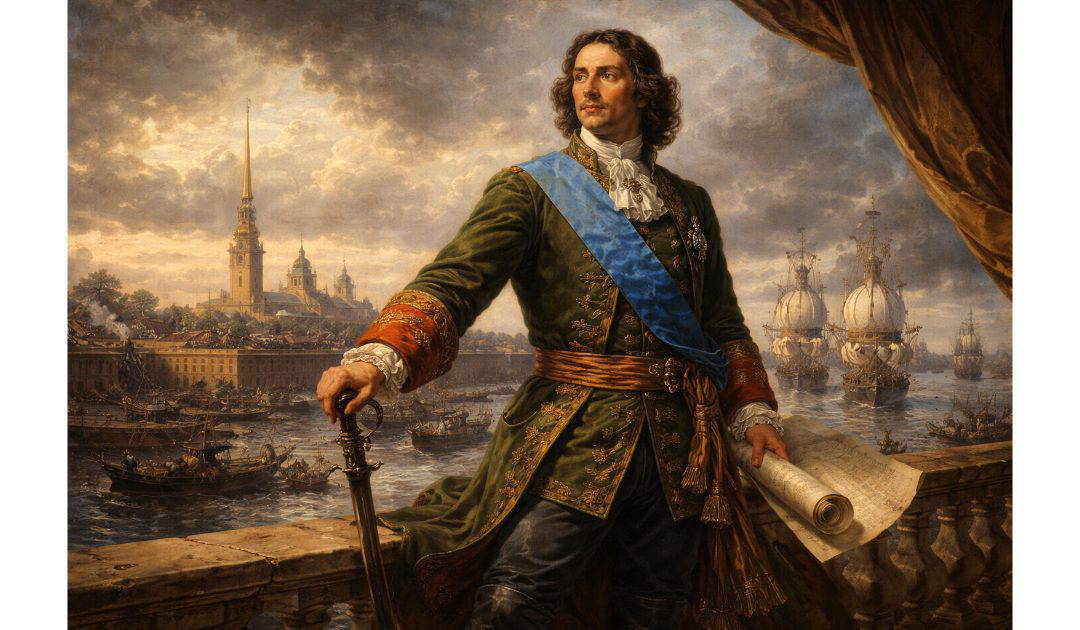
Claire and I were married on the 9th of June 1990, but curiously Wikipedia doesn’t cover that. Also on this day in 68CE Emperor Nero died by suicide, but I’ve written about Nero. So I’ll go for Peter the Great who was born on this day in 1672.
Peter was born in Moscow, the son of Tsar Alexis I. After Alexis’s death, a bitter struggle erupted between rival court factions. In 1682, at the age of ten, Peter was declared co-tsar alongside his sickly half-brother Ivan V, with their formidable sister Sophia acting as regent. The political turbulence of his childhood, including the violent uprising of the Streltsy (elite musketeers), left a deep impression on him and fostered his lifelong determination to modernise and strengthen Russia.
Unlike many rulers of his time, Peter had a practical and inquisitive mind. Fascinated by ships, artillery, and mechanical devices, he developed a passion for naval affairs. This interest shaped one of his greatest ambitions: to give Russia access to the sea and transform it into a maritime power.
In 1697–98, Peter embarked on the “Grand Embassy,” a remarkable journey incognito through Europe. Travelling to the Dutch Republic, England, and parts of the Holy Roman Empire, he studied shipbuilding, navigation, engineering, and military organisation. In the Dutch Republic he worked in shipyards; in England he visited dockyards and observed the Royal Navy. The experience profoundly influenced his reforms. He became convinced that Russia must adopt Western technology and administrative methods if it were to compete with European powers.
Peter’s reign was dominated by war, especially the Great Northern War (1700–1721) against Sweden, then one of Europe’s leading military states under King Charles XII. Early defeats exposed the weaknesses of Russia’s outdated army. Peter responded with sweeping reforms: he introduced conscription, reorganised the army along modern lines, and established new training systems. He also founded Russia’s first navy, built largely from scratch.
The turning point came at the Battle of Poltava in 1709, where Russian forces decisively defeated the Swedish army. This victory marked Russia’s emergence as a major European power. The war concluded in 1721 with the Treaty of Nystad, granting Russia territories along the Baltic Sea, including Ingria, Estonia, and Livonia. These acquisitions gave Russia the “window to the West” that Peter had long sought.
In 1703, amid the ongoing war, Peter founded a new city on marshland near the Baltic coast: St Petersburg. Built at immense human cost, the city was intended as a symbol of Russia’s new European orientation. In 1712 it became the capital, replacing Moscow. St Petersburg embodied Peter’s vision—planned, outward-looking, and strategically placed for trade and diplomacy.
Domestically, Peter introduced wide-ranging reforms. He reorganised the central government, replacing old boyar councils with new administrative bodies modelled on European systems. The Table of Ranks, introduced in 1722, restructured the nobility by linking status to state service rather than hereditary privilege. This measure aimed to create a merit-based elite loyal to the crown.
Peter also reformed the Russian Orthodox Church. After the death of the Patriarch in 1700, he did not appoint a successor; instead, in 1721, he replaced the patriarchate with a Holy Synod under state supervision. This effectively brought the Church under governmental control, reducing its independence.
His cultural reforms were equally striking. He encouraged Western dress and manners, famously taxing beards in an effort to push nobles toward European fashions. He promoted secular education, established schools for mathematics and navigation, and supported the translation of foreign texts. Although these reforms were often imposed harshly, they marked a decisive shift in Russian society’s orientation.
Peter’s methods were frequently brutal. He crushed opposition ruthlessly, including renewed Streltsy revolts. His own son, Tsarevich Alexei, who opposed his reforms, was accused of treason and died in prison in 1718, likely after torture. Such actions reveal the autocratic and uncompromising nature of his rule.
In 1721, following victory over Sweden, Peter assumed the title “Emperor of All the Russias,” signalling Russia’s new imperial status. By the time of his death in 1725, he had dramatically expanded Russia’s territory, strengthened its military, and integrated it more fully into European politics.
Peter the Great remains a complex and controversial figure. To some, he was a visionary moderniser who dragged Russia into the modern age; to others, he imposed Western models at immense human cost and reinforced autocratic rule. Yet there is little doubt that his reign marked a watershed in Russian history. The Russia that emerged after Peter was larger, stronger, and more assertively European than the Muscovite state he had inherited.