
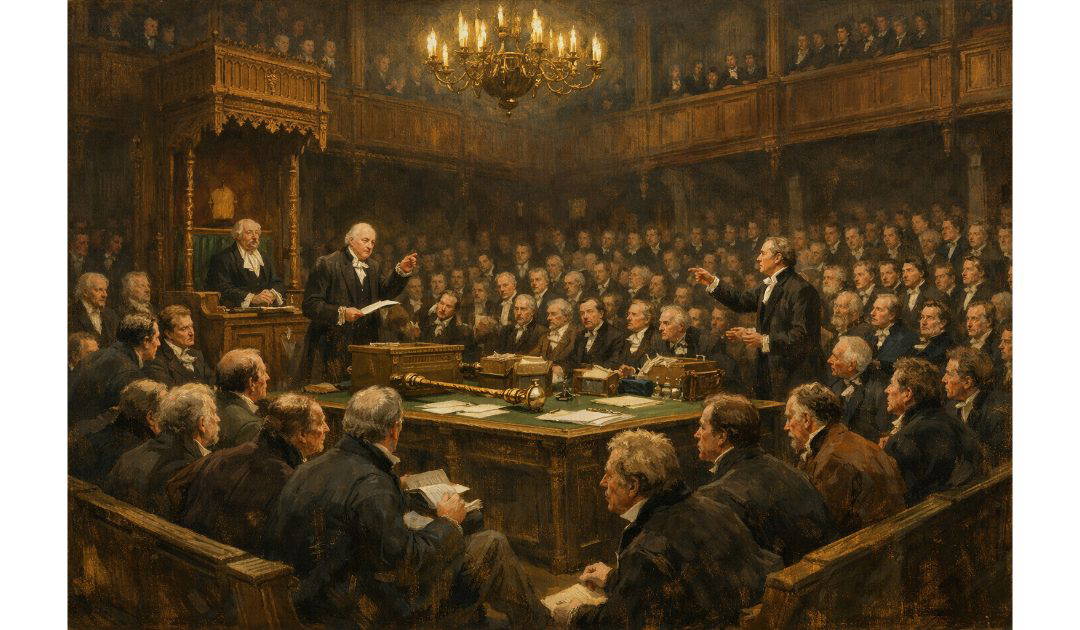
The Great Reform Act of England and Wales received royal assent on the 7th of June 1832. The Great Reform Act of 1832, formally known as the Representation of the People Act 1832, was one of the most significant constitutional changes in British history. It marked the first major reform of the electoral system in the United Kingdom and reshaped the political landscape of the nineteenth century. Though limited by modern democratic standards, it set Britain firmly on the path toward parliamentary reform.
By the early nineteenth century, the British electoral system was deeply flawed. Parliamentary representation had changed little since medieval times, despite dramatic population growth and urbanisation during the Industrial Revolution. Large new industrial cities such as Manchester, Birmingham and Leeds had no direct representation in Parliament, while tiny rural constituencies known as “rotten boroughs” sent two Members of Parliament each. Some of these boroughs had only a handful of voters; in extreme cases, they were effectively controlled by a single landowner. One notorious example was Old Sarum, a deserted hill that still returned MPs.
The system also severely restricted the franchise. In counties, the right to vote generally belonged to men who owned freehold property worth at least forty shillings a year — a qualification dating back to 1430. In boroughs, voting qualifications varied widely and were often based on outdated local customs. Overall, only about 435,000 men in a population of roughly 24 million had the vote. The system favoured the landed aristocracy and entrenched political patronage.
Pressure for reform increased after the end of the Napoleonic Wars in 1815. Economic hardship, rising food prices and demands for political representation led to unrest. The 1819 Peterloo Massacre in Manchester, where cavalry charged a crowd demanding reform, intensified calls for change. Meanwhile, political reform had taken place elsewhere in Europe, and the American and French Revolutions had demonstrated the power of popular political movements.
The reform cause was championed by the Whig Party under the leadership of Charles Grey, 2nd Earl Grey, who became Prime Minister in 1830. Grey believed that moderate reform was necessary to prevent revolution. His government introduced a Reform Bill in 1831. The bill proposed abolishing many rotten boroughs, redistributing seats to growing towns and cities, and standardising the franchise.
The proposal met fierce resistance from the Tory opposition, who argued that reform would undermine the constitution and threaten property rights. The House of Commons passed the bill, but it was rejected by the House of Lords. The rejection provoked widespread public anger. Reform riots broke out in several cities, including Bristol, where parts of the city were burned. Political unions organised mass demonstrations, demanding change.
Grey reintroduced the bill, and it again passed the Commons. In 1832 the Lords continued to resist. At this critical moment, Grey asked King William IV to create enough new pro-reform peers to force the measure through the House of Lords. Although reluctant, the King agreed in principle. Faced with the threat of being swamped by new Whig peers, many opponents abstained, allowing the bill to pass. It received royal assent on the 7th of June 1832.
The Act brought sweeping changes. It disenfranchised 56 rotten boroughs in England and Wales and reduced representation in 30 others. In their place, 42 new towns gained representation, and additional seats were allocated to counties and to Scotland and Ireland. Manchester, Birmingham and Leeds were among the major industrial centres that gained MPs for the first time.
The Act also introduced a more uniform property qualification for borough voters: adult males occupying property worth £10 per year could vote. In counties, the franchise was extended to include certain leaseholders and tenants-at-will. As a result, the electorate in England and Wales increased from roughly 435,000 to around 652,000 — about one in five adult males. Scotland’s electorate rose dramatically from around 5,000 to 65,000. Although still limited to property-owning men, this expansion was significant.
Importantly, the Act did not establish democracy in the modern sense. Working-class men, women of all classes, and many urban labourers remained excluded. Voting was still public rather than secret, leaving room for bribery and intimidation. Nevertheless, the Reform Act marked a decisive shift in political power away from the smallest aristocratic borough interests and toward the urban middle classes.
The political consequences were far-reaching. The Act strengthened the House of Commons and confirmed that Parliament could reform itself in response to public pressure. It also helped transform political parties. The Whigs evolved into the Liberal Party later in the century, while the Tories began to modernise under leaders such as Sir Robert Peel. Electoral politics became more organised, with greater emphasis on voter registration and campaigning.
In the longer term, the Great Reform Act paved the way for further reforms, including the Second Reform Act of 1867 and the Third Reform Act of 1884, which gradually extended the franchise to working-class men. The secret ballot was introduced in 1872. Each of these developments built upon the constitutional precedent established in 1832.
Historians have debated whether the Act was a cautious adjustment or a constitutional revolution. It did not create mass democracy, but it fundamentally altered the relationship between Parliament and the people. By recognising that representation must reflect social and economic change, the Great Reform Act of 1832 ensured that Britain would pursue reform through legislation rather than revolution, shaping the evolution of modern British democracy.