
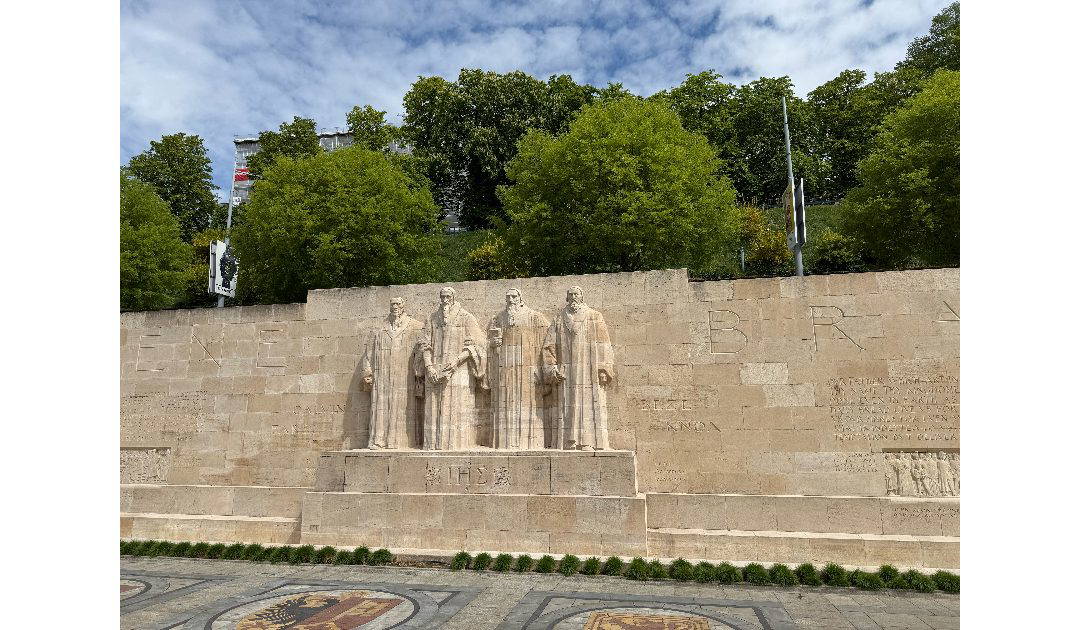
On the 26th of May, 1538, John Calvin and his followers were expelled from Geneva. Calvin lived in exile in Strasbourg for the next three years.
John Calvin (1509–1564) was one of the most influential theologians of the Protestant Reformation, shaping a branch of Christianity that would come to be known as Calvinism or the Reformed tradition. Though often associated with austerity and strict moral discipline, Calvin was above all a systematic thinker and biblical scholar whose ideas left a profound mark on theology, church governance, politics, and education across Europe and beyond.
Calvin was born Jean Cauvin in Noyon, in Picardy, northern France. His father intended him for a career in the Church, and Calvin initially studied theology in Paris. However, as Renaissance humanism spread across Europe, he became deeply influenced by its emphasis on returning to original sources, particularly the Bible in Greek and Hebrew. Under pressure from his father, he later studied law at Orléans and Bourges, acquiring the analytical skills and logical precision that would characterize his theological writing.
Sometime in the early 1530s, Calvin experienced what he later described as a sudden conversion. He embraced the reforming ideas that had been set in motion by Martin Luther in Germany. Like Luther, Calvin rejected the authority of the Pope and emphasized salvation by grace through faith rather than by works. However, Calvin developed these doctrines with a distinctive clarity and coherence, placing them within an overarching vision of God’s sovereignty.
Forced to flee France because of persecution of Protestants, Calvin eventually settled in Basel, where in 1536 he published the first edition of his most famous work, the Institutes of the Christian Religion. This book, expanded throughout his life, was intended as a systematic presentation of Protestant theology. Written in lucid Latin (and later translated into French), it argued that Scripture alone is the ultimate authority in matters of faith, that human beings are fallen and incapable of saving themselves, and that salvation depends entirely on God’s grace.
Central to Calvin’s theology was the doctrine of predestination. He taught that, from eternity, God had chosen some people for salvation (the “elect”) and others for damnation. This idea was not new, but Calvin gave it a particularly rigorous and prominent place within his system. For Calvin, predestination underscored the absolute sovereignty and justice of God. Critics then and since have regarded this teaching as severe, yet Calvin believed it provided assurance to believers by grounding salvation in God’s unchangeable will rather than human effort.
In 1536, on his way to Strasbourg, Calvin passed through Geneva. There he was persuaded by the fiery reformer William Farel to help lead the city’s Reformation. Geneva had recently broken with the authority of the Catholic Church and needed theological and organizational direction. Calvin and Farel sought to impose a disciplined moral and religious order, but resistance from the city authorities led to Calvin’s exile in 1538.
He spent three productive years in Strasbourg, pastoring a French refugee congregation and refining his ideas about church government. In 1541, however, Geneva invited him back. This time he was able to implement a more stable ecclesiastical structure. He helped establish the Consistory, a body of pastors and elders that exercised moral oversight, admonishing citizens for misconduct such as drunkenness, adultery, and blasphemy. While civil authorities retained ultimate power, Calvin’s influence over the spiritual and moral life of the city was considerable.
Geneva under Calvin became a center of Protestant learning and missionary activity. Refugees from across Europe came to study there, and in 1559 Calvin founded the Geneva Academy, which trained ministers who would spread Reformed theology to France, the Netherlands, Scotland, and parts of England. The Scottish reformer John Knox, for example, was strongly influenced by Calvin’s model, helping to shape Presbyterianism.
Calvin was also a prolific biblical commentator. Unlike some reformers who focused primarily on polemic, Calvin wrote detailed commentaries on most books of the Bible, aiming to explain the original meaning of the text. His humanist training equipped him to engage closely with Scripture’s languages and historical context.
One of the most controversial episodes of Calvin’s career was the trial and execution of Michael Servetus in 1553. Servetus, who denied the doctrine of the Trinity, was arrested in Geneva and condemned as a heretic. Although the city council pronounced the sentence, Calvin supported the conviction. Servetus was burned at the stake, a decision that has long cast a shadow over Calvin’s reputation and sparked debate about religious tolerance in the Reformation era.
By the time of his death in 1564, Calvin had transformed Geneva into a hub of Reformed Christianity. His ideas influenced Puritanism in England, the Huguenots in France, and Reformed communities in the Netherlands and later North America. Through his emphasis on disciplined church governance, the authority of Scripture, and the sovereignty of God, Calvin helped shape not only Protestant theology but also broader cultural attitudes toward work, education, and civic responsibility.
Though often portrayed as stern and unyielding, Calvin was also a pastor concerned with the spiritual welfare of his congregation. His legacy remains complex and debated, but his impact on Western religious and intellectual history is undeniable.