
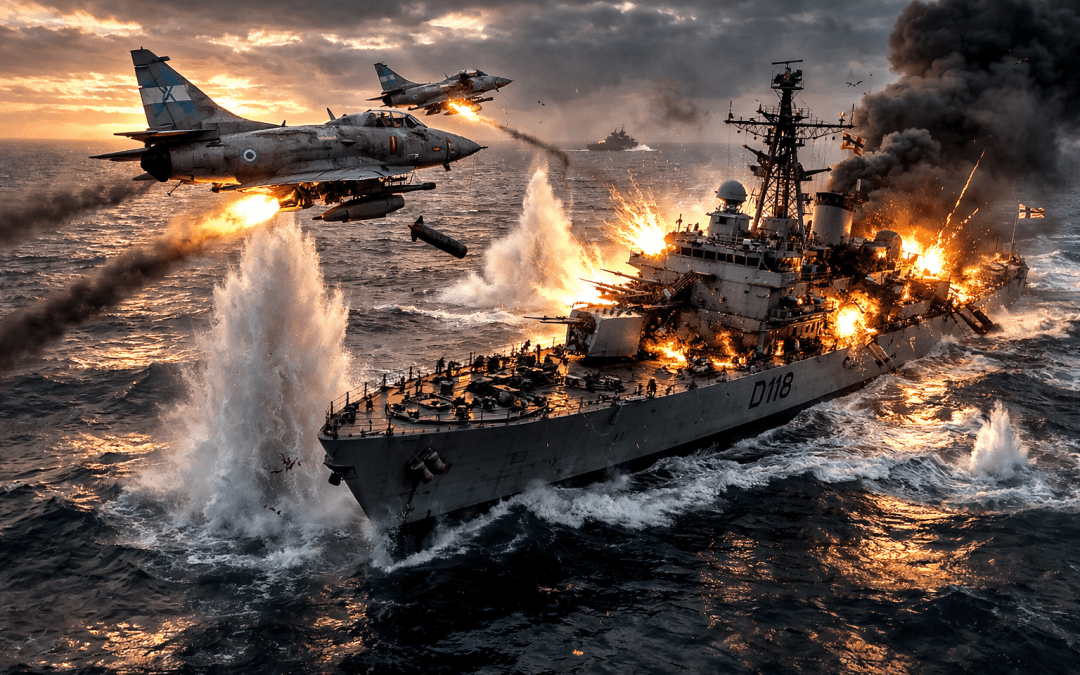
On the 25th of May, 1982, HMS Coventry was sunk by Argentine Airforce A4 Skyhawks during the Falkland Conflict. I have written a review of Admiral Sandy Woodward’s account of the conflict, One Hundred Days. It is a magnificent book and historical record. Coventry was commanded by Captin David Hart Dyke who is the father of the actress, comedian, and writer, Miranda Hart.
HMS Coventry was a Type 42 guided-missile destroyer of the Royal Navy. Commissioned in 1978, she was the third ship of her class, designed primarily for area air defence using the Sea Dart missile system. Sleek, fast, and bristling with radar and communications equipment, Coventry represented Britain’s Cold War naval doctrine: protecting fleets from high-speed aircraft and missiles in an era shaped by NATO–Warsaw Pact tensions. Within four years of entering service, she would be tested not in the North Atlantic, but in the harsh waters off the Falkland Islands.
The Falklands War began on the 2nd of April, 1982, when Argentine forces invaded and occupied the British Overseas Territory of the Falkland Islands. The ruling junta in Buenos Aires, facing domestic unrest, calculated that Britain would not mount a major military response. Instead, Prime Minister Margaret Thatcher’s government dispatched a naval task force over 8,000 miles to retake the islands. The campaign that followed lasted ten weeks and combined naval, air, and land operations in difficult weather and at extreme range from the United Kingdom.
HMS Coventry sailed south as part of the carrier battle group built around the aircraft carriers HMS Hermes and HMS Invincible. Her principal role was air defence. The Type 42 destroyers, including Coventry and her sister ships, formed a protective screen intended to detect and destroy incoming Argentine aircraft before they could threaten the carriers or amphibious forces. Equipped with the Sea Dart surface-to-air missile and advanced radar systems for the period, Coventry was theoretically well suited to counter high-level aerial threats.
In practice, the Argentine Air Force and Naval Aviation adapted quickly. Flying at extremely low altitude to evade radar detection, their pilots approached at wave-top height, popping up only briefly to release bombs or fire weapons. This tactic reduced the reaction time of British ships dramatically. Early in May, Coventry experienced both success and frustration. On the 9th of May, 1982, operating with other ships north of the islands, she successfully engaged and shot down Argentine aircraft using Sea Dart missiles, demonstrating the potency of her systems when given sufficient warning and clear radar tracks.
As British forces prepared to land at San Carlos Water on East Falkland, the threat intensified. The narrow waters of “Bomb Alley,” as it became known, forced ships to operate in confined spaces where manoeuvre was restricted. Coventry was assigned to a more exposed “picket” role north-west of the main landing area, alongside the Type 22 frigate HMS Broadsword. Their mission was to draw Argentine air attacks away from the amphibious ships and to intercept incoming aircraft.
On the 25th of May 1982—Argentina’s national day—waves of Argentine aircraft launched determined strikes against British naval units. In the early afternoon, a formation of A-4 Skyhawk jets approached Coventry and Broadsword at very low level. Radar clutter and the ships’ relative positioning complicated defensive measures. As Coventry manoeuvred to bring her Sea Dart system to bear, she inadvertently crossed Broadsword’s line of fire, disrupting the frigate’s ability to use her own Sea Wolf missile system.
Moments later, several bombs were released at close range. At least two struck Coventry on the port side. The explosions tore into her machinery spaces, igniting fires and causing catastrophic flooding. With power lost and fires spreading rapidly, the ship began to list heavily. Despite determined damage-control efforts by her crew, the angle of heel increased beyond recovery. Within about twenty minutes of being hit, HMS Coventry capsized and sank.
Nineteen members of her ship’s company lost their lives. Many others were rescued from the cold South Atlantic waters by nearby vessels and helicopters. The loss was a severe blow to the Royal Navy and underscored the vulnerability of modern warships to low-level air attack. It also highlighted shortcomings in equipment, coordination, and the difficulty of operating sophisticated missile systems in cluttered littoral environments.
Yet Coventry’s sacrifice was not in vain. By acting as an outer screen and drawing Argentine attacks, she and other picket ships helped shield the amphibious landings that were crucial to the British campaign. The beachhead at San Carlos held, allowing troops to establish a foothold and eventually advance across East Falkland toward Port Stanley. On the 14th of June, 1982, Argentine forces on the islands surrendered, bringing the conflict to an end.
In the aftermath, the Royal Navy examined lessons learned from the war, including improvements in close-in weapon systems, radar processing, and damage control. A new Type 22 frigate was later commissioned as the second HMS Coventry, preserving the name and honouring the fallen.