
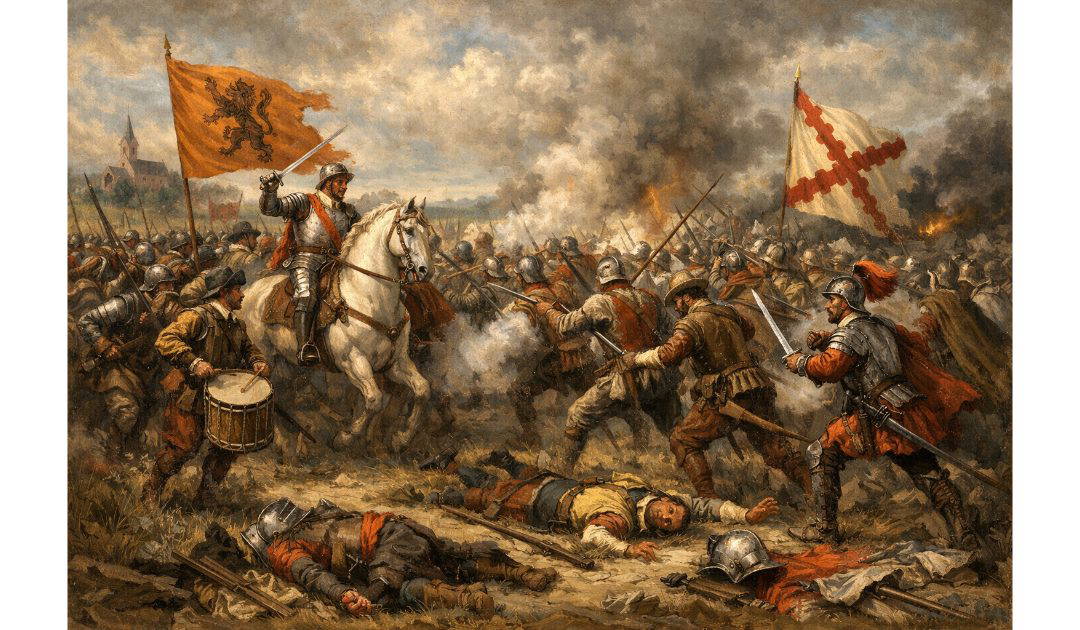
The Battle of Heiligerlee was fought on the 23rd of May, 1568, opening the Eighty Years’ War, which was the war in which my ancestor, Sir Anthony Standen, began his espionage career. You can follow his story in The Spy who Sank the Armada, the first book in the Sir Anthony Standen Adventures.
The Battle of Heiligerlee is traditionally regarded as the first pitched battle of the Eighty Years’ War, the long conflict through which the northern provinces of the Low Countries eventually won independence from Spanish rule. Though small in scale compared with later engagements, its political and symbolic importance was immense. It marked the opening of open armed revolt against the authority of King Philip II of Spain and demonstrated that Spanish power in the Netherlands could be challenged on the battlefield.
The engagement took place near the village of Heiligerlee in the province of Groningen, in the northeastern part of what is now the Netherlands. At the time, the Low Countries were under the sovereignty of Philip II, who ruled them as part of the vast Habsburg dominions. His efforts to strengthen central authority and enforce religious uniformity, particularly through the suppression of Protestantism, had created deep resentment among sections of the nobility and urban population. Tensions had already flared in the Beeldenstorm (Iconoclastic Fury) of 1566, when Protestant crowds attacked Catholic churches. In response, Philip sent the Duke of Alba with a veteran army to restore order, inaugurating a harsh regime of repression.
One of the leading opponents of Spanish policy was William of Orange. By 1568 he had gone into exile in the Holy Roman Empire but was preparing a coordinated military invasion of the Netherlands. The plan was to attack from several directions in the hope of igniting a broader uprising. The northern prong of this offensive was entrusted to his younger brother, Louis of Nassau (Lodewijk van Nassau), a committed Calvinist and capable soldier.
Louis gathered a force of around 3,000 to 4,000 men, including German mercenaries known as Landsknechts and a smaller contingent of cavalry. His objective was to secure a foothold in the northern provinces and encourage local support. As he advanced into Groningen territory, the Spanish authorities responded swiftly. Jean de Ligne, Duke of Aremberg, a loyal nobleman serving the Habsburg crown, was dispatched with a smaller but seasoned force to intercept the rebels. Aremberg had perhaps 1,500 to 2,000 troops, including experienced infantry and cavalry.
On the 23rd of May 1568 the two forces met near Heiligerlee. Louis chose his ground carefully. He positioned his troops in a marshy landscape bordered by heath and wooded areas, terrain that limited the effectiveness of Spanish cavalry. According to contemporary accounts, he concealed part of his force behind natural cover, intending to lure Aremberg into an attack.
Aremberg, perhaps underestimating the rebels or eager to strike before they could gather strength, launched an assault. The Spanish-led troops advanced into the difficult terrain and encountered stiff resistance. At a critical moment, Louis ordered a counterattack by his hidden reserves. The sudden appearance of fresh rebel troops threw Aremberg’s men into confusion. Fighting was intense and hand-to-hand, typical of sixteenth-century warfare, with pikes, arquebuses, and swords employed at close quarters.
The battle ended in a clear rebel victory. Aremberg himself was killed in the fighting, a significant loss for the Spanish side. His death contributed to the disarray among his troops, many of whom retreated in disorder. Casualty figures vary in the sources, but Spanish losses were substantial relative to the size of their force. Rebel casualties were lighter, though the engagement was by no means bloodless.
The victory at Heiligerlee was a powerful morale boost for William of Orange and his supporters. It proved that Spanish forces were not invincible and that disciplined resistance could succeed. News of the triumph spread quickly, encouraging hopes that a general uprising might follow.
Yet the strategic consequences were limited. The Duke of Alba reacted decisively. He personally led a larger, well-equipped army northwards to confront the rebels. Just two months later, on the 21ts of July, 1568, Louis of Nassau’s army was decisively defeated at the Battle of Jemmingen. Many of his troops were killed or dispersed, and the northern offensive collapsed. The early success at Heiligerlee could not be consolidated.
In retrospect, the Battle of Heiligerlee illustrates both the possibilities and the limits of early resistance to Habsburg rule. It was a tactical success achieved through effective use of terrain and surprise, and it removed a capable Spanish commander from the field. But it also revealed the challenges facing the rebels: limited resources, reliance on mercenaries, and the formidable military capacity of Spain. Though overshadowed by later sieges and campaigns, Heiligerlee remains a foundational moment in the long and complex struggle that reshaped the political map of northwestern Europe.