
I have written about Lincoln’s beard, and his Gettysburg Address, but did you know he was an inventor? On the 22nd of May, 1849, Lincoln was issued a patent for his invention to lift boats. This makes him the only US president to hold a patent. Don’t tell Trump or he’ll find some way of cheating the system.
In 1849, long before he became President of the United States, Abraham Lincoln secured a patent for a device designed to help boats pass over shallow water and river obstructions. It remains the only U.S. patent ever granted to a future American president. Though his invention was never manufactured commercially, it reveals much about Lincoln’s practical mind, his experience on the western rivers, and his lifelong interest in technology and internal improvements.
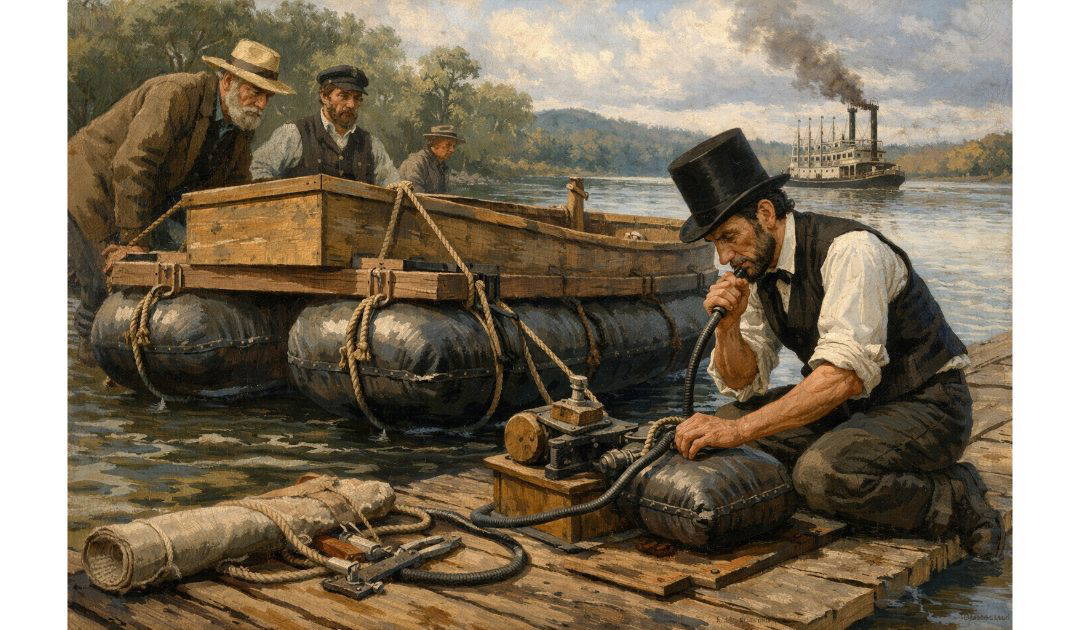
Lincoln’s invention is formally known as U.S. Patent No. 6,469, granted on May 22, 1849, for a device described as “Buoying Vessels Over Shoals.” The idea was simple in principle but ingenious in application. Lincoln proposed attaching inflatable air chambers—essentially large bellows or buoyant bags—to the sides of a flatboat or other river vessel. When the boat became stranded on a sandbar or encountered dangerously shallow water, the air chambers could be lowered and inflated, increasing the vessel’s buoyancy and lifting it over the obstruction.
The origins of the idea lay in Lincoln’s own youthful experiences. As a young man in the 1820s and early 1830s, he had worked on flatboats transporting goods down the Mississippi River system. On one famous trip to New Orleans in 1831, he witnessed firsthand the difficulties of navigating shallow, shifting river channels. Boats frequently ran aground on sandbars, sometimes requiring crews to unload cargo or physically lever the vessel free. These delays were costly, laborious, and occasionally dangerous. The memory of such incidents stayed with him for decades.
By 1848–1849, Lincoln was serving a single term in Congress as a Whig representative from Illinois. The Whig Party strongly supported federal funding for infrastructure—roads, canals, and river improvements. Lincoln shared this enthusiasm for what were called “internal improvements,” believing that better transportation would strengthen commerce and national unity. His boat-lift invention aligned closely with this political philosophy. It was both a practical mechanical solution and an expression of his broader belief in technological progress as a force for economic development.
The design he patented involved a system of expandable buoyant chambers made of waterproof fabric, attached to the hull of a vessel. These chambers were connected to a series of shafts and rods. When needed, they could be lowered into the water and inflated—likely using a manual air pump or bellows—thereby lifting the boat higher in the water. Once the vessel cleared the shoal, the chambers could be deflated and folded away.
Lincoln even constructed a small wooden model of the device to accompany his patent application. This model survives today in the collections of the Smithsonian Institution in Washington, D.C. It shows a narrow boat with accordion-like air chambers along its sides. The craftsmanship is modest but careful, reflecting Lincoln’s hands-on engagement with the mechanics of the design. He was known for his curiosity about how things worked and for his willingness to tinker and experiment.
Despite its creativity, the invention had practical limitations. River navigation in the mid-nineteenth century was unpredictable, and conditions varied widely. The added machinery might have been cumbersome or fragile in real-world use. There is no evidence that Lincoln ever attempted to market the invention or raise capital to produce it. After receiving the patent, he soon returned to Illinois and resumed his law practice, and the project appears to have faded into the background of his life.
Yet the significance of the patent extends beyond its commercial fate. Lincoln maintained a lifelong interest in patent law. As a lawyer, he handled several patent cases and developed a deep respect for the American patent system. In an 1858 lecture on “Discoveries and Inventions,” he praised the patent system for adding “the fuel of interest to the fire of genius.” He believed it encouraged innovation by ensuring that inventors could benefit from their own ideas. His personal experience navigating the patent process likely reinforced this conviction.
Lincoln’s boat-lift patent also illustrates an often-overlooked aspect of his character. He is remembered primarily for his leadership during the Civil War and for issuing the Emancipation Proclamation, but he was equally a man shaped by the practical challenges of frontier life. Growing up in Kentucky, Indiana, and Illinois, he split rails, farmed, and worked on riverboats. The problems he sought to solve were not abstract—they arose from lived experience.
Moreover, the invention symbolises the restless ingenuity of antebellum America. The 1840s were a period of rapid expansion and mechanical experimentation. Steamboats plied the Mississippi; railroads were spreading; canals linked inland towns to coastal markets. In this atmosphere, even a lawyer-congressman might imagine mechanical solutions to age-old transportation problems.
In the end, Lincoln’s inflatable boat lift was never put into practical use, and it did not transform river navigation. Nevertheless, it stands as a tangible reminder of his inventive spirit. It reflects his belief in improvement—whether of machines, laws, or society itself. Long before he guided the nation through its greatest crisis, he was already thinking about how to lift burdens, overcome obstacles, and move forward.