
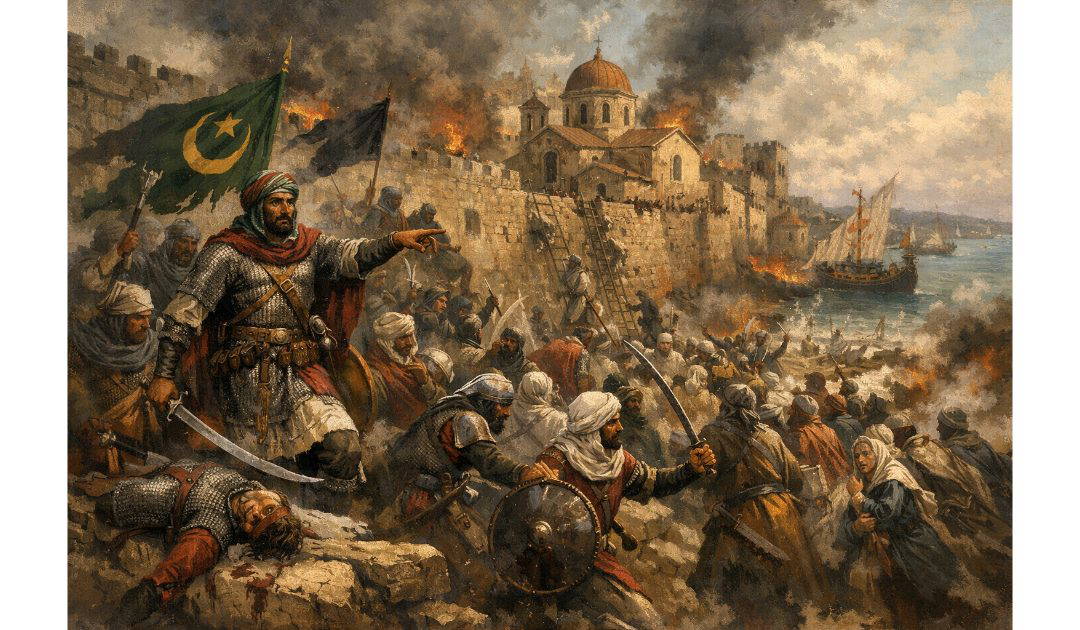
On the 21st of May, 878, Syracuse on Sicily was captured by the Muslim Aghlabids after a nine month siege. Amongst other events I could have chosen to write about, Charles Lindburgh landed at Le Bourget Field in Paris on the same day in 1927 having crossed the Atlantic, and Amelia Earhardt landed in a field in Derry in 1932 becoming the first woman to fly solo across the Atlantic. But Claire and I are going to Sicily in September, so some research won’t do me any harm, and I wrote about Charles and Amelia in my post on aviators.
Syracuse, on the south-eastern coast of Sicily, is one of the most storied cities of the Mediterranean world. Founded by Greek settlers and shaped by Romans, Byzantines, Muslims, Normans and Spaniards, it has stood at the crossroads of empire for nearly three millennia.
Greek Foundation and Greatness
Syracuse was founded in 734/733 BC by Corinthians led by Archias, who established their colony on the island of Ortygia, a defensible promontory with good harbours. From these beginnings the city expanded rapidly onto the mainland, forming a group of districts—Achradina, Tyche, Neapolis and Epipolae—that together made it one of the largest and wealthiest Greek cities in the western Mediterranean.
Under tyrants such as Gelon (r. 485–478 BC) and Hieron I, Syracuse became the dominant Greek power in Sicily. Its victory over the Carthaginians at the Battle of Himera in 480 BC was celebrated as a western counterpart to the Greek victories over Persia in the east. The city’s prosperity was reflected in monumental architecture: temples, theatres, and fortifications. The great Greek theatre in Neapolis, later enlarged, remains one of the most impressive survivals of classical antiquity.
Syracuse was also a centre of culture and science. The dramatist Aeschylus is known to have staged plays there, and in the third century BC the mathematician and engineer Archimedes was born in the city. His work in geometry, mechanics and hydrostatics would have a lasting global impact.
Conflict with Athens and Carthage
The city’s power inevitably drew it into wider Greek conflicts. During the Peloponnesian War, Athens launched the Sicilian Expedition (415–413 BC) in an attempt to conquer Syracuse. The campaign ended in catastrophe for the Athenians. After a protracted siege, their forces were defeated and annihilated, marking a decisive turning point in the war and securing Syracuse’s status as a formidable military state.
Yet the struggle with Carthage continued for centuries. Dionysius I (r. 405–367 BC), one of the most powerful tyrants of Syracuse, transformed the city into a heavily fortified stronghold and expanded its influence across Sicily and southern Italy. His massive walls, especially on the heights of Epipolae, were among the greatest defensive works of the Greek world.
Roman Conquest
The balance of power in Sicily shifted decisively during the Punic Wars between Rome and Carthage. Initially allied with Rome, Syracuse later sided with Carthage under King Hieronymus. In 214 BC, during the Second Punic War, Roman forces laid siege to the city. Despite ingenious defensive devices attributed to Archimedes, Syracuse fell in 212 BC to the Roman general Marcellus. Archimedes himself was killed in the aftermath.
Under Roman rule, Syracuse became the capital of the province of Sicily. Although it lost political independence, it remained an important administrative and commercial centre. Roman influence reshaped the cityscape, but many Greek institutions and cultural traditions endured.
Byzantine and Early Christian Era
After the fall of the Western Roman Empire, Syracuse came under Byzantine control. In the 7th century, it briefly served as an imperial residence when Emperor Constans II moved his court there from Constantinople between 663 and 668. This period reinforced its strategic importance as a bastion of Byzantine power in the central Mediterranean.
Christianity had taken root early. Syracuse venerates Saint Lucy (Santa Lucia), martyred during the persecutions of the early fourth century, who remains the city’s patron saint. Catacombs and early churches testify to a vibrant Christian community.
Muslim Conquest and Medieval Transformations
In 878, after a prolonged siege, Muslim forces from North Africa captured Syracuse. The conquest marked a major turning point. The city declined in political prominence as Palermo rose to become the capital of Islamic Sicily. Nevertheless, Syracuse remained an important regional centre, and elements of Islamic culture, agriculture and architecture influenced the wider island.
In 1086–1091, the Norman rulers of southern Italy completed the reconquest of Sicily from Muslim control. Under Norman, then Hohenstaufen and later Aragonese rule, Syracuse was reintegrated into the Latin Christian world. Ortygia, with its cathedral—built on the site of a Greek temple to Athena—became the fortified heart of the medieval city.
Early Modern Period and Earthquake
Under Spanish rule from the late 15th century, Syracuse was heavily fortified against Ottoman and Barbary corsair attacks. The imposing Castello Maniace, originally built under Frederick II in the 13th century, remained a key defensive structure.
A devastating earthquake struck eastern Sicily in 1693, destroying much of the region. Although Syracuse was damaged less severely than cities such as Catania and Noto, reconstruction in the Baroque style left a lasting architectural imprint. Ornate churches and palazzi in creamy limestone still define Ortygia’s appearance.
Modern Era
In 1860, during the Risorgimento, Syracuse became part of the Kingdom of Italy. The 20th century brought industrial development to the surrounding area, especially petrochemical plants, altering the economic landscape but also raising environmental concerns.
Today, Syracuse is recognised for its extraordinary historical layering. In 2005, it and the Necropolis of Pantalica were designated a UNESCO World Heritage Site. Visitors encounter Greek theatres, Roman amphitheatres, Byzantine relics, medieval fortifications and Baroque façades within a compact urban space.