
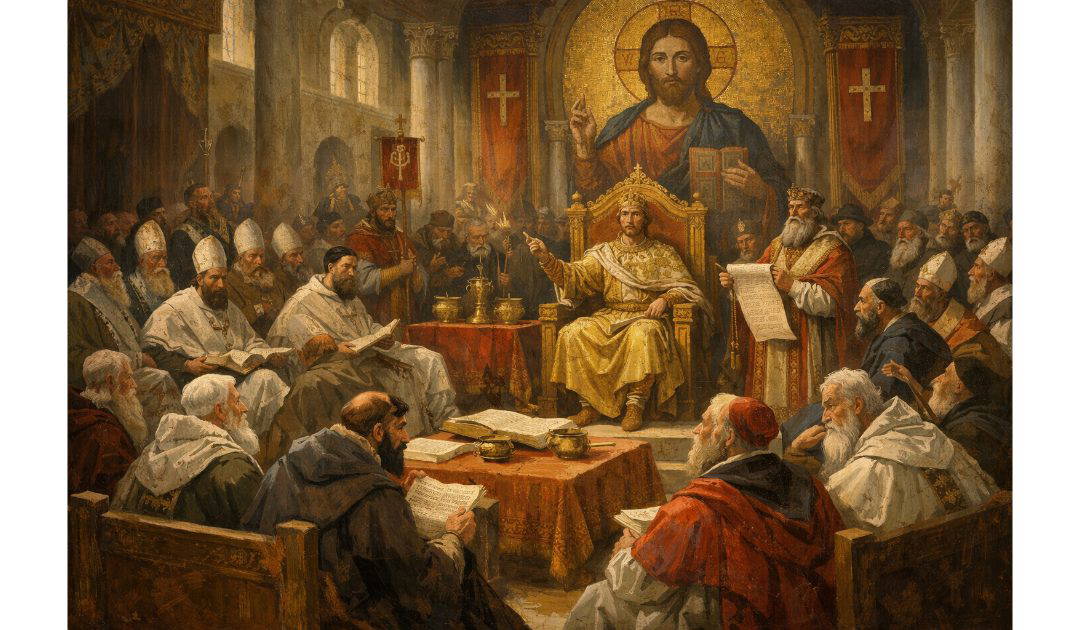
The first calling of the Council of Nicaea was on the 20th of May 325. The First Council of Nicaea was a landmark assembly of Christian bishops convened in 325 AD in the city of Nicaea (modern İznik in Turkey). Called by the Roman Emperor Constantine I, it was the first ecumenical council in Christian history—meaning it sought to represent the entire Church across the Roman Empire. Its primary purpose was to resolve a theological crisis that threatened both ecclesiastical unity and imperial stability.
Background: The Arian Controversy
The central issue before the council was the teaching of Arius, a presbyter from Alexandria. Arius argued that the Son of God, Jesus Christ, though divine, was not co-eternal with the Father. According to his view, the Son had been created by the Father at a point in time—“there was when he was not,” as his followers phrased it. This meant that Christ, while exalted above all creation, was not of the same divine essence as God the Father.
This teaching alarmed many church leaders, most notably Alexander of Alexandria and his deacon, the future Athanasius of Alexandria. They insisted that if Christ were not fully divine, then salvation itself was at risk, for only God could truly redeem humanity. The dispute spread rapidly throughout the eastern provinces of the empire, leading to unrest not only within congregations but also in wider society.
Constantine’s Role
Having recently consolidated control over the Roman Empire after years of civil war, Constantine was determined to secure unity. Though not yet baptized, he saw Christianity as a unifying force within his realm. The Arian controversy, however, threatened division. To settle the matter, Constantine summoned bishops from across the empire to meet at Nicaea in Bithynia.
Estimates vary, but around 250 to 300 bishops attended, predominantly from the eastern provinces, though representatives from the Latin West were also present. The Bishop of Rome, Pope Sylvester I, did not attend personally but sent legates.
Constantine himself presided ceremonially over the council’s opening session. Clad in imperial purple and gold, he reportedly urged the bishops to seek harmony and avoid schism. Though he did not dictate theology, his presence underscored the seriousness of the proceedings and the new relationship between Church and Empire.
The Nicene Creed
The most significant outcome of the council was the formulation of a creed—a statement of faith—designed to clarify Christian doctrine and exclude Arian interpretations. The council affirmed that the Son is “begotten, not made” and declared him to be homoousios (of the same substance) with the Father. This crucial Greek term meant that the Son shares the same divine essence as the Father, directly countering Arius’s claim that the Son was a created being of a different substance.
The resulting statement, known as the Nicene Creed, became a foundational declaration of orthodox Christian belief. Although later expanded at the Council of Constantinople in 381, its essential affirmations date from Nicaea.
Arius and a small number of supporters refused to sign the creed and were subsequently exiled. His writings were ordered to be burned. For a time, it appeared that the controversy had been decisively settled.
Other Decisions
The council also addressed several practical and disciplinary matters. It established a uniform method for calculating the date of Easter, ensuring that Christians across the empire would celebrate the feast on the same day. It issued canons (church laws) concerning clerical discipline, the reconciliation of lapsed Christians who had renounced the faith during earlier persecutions, and the proper ordering of ecclesiastical jurisdictions.
One canon recognized the traditional authority of major sees such as Alexandria, Antioch, and Rome, foreshadowing the later development of the patriarchal system.
Aftermath and Legacy
Despite its decisive language, the Council of Nicaea did not immediately end the Arian controversy. In the decades that followed, theological disputes continued, often entangled with imperial politics. At various times, Arian or semi-Arian bishops gained influence, and even Athanasius himself was exiled multiple times.
Nevertheless, Nicaea marked a turning point. It established the precedent of ecumenical councils as authoritative gatherings for defining doctrine. It also demonstrated the close alliance between imperial authority and ecclesiastical decision-making that would shape Byzantine Christianity for centuries.
Theologically, the council’s affirmation of Christ’s full divinity laid the groundwork for later Trinitarian doctrine. By insisting that the Father and the Son share the same divine essence, it protected the central Christian conviction that in Christ, God himself had acted to save humanity.
Historically, the First Council of Nicaea stands as a moment when Christianity, once a persecuted minority faith, publicly defined its beliefs with the backing of imperial power. Its creed continues to be recited, in slightly revised form, in churches around the world today—a testament to the enduring significance of the debates that took place in Nicaea in the summer of 325.