
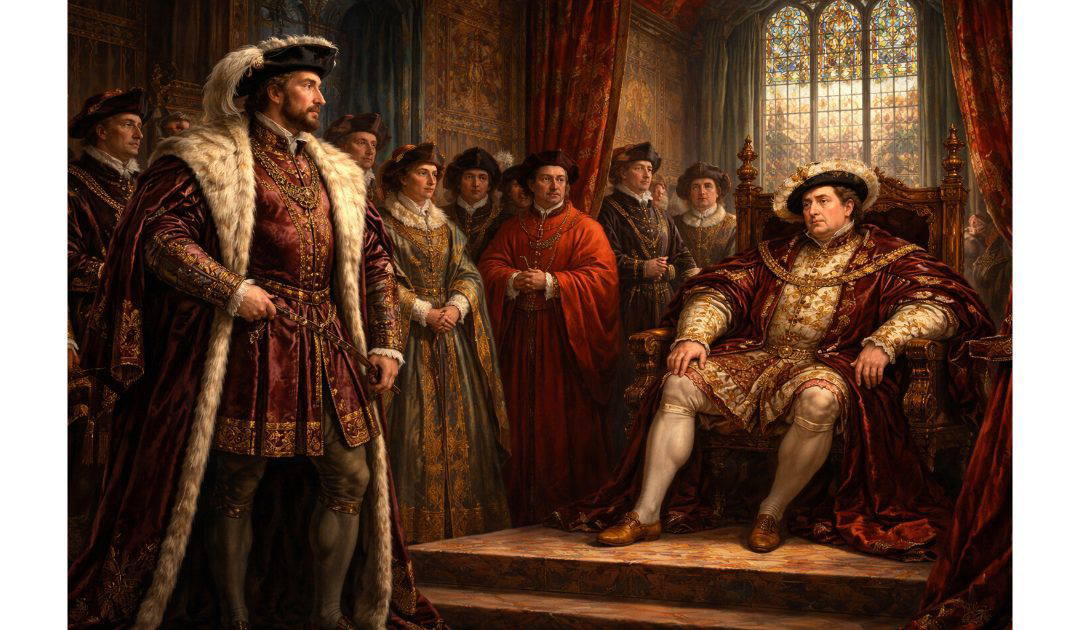
On the 17th of May, 1521, Edward Stafford, 3rd Duke of Buckingham was executed for treason. He was one of the many victims of Henry VIII’s suspicions, although it was before his marriage to Anne Boleyn, and before his jousting injury. Having looked at it myself, I think Stafford was probably innocent of the treason he was accused of. See what you think.
Background
Buckingham was born into one of the most illustrious families in England. Through his father, Henry Stafford, 2nd Duke of Buckingham, he was descended from Edward III. Through his mother, Katherine Woodville, he was connected to the Yorkist court of Edward IV. This royal blood made him, at least in theory, a potential claimant to the throne should the Tudor line fail.
After the execution of his father for rebellion against Richard III in 1483, the young Edward eventually recovered his family’s titles and estates under Henry VII. By the time Henry VIII ascended the throne in 1509, Buckingham was immensely wealthy, holding vast lands in Wales and the English Marches. He maintained a grand household and lived with a magnificence that reflected his lineage. His pride in his ancestry was well known, and he appears to have had a keen sense of his dynastic importance.
Relations with Henry VIII
At the start of Henry VIII’s reign, Buckingham outwardly enjoyed royal favour. He participated in court ceremonies and accompanied the king on campaigns in France. However, tensions gradually emerged. Buckingham was known for his haughty manner and independence. He resented the rise of “new men” at court, particularly Thomas Wolsey, whose influence over the king became dominant by the mid-1510s.
Wolsey, the son of an Ipswich butcher, embodied everything Buckingham disliked: low birth combined with immense power. It is widely believed that Buckingham’s hostility toward Wolsey contributed significantly to his downfall. Whether Wolsey actively sought his destruction or merely facilitated it remains debated, but Buckingham’s trial cannot be understood without recognising Wolsey’s central political role.
The Charges
In 1521, Buckingham was arrested and charged with high treason. The accusations centred on prophecies and alleged discussions about the king’s death and his own potential accession.
The main elements of the prosecution case included:
- Listening to and encouraging prophecies that foretold Henry VIII’s early death.
- Consulting a monk and a fortune-teller, who allegedly predicted that Buckingham would become king.
- Speaking of his royal blood as giving him a claim to the throne, particularly if Henry died without male heirs.
- Suggesting that he might kill the king if he were ever arrested or threatened.
At the time, Henry VIII had only one legitimate surviving child, the Princess Mary. The lack of a male heir created an atmosphere of anxiety about succession. In such circumstances, a powerful noble with Plantagenet blood could easily be viewed as a latent threat.
The Evidence
The prosecution relied heavily on testimony from Buckingham’s own servants, including his surveyor Charles Knyvett and his chancellor Robert Gilbert. These men claimed that Buckingham had entertained prophecies predicting Henry’s death and had expressed belief that he might succeed to the throne.
One of the most damaging allegations concerned a conversation in which Buckingham supposedly remarked that, if the king were to die without sons, he had “a better right” to rule than others. Another claim held that he had consulted a Carthusian monk about his prospects for kingship. In Tudor England, prophecy was politically explosive; even passive acceptance of such predictions could be construed as treasonous intent.
However, much of this evidence was second-hand and based on reported speech. There was no concrete proof of an active conspiracy, no army raised, no correspondence with foreign powers. The case hinged on words — alleged words — spoken in private and reported by men who may have had motives to protect themselves or curry favour.
The Trial
Buckingham was tried in May 1521 before a panel of peers in Westminster Hall, with the Duke of Norfolk presiding as Lord High Steward. The proceedings reflected the legal standards of the period, not modern notions of due process. The accused in treason cases had limited opportunity to challenge evidence or cross-examine witnesses.
Buckingham defended himself vigorously, denying that he had ever intended harm to the king. He admitted hearing prophecies but claimed he rebuked them. He argued that malicious servants had twisted his words.
Nevertheless, the verdict was a foregone conclusion. The political climate, Henry VIII’s suspicion, and Wolsey’s dominance meant acquittal was unlikely. Buckingham was found guilty of high treason.
Execution and Significance
On the 17th of May, 1521, Buckingham was executed on Tower Hill. Contemporary accounts describe him as meeting death with dignity, acknowledging the justice of the king while maintaining that he had never truly intended treason.
His fall sent a powerful message: ancient lineage offered no protection against Tudor authority. Henry VIII, still early in his reign, demonstrated that even the highest noble could be destroyed if perceived as a threat.
Historians remain divided on whether Buckingham was genuinely dangerous. Some argue that his pride and loose talk made him reckless in a tense dynastic climate. Others see him as the victim of political manoeuvring by Wolsey and an increasingly suspicious monarch.
What is clear is that the case illustrates the precarious nature of noble power under the Tudors. In a realm haunted by recent civil wars, words about succession could be fatal. Edward Stafford’s trial was less about overt rebellion than about the fear of what he represented: a magnate of royal blood in an age determined to secure a new dynasty.