
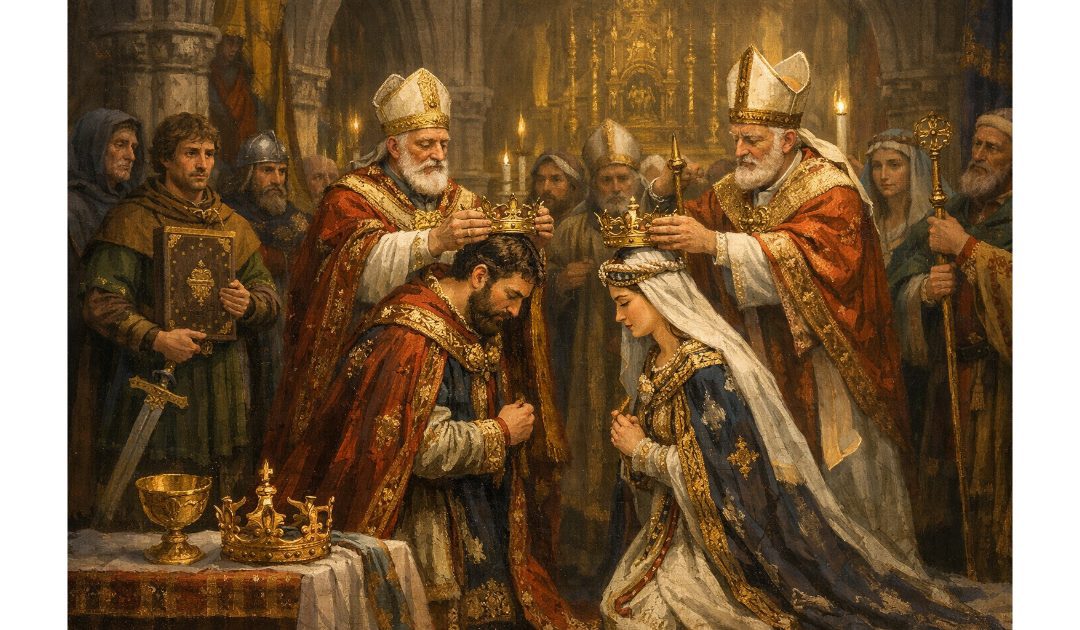
On the 11th of May, 973, Edgar the Peaceable was crowned king of England in the first coronation ceremony for an English monarch. Edgar the Peaceable (c. 943–975), was King of the English from 959 until his death in 975. Though his epithet suggests a quiet and uneventful reign, Edgar was in fact one of the most significant architects of early medieval English unity. His rule marked the high point of the Anglo-Saxon kingdom before the renewed Scandinavian invasions of the late tenth and early eleventh centuries.
Early Life and Accession
Edgar was the younger son of King Edmund I and his first wife Ælfgifu of Shaftesbury. When Edmund was murdered in 946, Edgar was still a child. The throne passed first to his uncle Eadred and then to his elder brother Eadwig. Eadwig’s reign was troubled by political division, particularly between the king and powerful church reformers such as Dunstan.
By 957, discontent in the north and midlands led to Edgar being accepted as king in those regions, effectively dividing the kingdom. When Eadwig died in 959, Edgar became sole ruler of a reunited England. He was about sixteen years old.
The Making of a Peaceful King
Edgar’s reign is remembered for internal stability. Unlike many of his predecessors and successors, he did not have to defend his kingdom against major Viking invasions or prolonged civil strife. This peace, however, was not accidental. It rested on careful administration, strong alliances with leading churchmen, and the maintenance of royal authority throughout the realm.
Central to Edgar’s kingship was his close partnership with leading ecclesiastical reformers: Dunstan (Archbishop of Canterbury), Oswald of Worcester, and Æthelwold of Winchester. Together they spearheaded the Benedictine Reform movement in England. This reform aimed to replace secular clergy in major monasteries with monks living under the Rule of St Benedict, thereby strengthening discipline, learning, and spiritual life.
Edgar strongly supported the foundation and refoundation of monasteries, granting them lands and privileges. Monastic centres became hubs of scholarship, manuscript production, and liturgical uniformity. The Regularis Concordia, a document produced under his reign, helped standardise monastic practice across England. In supporting reform, Edgar reinforced both the moral authority of the Church and his own legitimacy as a Christian king.
Administrative Achievements
Edgar’s reputation for peace was also the result of effective governance. He developed and refined the system of shires and hundreds, ensuring royal justice reached into local communities. Law codes issued in his name emphasised order, fair dealing, and the suppression of theft and disorder.
Coinage reform was another hallmark of his reign. Edgar introduced a more uniform and controlled system of minting coins, with regular recoinages and strict oversight. This strengthened royal authority and facilitated trade across his kingdom, which by this time included not only Wessex and Mercia but also Northumbria and the Danelaw territories.
He also cultivated naval power. Later sources claim he maintained a fleet to patrol the coasts, discouraging Viking incursions and piracy. Whether these claims are somewhat idealised or not, they reflect a perception of Edgar as a ruler who secured England’s shores without the need for major warfare.
The Coronation at Bath
One of the most famous moments of Edgar’s reign was his ceremonial coronation in 973 at Bath. Although he had ruled since 959, this grand event symbolised the maturity and unity of his kingship. The ceremony, probably organised by Dunstan, set a pattern for later English coronations, including elements that would endure for centuries.
Soon after, according to later chroniclers, Edgar received the submission of several rulers at Chester, including kings from Scotland and Wales, who reputedly rowed him on the River Dee as a sign of overlordship. While the story may be embellished, it reflects the perception of Edgar as a dominant ruler in Britain.
Marriage and Controversy
Edgar’s personal life was more complex than his public image suggests. He had relationships before and during his reign that produced children, including his future successor Edward the Martyr. His later marriage to Ælfthryth (Aelfthryth) was significant, as she became the first English queen known to have been formally crowned alongside her husband.
After Edgar’s death in 975, succession tensions emerged between supporters of Edward and those of Ælfthryth’s son, Æthelred the Unready. Edward briefly reigned before being murdered in 978, after which Æthelred became king. The instability that followed cast Edgar’s reign in an even more favourable light by contrast.
Legacy
Edgar died in 975 at about thirty-two years of age and was buried at Glastonbury Abbey. His relatively short reign nonetheless left a lasting mark. He consolidated the unity achieved by his grandfather Alfred the Great and his uncle King Athelstan, embedding administrative and ecclesiastical reforms that strengthened the English kingdom.
Though later generations would face renewed Viking invasions and political turmoil, Edgar’s reign came to be remembered as a golden age of order and Christian kingship. The epithet “the Peaceable” captures not a passive ruler, but a king whose authority, reforming zeal, and administrative competence created a rare and precious stability in early medieval England. The oldest complete document held in the National Archive is by Edgar