
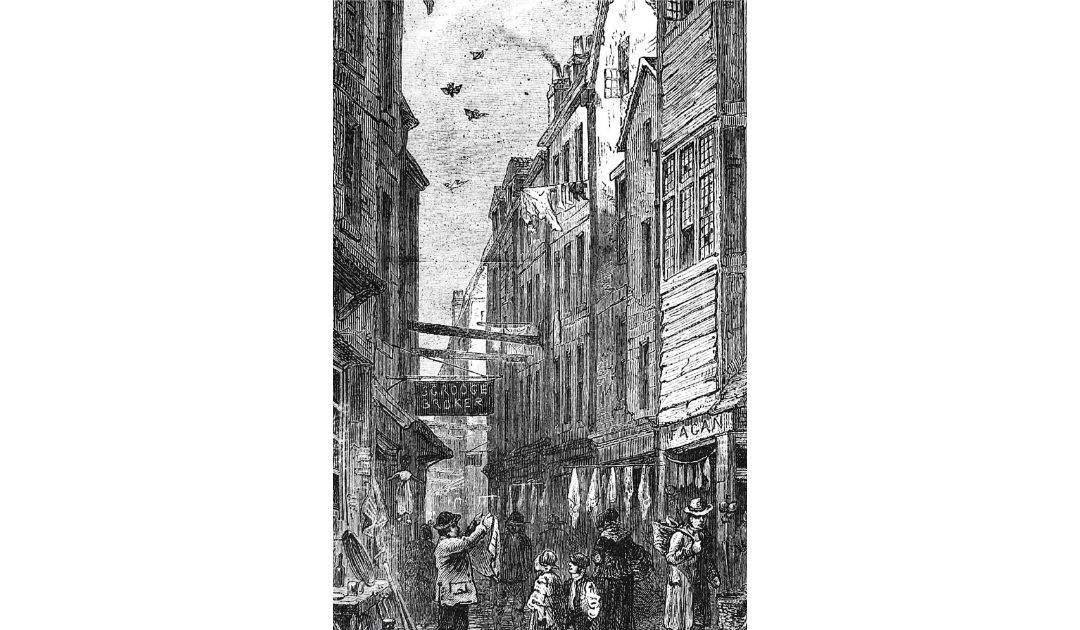
The other event for the 9th of May that caught my eye was the execution of five homosexual men at Tyburn in 1726 following their arrest at Mother Clap’s Molley House. Instead I chose Operation Primrose. Yet Operation Primrose concerns the capture of an Enigma machine and codebooks which helped Alan Turing and the codebreakers at Bletchley Park break the codes and greatly help win the war. Alan Turing’s subsequent treatment because of his homosexuality is disgraceful. So this story must be told too.
Margaret Clap, better known to history as “Mother Clap,” was the proprietor of one of the most famous molly houses in early eighteenth-century London. Active during the 1720s, she became a central figure in a major crackdown on homosexual subculture in Georgian England. Her establishment, often referred to as Mother Clap’s Molly House, offers historians a rare and vivid glimpse into the hidden social worlds of queer men in a period when same-sex relations were criminalized and punishable by death.
Very little is known about Margaret Clap’s early life. She was probably born in the late seventeenth century and was married (hence the surname Clap), though her husband does not figure prominently in surviving records. By the early 1720s, she was running a coffee house in Field Lane, Holborn—an area of London known for poverty and vice. Unlike the grand coffee houses frequented by merchants and intellectuals in places such as Covent Garden or the City, Clap’s establishment catered to a very different clientele.
Her coffee house functioned as a “molly house.” The term “molly” was contemporary slang for an effeminate man or a man who had sex with other men. Molly houses were private meeting places where men could socialize, drink, dance, and pursue relationships with relative safety from the hostile outside world. In an era when sodomy was a capital offence under English law—punishable by hanging—such spaces were essential for those seeking companionship and community.
Accounts from the period, particularly court records from the Old Bailey, provide unusually detailed descriptions of activities at Clap’s house. Informers testified that men gathered there to engage in what they described as “indecent” behaviour. Patrons reportedly used female names for one another, held mock weddings, and participated in rituals that mimicked heterosexual domestic life. Some accounts describe cross-dressing, singing, and dancing. Others, more lurid in tone, detail sexual encounters in private rooms.
These descriptions must be read with caution. Much of what we know comes from hostile witnesses—informers and moral reformers—whose aim was prosecution rather than objective documentation. Nevertheless, historians consider these records invaluable. They show that molly houses were not merely places for clandestine sexual encounters but were social institutions where identity, friendship, and a sense of belonging could flourish.
Mother Clap herself appears to have been more than a passive landlady. According to testimony, she actively encouraged her patrons, provided rooms for privacy, and sometimes intervened to warn them of danger. Witnesses alleged that she had hosted gatherings of 30 or 40 men at a time and had operated her house for at least two years before the authorities intervened.
The crackdown that brought about her downfall was part of a broader campaign by the Society for the Reformation of Manners, a moral reform organization active in the late seventeenth and early eighteenth centuries. The Society employed informers to infiltrate molly houses and gather evidence. In 1726, after surveillance and coordinated raids, Clap and several of her patrons were arrested.
Her trial took place in February 1726 at the Old Bailey. Multiple witnesses testified that they had observed sexual acts on the premises. Margaret Clap was convicted of keeping a disorderly house—a charge often used to prosecute brothel-keepers and others accused of facilitating immoral behaviour. She was sentenced to stand in the pillory, fined, and imprisoned. The pillory was not merely a punishment but a public spectacle; offenders were exposed to jeers, thrown objects, and sometimes physical assault from the crowd.
Several of her patrons faced harsher consequences. At least three men (Wiki says five) arrested in the same sweep were convicted of sodomy and executed at Tyburn. Their deaths underscore the severe risks associated with homosexual life in early eighteenth-century England.
After her conviction, Margaret Clap largely disappears from the historical record. It is unclear whether she survived long after her imprisonment or what became of her coffee house. Yet her name endures because her case provides one of the clearest documentary windows into London’s early queer subculture.
Today, historians view Mother Clap’s molly house as evidence that vibrant, organized same-sex communities existed long before the modern LGBTQ+ rights movement. Her story highlights both the resilience of marginalized communities and the intensity of the repression they faced. Though condemned in her own time as a corrupter of morals, Margaret Clap is now recognized as a figure of historical significance in the long and complex history of sexuality in Britain.