
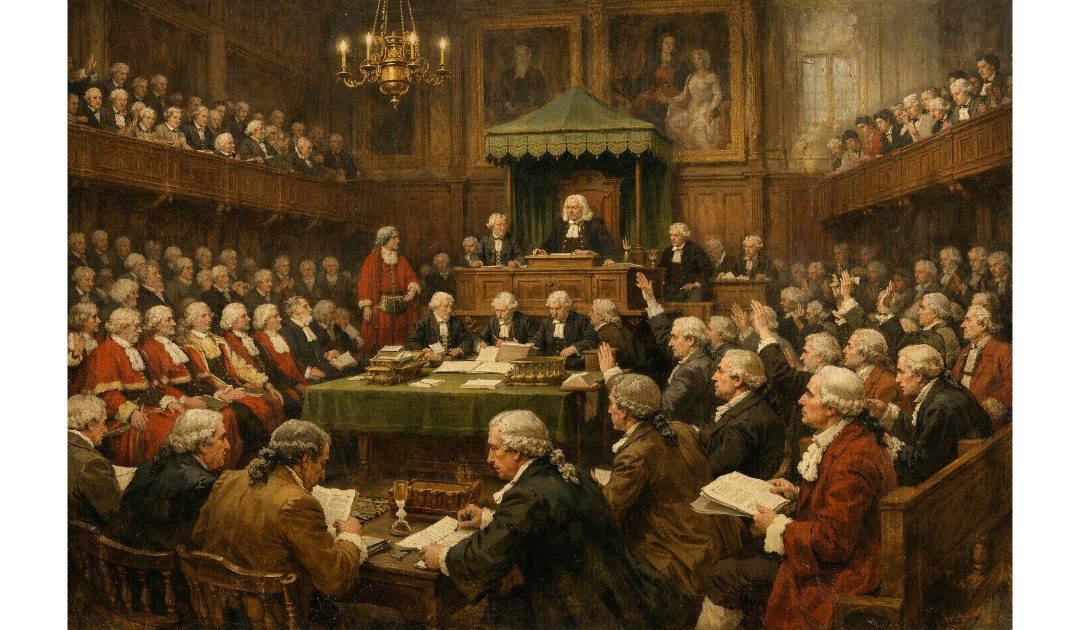
On the 10th of May, 1773, Parliament passed the Tea Act. It was intended to save the British East India Company by reducing taxes on its tea and granting it the right to sell tea directly to North America.
Following the costly victory of Britain in the Seven Years’ War (known in America as the French and Indian War), the British government was left with a staggering national debt and the responsibility of defending an expanded empire in North America. To help defray costs, Parliament introduced a series of revenue measures directed at the colonies, including the Stamp Act and the Townshend Acts. Colonial resistance was fierce. The Stamp Act was repealed in 1766 after widespread protest, but the Townshend duties—taxes on imported goods such as glass, paint, paper, and tea—remained a source of grievance. By 1770, most of the Townshend duties were repealed, except for a small tax on tea. Parliament retained this duty deliberately, to assert its right to tax the colonies.
At the same time, another crisis was brewing in London. The British East India Company, which held a monopoly on British trade with Asia, was facing financial collapse. The Company was burdened with unsold tea stockpiled in its warehouses and was struggling under debt and administrative mismanagement, especially following the Bengal Famine of 1770. The British government feared that the failure of such a powerful commercial entity would destabilize the national economy.
The Tea Act was designed primarily as a bailout for the East India Company. It allowed the Company to ship tea directly to the American colonies without first landing it in Britain. Previously, tea imported into Britain had to pay customs duties before being re-exported to America. The new act removed this requirement, enabling the Company to sell tea at a lower price in the colonies—even with the existing Townshend tax included.
In theory, colonial consumers would benefit from cheaper tea. The act did not impose a new tax; rather, it made the taxed tea more affordable than smuggled Dutch tea, which had been widely consumed in America. British Prime Minister Lord North believed that the colonists, tempted by lower prices, would purchase the tea and thereby tacitly accept Parliament’s right to tax them. However, this calculation underestimated colonial political sentiment.
To many colonists, the Tea Act represented a dangerous principle rather than a financial burden. Although the tea was cheaper, purchasing it meant accepting the legitimacy of parliamentary taxation without colonial representation. The slogan “no taxation without representation” had become a unifying cry among American patriots. Moreover, colonial merchants and smugglers resented the monopoly granted to the East India Company. By permitting the Company to sell directly through selected colonial agents, the act bypassed established colonial middlemen. This threatened local commercial interests and reinforced fears of imperial overreach.
Resistance quickly organized. In cities such as Boston, New York, and Philadelphia, public meetings denounced the act. Colonial assemblies petitioned against it. In several ports, ships carrying East India Company tea were turned away or prevented from unloading their cargo. The crisis reached its most famous expression in Boston. Massachusetts had been a focal point of imperial tensions since the Boston Massacre, and radical leaders such as Samuel Adams mobilized public opposition to the Tea Act.
In December 1773, three ships—the Dartmouth, Eleanor, and Beaver—arrived in Boston Harbor carrying tea. Under British law, the tea had to be unloaded and duties paid within twenty days, or it would be seized. Royal Governor Thomas Hutchinson refused to allow the ships to leave without paying the tax.
On the night of 16th of December 1773, a group of colonists, many disguised as Mohawk Indians, boarded the ships and dumped 342 chests of tea into the harbor. This dramatic act of defiance became known as the Boston Tea Party. It electrified public opinion on both sides of the Atlantic.
The British government responded with fury. In 1774, Parliament passed a series of punitive measures known in Britain as the Coercive Acts and in America as the Intolerable Acts. These laws closed Boston Harbor, altered the Massachusetts charter, and expanded the powers of royal officials. Rather than isolating Massachusetts, however, they united the colonies in sympathy and resistance.
The crisis prompted the convening of the First Continental Congress in 1774, where delegates from twelve colonies coordinated a collective response. The path toward armed conflict had begun. Within two years, fighting would erupt at Lexington and Concord in April 1775, and the colonies would declare independence in 1776.