
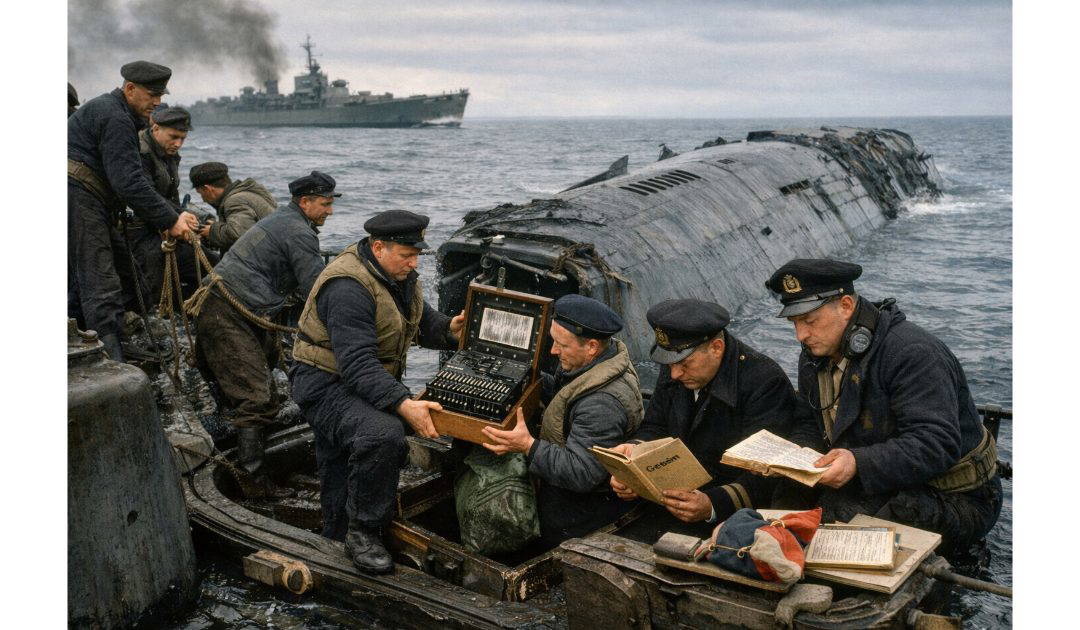
On the 9th of May, 1941, the German submarine U-110 was captured by the Royal Navy in what was called Operation Primrose. Confusingly there was another Operation Primrose in 1940 which was a failed landing of Royal Marines at Ålesund in Norway. Though little publicised at the time, its consequences were immense, materially assisting Britain’s codebreakers in their struggle to penetrate German naval communications.
By the spring of 1941, the Battle of the Atlantic was entering a critical phase. German U-boats were inflicting devastating losses on Allied merchant shipping, threatening Britain’s survival. The German Navy relied on the Enigma cipher machine to encode operational signals to its submarines, believing the system unbreakable. While British cryptanalysts at Bletchley Park had already achieved intermittent success against earlier Enigma settings, the Kriegsmarine’s more complex naval Enigma posed a formidable challenge. Its additional rotors and stricter procedures made decryption extremely difficult without current key material.
U-110, commanded by Kapitänleutnant Fritz-Julius Lemp, was operating in the North Atlantic as part of a wolfpack attacking convoy OB 318. The convoy was protected by an escort group that included the destroyer HMS Bulldog, commanded by Commander Joe Baker-Cresswell, along with the corvette HMS Aubrietia and the destroyer HMS Broadway.
After U-110 attacked the convoy, Aubrietia detected her by ASDIC (sonar) and launched depth charges. Bulldog and Broadway joined the assault. The sustained barrage severely damaged the submarine, causing flooding and disabling vital systems. Believing his boat fatally crippled, Lemp ordered the crew to abandon ship. In the confusion, however, critical scuttling procedures were not fully carried out. The Germans assumed the submarine would sink quickly.
Recognising the extraordinary opportunity, Baker-Cresswell made a bold decision. Rather than sinking the U-boat outright, he ordered a boarding party to attempt capture. Lieutenant David Balme led a small group of sailors from Bulldog across the heaving Atlantic in a whaler. Boarding an enemy submarine in wartime, potentially booby-trapped and liable to sink at any moment, was an act of remarkable courage.
Inside the abandoned vessel, the British sailors found the submarine in chaos but not yet flooded beyond salvage. Most crucially, they discovered an intact Enigma machine, along with current codebooks, cipher keys, signal logs, and other cryptographic documents. These materials were hastily gathered and transferred to Bulldog. After efforts to tow the submarine failed, U-110 eventually sank the following day, but by then her most valuable secrets had been secured.
The captured material was rushed under tight secrecy to Bletchley Park. There, cryptanalysts working in Hut 8—including the mathematician Alan Turing—were attempting to break the naval Enigma. The documents from U-110 provided up-to-date key settings and procedural details that enabled the codebreakers to read German naval traffic for a crucial period. Although Enigma keys changed regularly, the haul allowed Bletchley Park to refine its methods and regain access when the system shifted.
The intelligence derived from this breakthrough was known by the codename “Ultra.” It allowed the Admiralty to reroute convoys away from wolfpacks, significantly reducing shipping losses. The capture of U-110 did not end the U-boat threat, but it shifted the balance at a moment when Britain’s situation was precarious.
Secrecy was paramount. The Germans were never allowed to suspect that Enigma material had been captured intact. Publicly, U-110 was simply listed as lost. Even within the Royal Navy, knowledge of the boarding’s success was tightly restricted. Had the Kriegsmarine realised that their cipher had been compromised through physical capture, they would have immediately revised procedures, potentially nullifying the advantage.
Operation Primrose was not the only such success—later captures, such as those from U-559 in 1942, would also prove invaluable—but it was the first major intact seizure of current naval Enigma materials during the war. Its timing in mid-1941 was critical, coming just weeks before Germany’s invasion of the Soviet Union and months before the United States entered the war. Maintaining Atlantic supply lines during this period was essential to sustaining Britain and enabling future Allied offensives.
Commander Baker-Cresswell and Lieutenant Balme received recognition for their actions, though much of the operation’s significance remained classified for decades. Only after the war did the full story emerge, revealing how close-run and daring the boarding had been.
Historians now regard Operation Primrose as a textbook example of tactical initiative yielding strategic intelligence gains. It demonstrated the importance of flexibility in command, the value of technological exploitation, and the interplay between frontline action and cryptographic analysis. Without the decision to board rather than sink U-110, the flow of naval Enigma intelligence in 1941 might have been severely disrupted.