
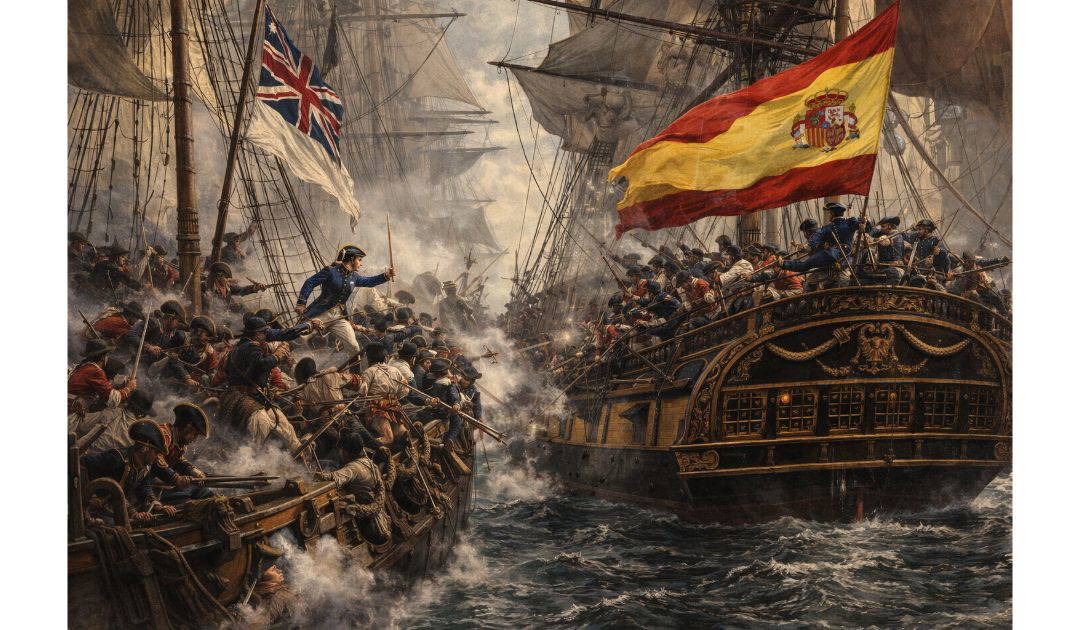
On the 6th of May, 1801, Captain Thomas Cochrane in the 14-gun HMS Speedy captured the 32-gun Spanish frigate El Gamo. Thomas Cochrane (1775–1860) was one of the most audacious and controversial naval commanders of the age of sail, a man whose exploits during the Napoleonic Wars made him a legend in his own lifetime and later the principal inspiration for Patrick O’Brian’s fictional hero Jack Aubrey in the Master and Commander series.
Born in Scotland, the son of the 9th Earl of Dundonald, Cochrane entered the Royal Navy at a young age, as was common for boys of his class. His early career coincided with Britain’s long struggle against Revolutionary and Napoleonic France. From the outset, he showed an unconventional streak, combining technical ingenuity with fearless aggression. He despised rigid naval orthodoxy and was willing to take risks that more cautious captains would never contemplate.
Cochrane’s most famous exploit came in 1801 while commanding the tiny brig-sloop HMS Speedy. Speedy carried only 14 small guns and a crew of around 50 men. Off the coast of Spain, Cochrane encountered the much larger Spanish frigate El Gamo, armed with 32 guns and manned by more than 300 sailors and marines. By any conventional calculation, Speedy was hopelessly outmatched.
Cochrane turned disparity into advantage. He sailed so close under El Gamo’s guns that the Spanish ship could not depress its cannon sufficiently to hit him. After a fierce exchange of musketry and small-arms fire, he led repeated boarding attempts, personally rallying his men. In a display of psychological audacity, he reportedly ordered his crew to make as much noise as possible to give the impression of larger numbers. Against all odds, the Spanish crew surrendered. The capture of El Gamo became one of the most celebrated single-ship actions of the wars and established Cochrane’s reputation for brilliance and daring.
Such feats strongly influenced Patrick O’Brian when creating Jack Aubrey, the bold and resourceful captain in his long-running naval series. Aubrey’s appetite for battle, his tactical inventiveness, and his ability to inspire fierce loyalty in his crew owe much to Cochrane’s example. O’Brian also borrowed from Cochrane’s flair for cutting-out expeditions—small-boat raids into defended harbours to seize enemy vessels—another hallmark of his early career.
In 1809, Cochrane commanded the frigate HMS Imperieuse during the Battle of the Basque Roads. The British fleet sought to destroy a powerful French squadron anchored under heavy shore batteries. Cochrane devised a daring plan using fireships and explosive vessels to break the enemy line. The attack caused chaos and grounded several French ships. However, the British admiral in overall command, Lord Gambier, failed to press the advantage decisively. Furious at what he saw as timidity, Cochrane publicly criticised his superior. Though hailed as a hero by the public and awarded a knighthood, he made powerful enemies within the Admiralty.
Cochrane’s career took a dramatic downturn in 1814 when he was implicated in the so-called Great Stock Exchange Fraud, a scheme involving false rumours of Napoleon’s death to manipulate government securities. Though Cochrane maintained his innocence, he was convicted, imprisoned, fined, expelled from Parliament, and struck off the Navy List. Many contemporaries believed he was scapegoated, but the scandal ruined his British naval career for years.
Characteristically undeterred, Cochrane sought employment abroad. In the 1810s and 1820s he became a naval commander in several South American wars of independence. Serving first Chile, then Brazil, and later Greece, he helped emerging nations challenge Spanish, Portuguese, and Ottoman control. In Chile, he reorganised the navy and captured the formidable Spanish fortress of Valdivia. In Brazil, he secured key ports and hastened Portuguese withdrawal. His blend of audacity and improvisation again proved effective, though disputes over pay and politics followed him everywhere.
These later adventures also fed into his literary afterlife. O’Brian was not the only writer inspired by him; C. S. Forester’s Horatio Hornblower similarly bears traces of Cochrane’s career. Yet O’Brian’s Aubrey most vividly reflects the exuberant, combative side of Cochrane—the captain who relished close action, trusted in seamanship and morale, and thrived in situations of apparent impossibility.
Cochrane was eventually pardoned in Britain and restored to the Navy List in 1832. Later, he rose to the rank of admiral and inherited the earldom of Dundonald. By the time of his death in 1860, he had been partially rehabilitated, and his extraordinary life was widely acknowledged. He was buried in Westminster Abbey, a rare honour for a naval officer of such a turbulent career.
Thomas Cochrane remains a figure of paradox: a brilliant tactician and fearless combat leader, yet quarrelsome, politically radical, and often embroiled in controversy. His life combined high adventure, scandal, innovation, and restless ambition. It is little wonder that novelists found in him the perfect model for a fictional sea captain. In Cochrane’s daring actions—especially the improbable victory of Speedy over El Gamo—one can clearly glimpse the real-life origins of Jack Aubrey’s cry to clear for action and engage the enemy against all odds.