
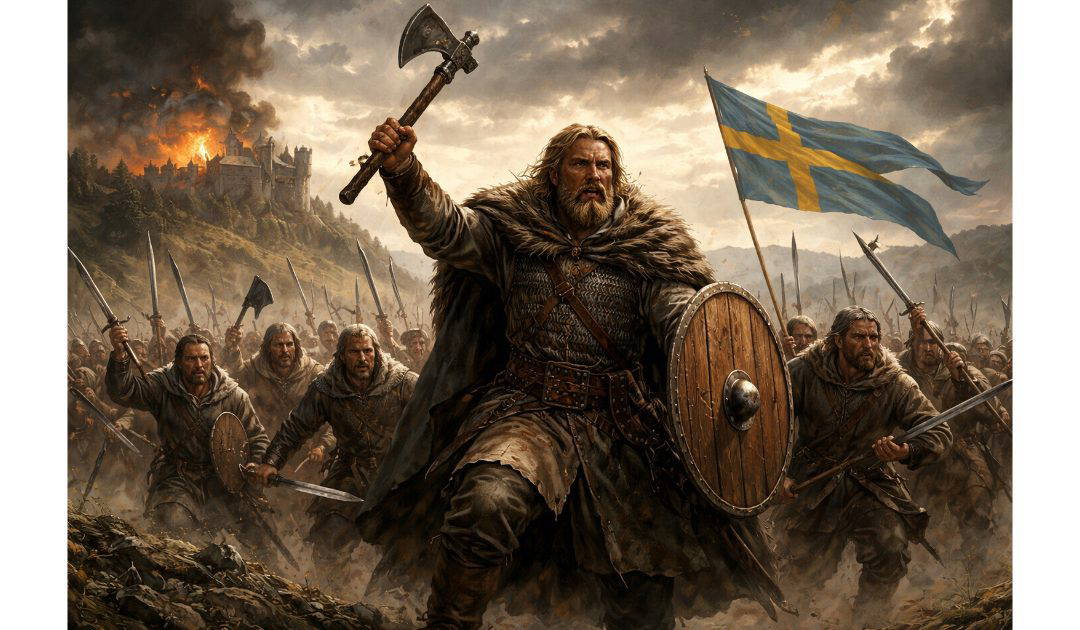
On the 4th of May, 1436, the Swedish rebel Engelbrekt Engelbrektsson was assassinated. My mother was a fan of Englebert Humperdink, but I know little about Englebrekt. I have posted about my Danish DNA, but I don’t have any from Sweden.
Engelbrekt Engelbrektsson was a Swedish nobleman, mine owner, and rebel leader whose uprising in the 1430s marked a decisive moment in Sweden’s struggle against Danish dominance within the Kalmar Union. Though his life was short—he was assassinated in 1436—his revolt reshaped Swedish politics and helped lay foundations for later independence movements.
Engelbrekt was born around 1390 in Bergslagen, the mining district of central Sweden. His family belonged to the lower nobility and had strong ties to the iron industry, which was vital to Sweden’s economy. The Bergslagen region was rich in iron ore, and its production was a key export within the Scandinavian kingdoms. Engelbrekt himself was a mine owner at Norberg and was deeply embedded in the economic life of the district. This background proved crucial, as the grievances that fueled his rebellion were closely connected to trade, taxation, and local governance.
At the time, Sweden was part of the Kalmar Union, formed in 1397 under Margaret I of Denmark. The Union united Denmark, Norway, and Sweden under a single monarch, but in practice Denmark often dominated. By the 1430s, the reigning king was Eric of Pomerania. His rule was widely resented in Sweden. Heavy taxation, interference by Danish officials, and economic disruptions caused by conflicts—particularly war with the Hanseatic League—created mounting dissatisfaction.
In Bergslagen, these tensions were acute. German and Danish bailiffs appointed by the crown were accused of corruption and harsh rule. Trade suffered, and the miners and peasants felt squeezed by taxes and arbitrary justice. Engelbrekt emerged as a spokesman for these grievances. In 1434, after complaints to the king went unanswered, he led an armed uprising. Castles symbolizing royal authority, such as Borganäs near Borlänge, were attacked and burned. The revolt spread rapidly across Sweden, gaining support not only from peasants and miners but also from segments of the nobility and clergy who were dissatisfied with Danish control.
Engelbrekt proved an effective and charismatic leader. He framed the rebellion not merely as a local protest but as a national cause: resistance against foreign oppression and the defense of Swedish law and custom. His movement gathered momentum, and by 1435 he had become the central figure in Swedish politics. That year, representatives of the four estates—nobility, clergy, burghers, and peasants—met in Arboga in what is often described as one of the earliest Swedish Riksdags. Engelbrekt was elected “rikshövitsman” (captain of the realm), effectively making him the kingdom’s military leader and chief executive in opposition to the king.
Although Eric of Pomerania was temporarily recognized again after negotiations, his authority remained fragile. Engelbrekt’s position symbolized a new assertion of Swedish political autonomy within the Union. Importantly, the rebellion demonstrated that broad segments of Swedish society—including peasants—could organize politically and demand accountability from rulers. This was unusual in medieval Europe and became a lasting feature of Swedish political culture.
However, Engelbrekt’s success also generated rivalries. Some members of the higher nobility were uneasy with his popularity and the social breadth of his support. Chief among his rivals was Karl Knutsson Bonde, a powerful nobleman who would later become king as Charles VIII of Sweden. Tensions grew between the factions, and Engelbrekt’s authority began to wane as noble opposition coalesced.
In 1436, while traveling to Stockholm to attend a council meeting, Engelbrekt was assassinated. He was killed on a small island in Lake Hjälmaren by Måns Bengtsson (Natt och Dag), a nobleman with ties to his political opponents. The murder shocked the country. Although Engelbrekt’s uprising did not immediately end the Kalmar Union, it weakened Danish control and emboldened Swedish resistance. Over the following decades, Sweden experienced intermittent conflict and shifting leadership, culminating in the eventual dissolution of the Union in the early sixteenth century under Gustav I of Sweden.
Engelbrekt’s legacy has endured in Swedish historical memory. He has often been portrayed as a proto-national hero, a defender of Swedish liberty against foreign domination. In the nineteenth century, during a period of romantic nationalism, he was celebrated as a symbol of popular resistance and constitutional tradition. Statues were erected in his honor, and his name became associated with early democratic impulses in Sweden.
Modern historians tend to adopt a more nuanced view. Engelbrekt was not a democrat in the modern sense, nor was his revolt purely nationalist; economic and regional grievances played a central role. Nevertheless, his ability to mobilize diverse social groups and challenge royal authority marked a turning point. The events of 1434–1436 showed that the Swedish political community could act collectively to defend its interests, setting precedents for later constitutional developments.