
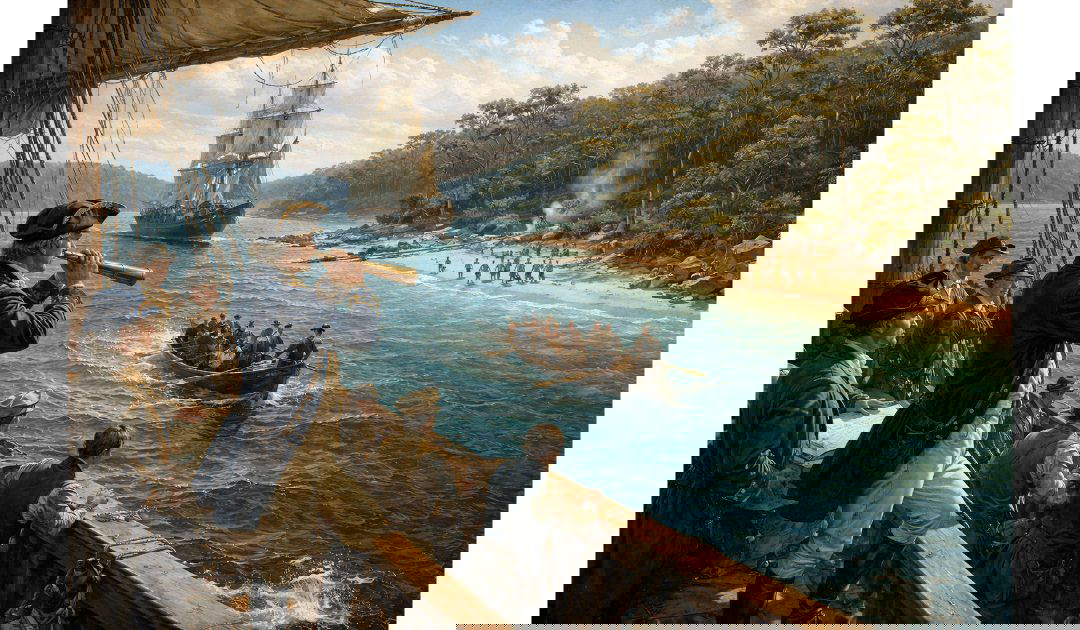
I can’t believe I haven’t written about James Cook before now. He got a brief mention in my post on Antarctica. Well, here goes then. On the 29th of April, 1770, Captain James Cook arrived in a bay on Australia’s south east coast which he named Botany Bay.
Cook was born in 1728 in Marton, Yorkshire, the son of a farm labourer. His modest origins make his later achievements all the more remarkable. Apprenticed initially to a shopkeeper, he soon turned to the sea, joining the merchant marine before volunteering for the Royal Navy in 1755 during the Seven Years’ War. Cook quickly distinguished himself as a skilled navigator and surveyor. His detailed charts of the St. Lawrence River during the British campaign against Quebec were instrumental in the capture of the city in 1759. Later, his surveys of the coasts of Newfoundland demonstrated an extraordinary precision that would become his hallmark. These accomplishments brought him to the attention of the Admiralty and the Royal Society.
Cook’s first great voyage was undertaken aboard the HMS Endeavour. Officially, the expedition’s purpose was scientific: to observe the transit of Venus from Tahiti in 1769, an event that would help astronomers calculate the distance between the Earth and the Sun. Secret instructions, however, directed Cook to search for the hypothesised southern continent, Terra Australis.
After completing the astronomical observations in Tahiti, Cook sailed south and west, circumnavigating New Zealand and proving that it consisted of two main islands rather than being part of a larger southern landmass. He then charted the eastern coast of Australia, landing at Botany Bay in April 1770 and later claiming the territory for Britain as New South Wales.
Cook’s charts of Australia’s east coast were extraordinarily accurate and remained in use for decades. His careful navigation through the treacherous waters of the Great Barrier Reef—despite nearly losing the Endeavour when it struck a reef—demonstrated both skill and determination.
Cook’s second voyage, aboard HMS Resolution, was designed to settle definitively the question of Terra Australis. This expedition pushed farther south than any previous European voyage, crossing the Antarctic Circle three times. Although Cook did not sight Antarctica itself, he proved that no great habitable southern continent existed in the temperate latitudes.
This voyage also showcased Cook’s innovations in maintaining crew health. He enforced strict hygiene and dietary measures, including the use of sauerkraut and other antiscorbutic foods, drastically reducing deaths from scurvy. His success in this regard marked a major advance in naval medicine and contributed to the effectiveness of long-distance sea travel.
Cook’s third voyage sought the elusive Northwest Passage—a sea route connecting the Atlantic and Pacific Oceans via the Arctic. Sailing again in the Resolution, accompanied by the Discovery, Cook explored the Pacific North West, charting the coasts of what are now Oregon, British Columbia, and Alaska with remarkable precision.
In 1778, Cook became the first European to record contact with the Hawaiian Islands, which he named the Sandwich Islands. Initially welcomed, he returned to Hawaii in early 1779 after damage to his ships forced repairs. Relations with the local population deteriorated, and tensions escalated.
On the 14th of February, 1779, during a confrontation at Kealakekua Bay, Cook was killed by Hawaiian islanders. His death shocked Britain and marked the end of an extraordinary career. His crew completed the voyage and returned home, carrying with them invaluable geographical data.
Cook’s impact on geography was immense. His voyages filled in vast blank spaces on European maps. He demonstrated that New Zealand was not part of a southern continent, mapped the eastern coast of Australia, clarified the geography of the Pacific islands, and charted the North American Pacific coast with unmatched accuracy.
Scientifically, his expeditions gathered botanical, zoological, and ethnographic information. Naturalists such as Joseph Banks, who sailed on the first voyage, collected thousands of plant specimens. Cook’s journals offered detailed observations of the cultures he encountered, though they were inevitably shaped by the assumptions of his era.
Yet Cook’s legacy is complex. While he is celebrated as a navigator and explorer, his voyages also opened the Pacific to intensified European colonisation. In Australia and New Zealand, his landfalls preceded profound and often devastating consequences for Indigenous populations. The spread of disease, displacement, and imperial expansion followed in the wake of exploration.