
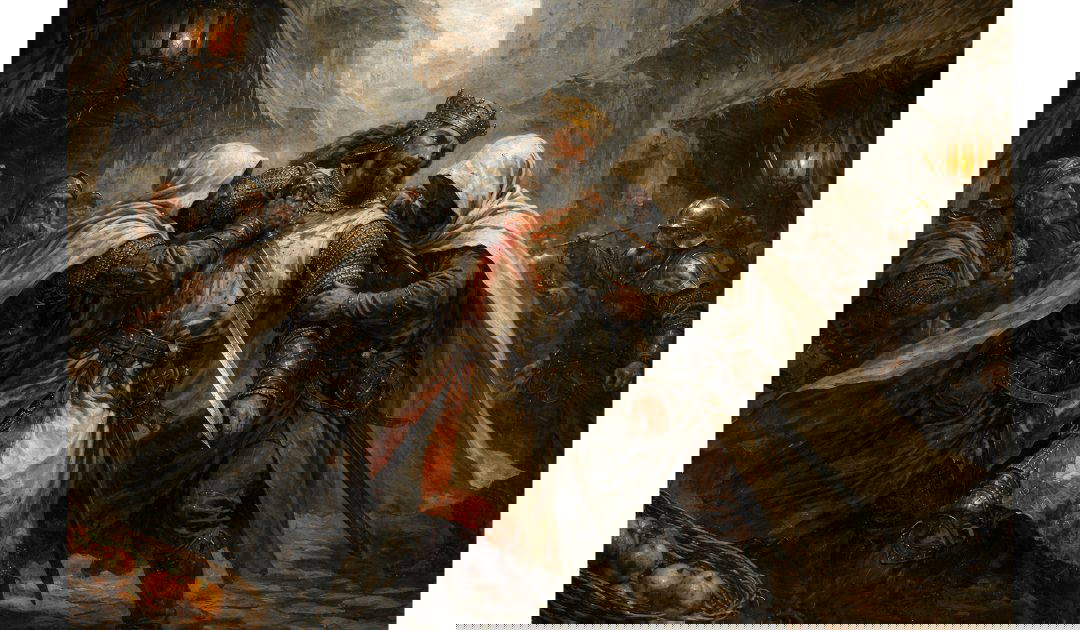
As a writer of historical fiction, the Sir Anthony Standen Adventures, I am interested in both history and words. My pick for today’s historical event is the assassination of Conrad of Montferrat, King of Jerusalem, on the 28th of April, 1192. The assassination was one of the most dramatic and mysterious episodes of the Third Crusade. Occurring in the city of Tyre, then a crucial stronghold of the crusader states, the murder removed a newly elected king at the very moment he stood poised to consolidate power in the Latin Kingdom of Jerusalem.
Conrad was a member of the powerful Italian noble house of Montferrat. He arrived in the Holy Land in 1187, shortly after the catastrophic crusader defeat at the Battle of Hattin and the capture of Jerusalem by Saladin. At a time when morale among the Franks was shattered, Conrad distinguished himself by successfully defending Tyre against Saladin’s forces. His leadership preserved one of the last significant coastal cities still in Christian hands and made him a central figure in the struggle to maintain a crusader foothold.
The politics of the Kingdom of Jerusalem were deeply divided. The reigning king, Guy of Lusignan, had been widely blamed for the disaster at Hattin. Conrad, by contrast, had proven his military competence and gained the support of many nobles. This rivalry split the crusader leadership, even as the Third Crusade—led by figures such as Richard I of England and Philip II of France—attempted to recover lost territories.
Initially, Richard supported Guy of Lusignan, while Philip backed Conrad. The dispute over the crown became entangled with broader rivalries between the English and French kings. After Philip returned to France in 1191, Richard remained in the East, still navigating the unstable politics of the crusader elite.
By early 1192, the balance of opinion had shifted decisively in Conrad’s favour. Many barons and leading figures concluded that Guy was no longer viable as king. In April 1192, Conrad was formally elected King of Jerusalem by the barons of the realm. His position seemed secure, and even Richard, who had long opposed him, accepted the outcome. Conrad’s marriage to Isabella of Jerusalem strengthened his claim, as she was the hereditary link to the royal line. Yet Conrad never had the opportunity to rule effectively. Within days of his election, he was dead.
On the 28th of April, 1192, Conrad was returning home from a meal at the residence of the Bishop of Beauvais in Tyre. As he walked through a narrow street, two men approached him. According to contemporary accounts, they had posed as monks or Christian pilgrims and had gained his confidence over several months.
Suddenly, the two attackers drew daggers and stabbed Conrad repeatedly. He was mortally wounded and died shortly thereafter. The assassins were immediately seized; one was killed on the spot, and the other reportedly confessed under interrogation before being executed.
The killers were widely identified as members of the Nizari Ismaili sect, known in Western sources as the Assassins. This group, operating from mountain fortresses in Syria and Persia, had developed a reputation for targeted political killings. Their involvement lent the murder an aura of calculated intrigue rather than spontaneous violence.
The most enduring question surrounding Conrad’s assassination is: who was responsible? Several theories circulated almost immediately. Some contemporaries suspected Richard I of England. Conrad had been Richard’s political rival, and the timing—so soon after his election—appeared suspicious. Richard’s enemies, especially in France, later used the accusation as propaganda. However, there is no conclusive evidence linking Richard directly to the plot.
Others speculated that Philip II of France might have been involved, though this seems less plausible given that Conrad had been his ally. A further possibility was Saladin, the Muslim leader opposing the crusaders. Yet Saladin had shown little inclination for covert murder, and his correspondence suggests surprise at the event.
The most credible explanation may be that the Assassins acted for their own strategic reasons. Conrad had been involved in regional politics affecting Muslim factions as well as Christian ones, and he may have antagonised the sect’s leadership. Still, absolute certainty remains elusive. The assassination remains one of the great unsolved political murders of the medieval world.
Conrad’s death plunged the kingdom into renewed uncertainty. His widow, Isabella, was pregnant at the time; their daughter, Maria of Montferrat, would later become queen. In the immediate aftermath, however, political necessity demanded swift action. Within days, Isabella married Henry of Champagne, a nephew of both Richard I and Philip II. This rapid remarriage stabilised the succession and avoided a potentially destructive power vacuum.
For Richard, Conrad’s death removed a troublesome rival and simplified negotiations. In September 1192, Richard concluded a treaty with Saladin that allowed Christian pilgrims access to Jerusalem while leaving the city under Muslim control.
The assassination of Conrad of Montferrat encapsulates the volatile blend of crusading idealism and ruthless realpolitik that characterised the Third Crusade. It demonstrated how deeply divided the crusader leadership had become and how fragile the political structures of the Latin East were.
Conrad’s career had been marked by resilience and military skill, especially in the defence of Tyre. His death deprived the kingdom of an energetic and capable ruler at a critical juncture. Whether orchestrated by rival monarchs, Muslim adversaries, or the Assassins acting independently, the murder reshaped the political landscape of the crusader states.
In the end, Conrad’s reign as King of Jerusalem lasted mere days. Yet his dramatic rise and violent death ensured that his story would remain one of the most compelling episodes of the crusading era—an event where ambition, factional rivalry, and clandestine violence intersected in a single fatal moment in the streets of Tyre.