
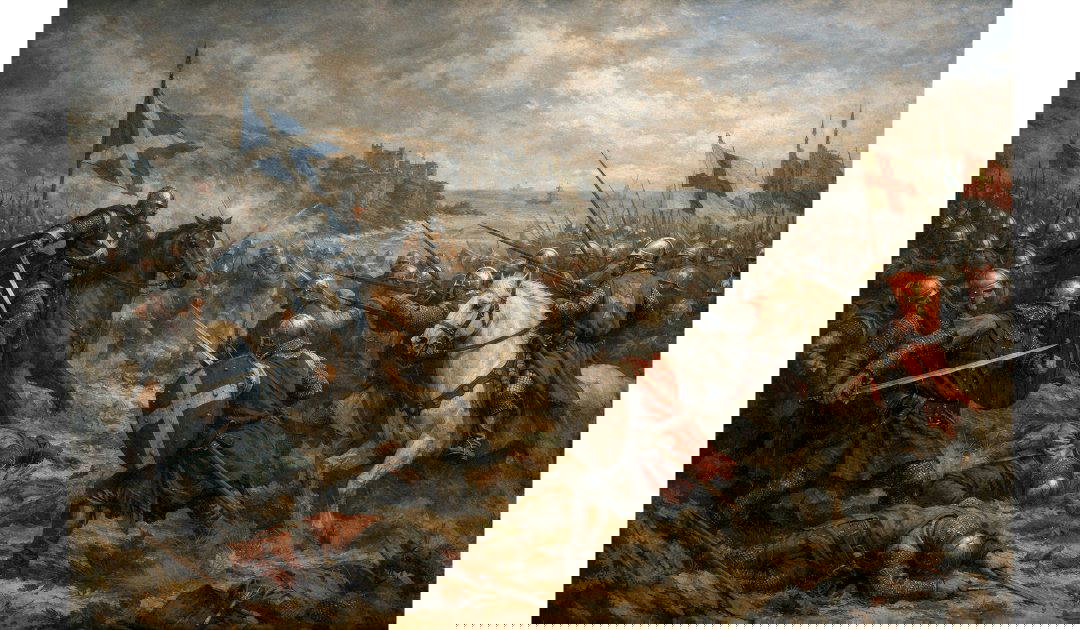
The Battle of Dunbar was fought on the 27th of April, 1296. It was one of the opening engagements of the First War of Scottish Independence and resulted in a decisive English victory. Though sometimes overshadowed by later battles such as Stirling Bridge and Bannockburn, Dunbar was a catastrophe for Scotland in the short term and marked the effective collapse of organised Scottish resistance in the early phase of the war.
The roots of the battle lay in the succession crisis following the death of Alexander III in 1286 and, soon after, his granddaughter and heir, Margaret, the “Maid of Norway.” With no direct successor, the Scottish nobility invited Edward I (Longshanks) to arbitrate among the claimants to the throne. Edward agreed—but only after asserting his overlordship over Scotland.
In 1292 Edward selected John Balliol as king. However, Edward treated Balliol as a vassal rather than an independent monarch, summoning him to English courts and demanding military service. Resentment among the Scottish political community grew. In 1295, the Scots formed an alliance with France—the “Auld Alliance”—in direct defiance of Edward. This act effectively declared political independence and prompted Edward to invade.
Edward moved swiftly and ruthlessly. In March 1296, he captured and brutally sacked Berwick-upon-Tweed, killing thousands. The massacre sent shockwaves across Scotland and demonstrated the seriousness of English intent. From Berwick, Edward advanced northwards.
The Scots, led by a faction of nobles including John Comyn, Earl of Buchan, assembled their forces to resist the English advance. The English army included experienced knights and infantry, many veterans of Edward’s campaigns in Wales. Crucially, Edward’s forces were disciplined and well organised.
Dunbar Castle, perched dramatically on a cliff overlooking the North Sea in what is now East Lothian, was held for the Scottish side by Patrick, Earl of March. The English laid siege to the castle, but a Scottish field army approached in an attempt to relieve it.
The decisive encounter occurred not directly beneath the castle walls but on rising ground nearby. According to contemporary chroniclers, the Scots occupied a strong defensive position on a hill. However, confusion and misjudgment played a fatal role. Seeing part of the English army manoeuvring, the Scots believed their opponents were retreating. In reality, the English were repositioning.
The Scottish forces descended from their advantageous ground to attack. This move proved disastrous. Once on lower terrain and disordered in their advance, they were met by a well-timed English counterattack. English heavy cavalry charged with devastating effect, breaking the Scottish lines. What might have been a stalemate on high ground became a rout in the open field.
The battle was short and brutal. Many Scottish nobles were captured rather than killed—valuable prisoners who could be ransomed or politically neutralised. English losses appear to have been minimal in comparison.
The defeat at Dunbar effectively shattered organised Scottish resistance in 1296. With much of the nobility captured, there was little capacity for coordinated opposition. Within weeks, Edward advanced north, accepting submissions from towns and nobles. In July 1296, at Montrose and later at Brechin, many leading Scots formally acknowledged Edward’s authority.
King John Balliol himself was forced to abdicate in July 1296. Edward stripped him of his royal insignia and, in a symbolic act of humiliation, removed the Stone of Scone—the traditional coronation stone of Scottish kings—to Westminster Abbey. Balliol was taken into English custody, and Scotland was placed under direct English administration.
The scale of the political collapse following Dunbar cannot be overstated. For a time, Scotland ceased to function as an independent kingdom.
Although Dunbar was a crushing defeat, it did not end Scottish resistance permanently. Instead, it created the conditions for a new phase of rebellion. By 1297, figures such as William Wallace and Andrew Moray would lead uprisings that culminated in the Scottish victory at the Battle of Stirling Bridge.
In this sense, Dunbar marks both an end and a beginning: the end of aristocratic-led resistance under Balliol, and the beginning of a more popular and regional insurgency. It also revealed Edward I’s determination to dominate Scotland fully rather than merely influence it.
Strategically, Dunbar demonstrated the superiority of English military organisation and cavalry tactics when facing poorly coordinated opposition. Politically, it showed how fragile Scotland’s unity was in the face of external pressure and internal factionalism.
The Battle of Dunbar in 1296 was a decisive early victory for Edward I and a devastating blow to Scottish independence. It led directly to the temporary collapse of the Scottish monarchy and English occupation. Yet it also sowed the seeds of a longer, more determined struggle that would define the next three decades of British history. Though less celebrated than later Scottish triumphs, Dunbar was a pivotal moment in the Wars of Scottish Independence—a battle whose consequences echoed far beyond the field on which it was fought.