
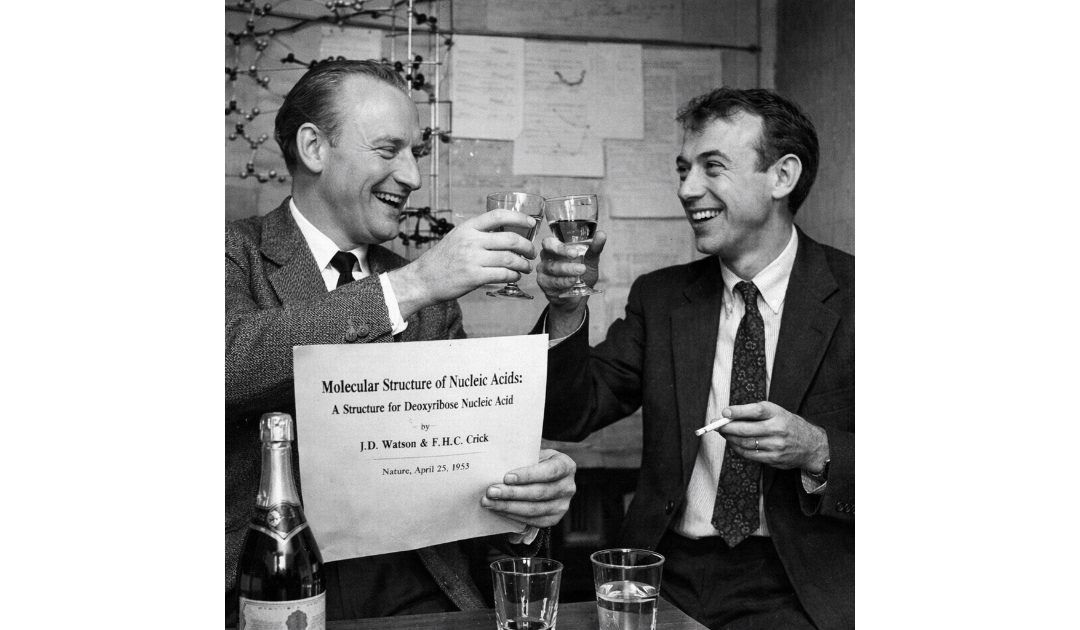
On the 25th of April, 1953, Francis Crick and James Watson published Molecular Structure of Nucleic Acids: A Structure for Deoxyribose Nucleic Acid. I have written before about DNA, but not its discovery.
The discovery of DNA as the molecule of heredity was not a single dramatic moment but a long, cumulative process stretching over nearly a century. It involved chemists, biologists, physicists and crystallographers, each adding a crucial piece to a puzzle that ultimately transformed biology and medicine.
The story begins in 1869 with a young Swiss physician, Friedrich Miescher. Working in a laboratory in Tübingen, he examined pus cells collected from surgical bandages. From the nuclei of these cells he isolated a strange, phosphorus-rich substance unlike proteins, which were then considered the likely carriers of heredity. Miescher called this material “nuclein.” Although he did not understand its function, he had in fact discovered DNA. For decades, however, nuclein attracted limited attention. Most scientists believed that proteins—with their complexity and variety—were far better candidates for genetic material than a molecule thought to be relatively simple and repetitive.
In the early 20th century, research on chromosomes began to clarify that heredity was associated with structures in the cell nucleus. By the 1920s, DNA was known to be a component of chromosomes, but its importance remained uncertain. The turning point came in 1928 with British bacteriologist Frederick Griffith. Studying pneumonia-causing bacteria (Streptococcus pneumoniae), Griffith observed a phenomenon he called “transformation.” When he mixed harmless bacteria with heat-killed virulent bacteria, the harmless ones became deadly. Something from the dead bacteria had transformed the living ones. Griffith did not know what this “transforming principle” was, but his experiment suggested that hereditary information could be transferred chemically.
The identity of that transforming principle was revealed in 1944 by Oswald Avery, Colin MacLeod and Maclyn McCarty at the Rockefeller Institute in New York. Through painstaking biochemical experiments, they demonstrated that DNA—not protein—was responsible for transformation. By systematically destroying proteins, RNA and DNA in bacterial extracts, they showed that only the destruction of DNA prevented transformation. Their conclusion was revolutionary: DNA carried genetic information. Yet skepticism remained. Many scientists still found it difficult to believe that a molecule composed of just four building blocks could encode life’s diversity.
Further evidence came in 1952 from Alfred Hershey and Martha Chase. Using bacteriophages—viruses that infect bacteria—they labeled viral DNA with radioactive phosphorus and viral protein with radioactive sulfur. When the viruses infected bacteria, only the DNA entered the cells and directed the production of new viruses. This elegant experiment strongly confirmed that DNA was the hereditary material.
At the same time, understanding DNA’s structure became the central challenge. In the late 1940s, Austrian-born biochemist Erwin Chargaff made a key discovery. By analyzing DNA from various species, he found that the amount of adenine (A) always equaled thymine (T), and the amount of guanine (G) equaled cytosine (C). These “Chargaff’s rules” suggested specific pairing relationships between bases.
Equally crucial was the work of Rosalind Franklin and Maurice Wilkins at King’s College London. Using X-ray diffraction, Franklin produced remarkably clear images of DNA fibers, including the famous “Photograph 51.” Her data indicated that DNA had a helical structure with specific dimensions. Franklin’s precise measurements were essential to solving the structure, though her contribution was not fully recognized at the time.
In 1953, at the Cavendish Laboratory in Cambridge, James Watson and Francis Crick synthesized these disparate findings into a coherent model. Drawing on Chargaff’s rules and Franklin’s X-ray data (shown to Watson without her direct permission), they proposed the double helix structure of DNA. In their model, two strands wound around each other, with sugar-phosphate backbones on the outside and paired bases (A with T, G with C) forming the rungs of the helix. This arrangement immediately suggested a mechanism for replication: each strand could serve as a template for a new complementary strand.
Their landmark paper, published in Nature on the 25th of April, 1953, was strikingly brief. It ended with a modest understatement: “It has not escaped our notice that the specific pairing we have postulated immediately suggests a possible copying mechanism for the genetic material.” With that insight, the molecular basis of heredity was revealed.
In 1962, Watson, Crick and Wilkins were awarded the Nobel Prize in Physiology or Medicine. Rosalind Franklin had died of cancer in 1958 at the age of 37 and was ineligible for the prize, which is not awarded posthumously. In subsequent decades, her pivotal role has been widely acknowledged.
The discovery of DNA’s structure ushered in the era of molecular biology. It led to the cracking of the genetic code in the 1960s, the development of recombinant DNA technology in the 1970s, and ultimately to genome sequencing, genetic engineering and modern biotechnology. Today, DNA analysis underpins fields from medicine and forensic science to evolutionary biology.
What began with Miescher’s extraction of an obscure substance from pus cells culminated in one of the most profound scientific revelations of the twentieth century: the realization that life’s instructions are written in a simple yet elegant molecular script.