
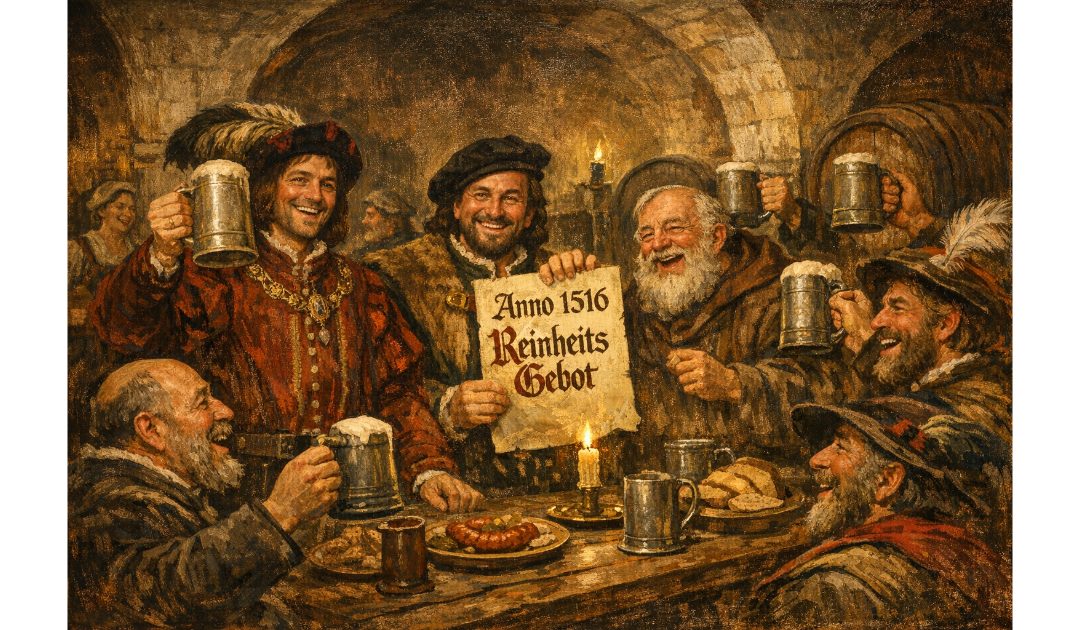
I like a beer or two, or three. On the 23rd of April, 1516, the Munich Reinheitsgebot, which specifies the ingredients in beer, came into effect in all Bavaria.
The Munich Reinheitsgebot of 1516, often called the Bavarian Beer Purity Law, is one of the most famous food and drink regulations in history. Proclaimed in the city of Ingolstadt (then part of the Duchy of Bavaria), it was issued jointly by Duke Wilhelm IV and his brother Duke Ludwig X. Although later romanticised as a noble attempt to preserve the quality of beer, the law was in fact a pragmatic response to economic pressures, public health concerns, and the need for political and social order in a rapidly changing early-modern society.
At its core, the decree was simple. It stated that beer could be brewed only from three ingredients: water, barley, and hops. (Yeast was not mentioned because its role in fermentation was not yet scientifically understood.) Brewers who violated the law would have their beer confiscated and face fines. The measure applied across Bavaria and gradually became a defining feature of Bavarian brewing.
By the early sixteenth century, beer was not merely a leisure drink. It was a staple of everyday life, consumed by rich and poor alike, often safer to drink than contaminated water. As a result, brewing was widespread, lucrative, and only loosely regulated. Many brewers added a bewildering variety of ingredients to their beer: herbs, roots, spices, soot, resin, and even toxic substances. Some of these additions were intended to improve flavour or prolong shelf life; others were used to increase intoxication cheaply. The result was highly inconsistent quality and occasional serious illness.
There were three main problems that the Bavarian authorities sought to address.
First, public health. The use of questionable and sometimes poisonous additives in beer was causing harm. By restricting ingredients to water, barley, and hops, the authorities could reduce the risk of dangerous brewing practices.
Second, economic control of grain. Wheat and rye were essential for bread, the primary food of the population. In times of poor harvests, brewers competing for these grains drove up prices, threatening food security and provoking unrest. By mandating that only barley be used for brewing, the dukes ensured that wheat and rye remained available and affordable for bakers and the general populace.
Third, taxation and governance. Beer was an important source of revenue through taxation and licensing. Standardising ingredients made beer easier to regulate, price, and tax. It also reinforced ducal authority over a key industry, bringing brewing under clearer legal oversight. Thus, the Reinheitsgebot was as much an economic and political measure as it was a quality control law.
In the short term, the law stabilised both brewing practices and grain markets in Bavaria. Brewers were compelled to adopt more consistent methods, which improved the overall reliability and safety of beer. It reduced the misuse of bread grains, helping to secure the food supply in a period when famine was a genuine fear.
In the longer term, the law became a powerful cultural marker. Bavarian beer acquired a reputation for purity and reliability. Over the centuries, this reputation spread beyond Bavaria, especially as Bavarian brewing methods influenced wider German practice.
The law also had unexpected technical consequences. Restricting ingredients encouraged brewers to refine techniques of malting barley and managing fermentation. Although yeast was not mentioned, brewers became increasingly skilled at maintaining consistent fermentation cultures. This helped lay foundations for the later scientific study of brewing in the nineteenth century, particularly in Bavaria.
By the nineteenth century, the Reinheitsgebot was adopted more widely across the German states and, after German unification in 1871, became part of national brewing identity. It remained influential in German law until European Union regulations in the late twentieth century required more flexibility in ingredient use for imported beers. Even so, many German brewers voluntarily continue to follow it as a mark of tradition and quality.
The law was issued by Duke Wilhelm IV of Bavaria (1493–1550) and his brother Duke Ludwig X (1495–1545). Wilhelm IV, in particular, is closely associated with the decree. He was an able administrator who sought to strengthen ducal authority and promote order in his territories. The proclamation formed part of a broader set of regulations concerning market prices, food supply, and economic governance.
Behind the dukes stood a network of advisers, legal scholars, and municipal authorities. Brewing guilds, city councils, and market inspectors all played roles in enforcing the new rules. Brewers themselves were both subjects of the law and participants in its evolution; over time, they adapted techniques to comply while maintaining profitability.
The law also reflects the concerns of bakers and consumers, whose interests were indirectly protected. By reserving wheat and rye for bread, the authorities addressed complaints from bakers and the urban poor, who were vulnerable to rising grain prices.
Although originally a practical regulation, the Munich Reinheitsgebot became a symbol of German brewing tradition. Its endurance for over 500 years is remarkable. What began as a ducal ordinance aimed at preventing adulteration, securing food supplies, and improving governance evolved into a cultural emblem celebrated by brewers and drinkers alike.
Today, the Reinheitsgebot is often invoked in marketing and in celebrations such as German Beer Day on 23 April. It represents not only a historical legal code but also the idea that beer can be defined by simplicity, quality, and respect for tradition.