
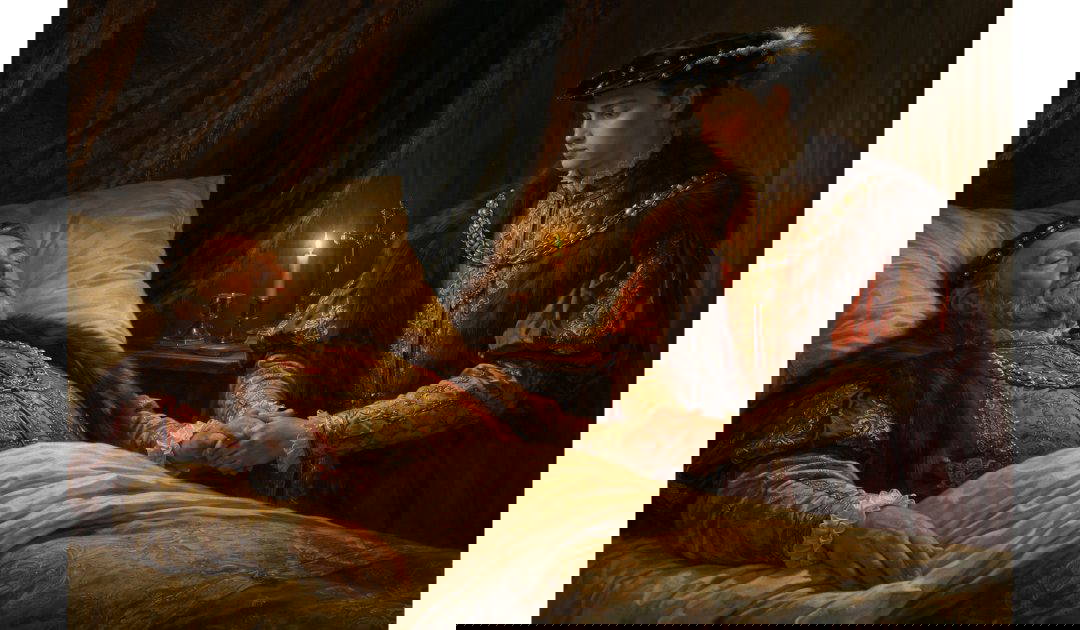
On the 21st of April, 1509, King Henry VII, or Henry Tudor, died and Henry VIII became king. I have written about Henry VIII but I don’t think I have written about Henry VII. That’s a poor omission because he founded the Tudor dynasty through which my ancestor, Sir Anthony Standen, lived and spied.
Henry was born on the 28th of January, 1457, at Pembroke Castle in Wales. His claim to the English throne was distant and, in strict hereditary terms, weak. It came through his mother, Lady Margaret Beaufort, a descendant of John of Gaunt, son of Edward III. The Beaufort line, however, had been declared illegitimate, though later legitimised, and explicitly barred from succession. Henry’s father, Edmund Tudor, Earl of Richmond, died before Henry was born. Thus, from infancy, Henry’s fortunes depended on the shifting allegiances of powerful men during the dynastic struggle between the houses of Lancaster and York.
After the Yorkist victory and the accession of Edward IV in 1461, Henry’s prospects darkened. As a Lancastrian claimant, he was a potential threat. He spent much of his youth in exile in Brittany and later in France, effectively a political refugee. During these years, he was educated in the arts of diplomacy, patience, and survival. He learned to conceal his intentions and to wait for opportunity—qualities that would later define his kingship.
That opportunity came in 1485. England was weary after decades of civil conflict, and Richard III, who had seized the throne in 1483, faced growing opposition. Henry, backed by French support and disaffected English nobles, landed in Wales in August 1485. Gathering support as he marched east, he confronted Richard at the Battle of Bosworth Field on the 22nd of August. Richard was killed in the fighting, and Henry was proclaimed king on the battlefield. He dated his reign from the day before the battle, a shrewd legal device that allowed him to treat Richard’s supporters as traitors.
One of Henry’s first and most significant acts was to marry Elizabeth of York, daughter of Edward IV. This union symbolically and politically united the rival houses of Lancaster and York, embodied in the Tudor rose. It strengthened his claim and helped to reconcile a divided kingdom.
Henry’s early reign was not secure. Pretenders emerged, most notably Lambert Simnel and Perkin Warbeck, who claimed to be Yorkist princes. Both gained foreign backing and domestic support. Henry dealt with these threats firmly but pragmatically. Simnel, after defeat, was spared and put to work in the royal kitchens; Warbeck, after repeated attempts and escapes, was eventually executed. These episodes underscored how precarious Henry’s position remained and reinforced his determination to eliminate overmighty subjects and rival claimants.
Central to Henry’s rule was the restoration of royal authority and financial stability. The crown had been weakened by years of war and baronial independence. Henry worked tirelessly to reverse this. He revived and extended the use of bonds and recognisances—legal agreements that compelled nobles to guarantee good behaviour with heavy financial penalties. This policy curbed private armies and reduced the power of the nobility.
Henry was also an astute financial manager. He improved the efficiency of royal revenue collection, revived feudal dues, and ensured that taxes, customs, and fines were carefully gathered. He preferred to manage finances through the Chamber system, which allowed closer royal supervision than the traditional Exchequer. By the end of his reign, he had accumulated a substantial surplus, providing his successors with financial security.
In foreign policy, Henry avoided costly wars. His aim was recognition and security rather than glory. Through diplomacy and marriage alliances, he strengthened England’s position. His eldest son, Arthur, married Catherine of Aragon, linking England with Spain. After Arthur’s death, Catherine would later marry Henry’s second son, the future Henry VIII. His daughter Margaret married James IV of Scotland, a union that would eventually lead to the union of the English and Scottish crowns in 1603. Another daughter, Mary, later married the king of France.
Henry also secured peace with France through the Treaty of Étaples (1492), which provided him with a pension, and with Scotland through the Treaty of Ayton (1497). These agreements reduced the likelihood of foreign support for domestic rebels.
Despite his achievements, Henry’s reign was marked by suspicion and caution. He trusted few and relied heavily on a small group of loyal administrators, many of whom were not from the high nobility but from the gentry or legal professions. Men such as Sir Reginald Bray and Edmund Dudley were key figures in his government. His methods, particularly his financial exactions, made him unpopular in some quarters and contributed to a reputation for avarice.
Personally, Henry was reserved, intelligent, and deeply private. The death of his eldest son Arthur in 1502 and his queen Elizabeth in 1503 affected him profoundly, making him even more withdrawn. In his later years, he became increasingly suspicious and harsh in his enforcement of financial policies.
Henry VII died on 21 April 1509 at Richmond Palace. He left to his son, Henry VIII, a stable kingdom, a full treasury, and a strengthened monarchy. Though lacking the glamour of his son’s reign, Henry VII’s achievement was arguably greater. He ended civil war, established a new dynasty, and laid the foundations of Tudor power through prudence, patience, and political skill. His reign marked the transition from medieval instability to early modern statecraft, ensuring that the Tudor name would dominate English history for more than a century.