
Belgium was the last country Claire and I visited on our Interrail trip last spring. In Brussels I posted about a connection between Sir Anthony Standen and Snow White. The fact is that when Sir Anthony was caught by the Don John, Duke of Austria, in an inappropriate relationship with John’s mother, Barbara von Blomberg in Brussels, Belgium didn’t exist as a country.
In antiquity, the area that is now Belgium was inhabited by Celtic and Germanic tribes known collectively as the Belgae. Julius Caesar conquered the region in the first century BC, incorporating it into the Roman province of Gallia Belgica. Roman rule brought roads, towns, trade, and Latin culture, particularly in the southern parts of the region. When the Western Roman Empire declined in the fifth century, Germanic Franks settled in the area, laying the foundations for the linguistic divide that still exists today: Romance speech in the south (Wallonia) and Germanic speech in the north (Flanders).
During the early Middle Ages, the territory became part of the Frankish Kingdom and later the Carolingian Empire of Charlemagne. After the empire fragmented in the ninth century, the region was divided between the Kingdom of France and the Holy Roman Empire. Over time, it splintered into numerous feudal states and counties, including Flanders, Brabant, Hainaut, and Liège. These territories developed into some of the wealthiest and most urbanised parts of medieval Europe. Cities such as Bruges, Ghent, and Antwerp thrived on the cloth trade, banking, and commerce, linking northern Europe with Mediterranean markets.
In the 14th and 15th centuries, many of these territories came under the rule of the Dukes of Burgundy. The Burgundian Netherlands unified much of the region for the first time and fostered a remarkable flowering of art and culture, seen in the works of Jan van Eyck and other Flemish masters. When the Burgundian line ended, the lands passed through marriage to the Habsburgs, becoming part of the vast empire of Charles V in the 16th century.
Under Spanish Habsburg rule, the region was drawn into the religious and political turmoil of the Reformation. Protestant ideas spread rapidly, particularly in the northern provinces. The harsh response of the Spanish authorities triggered the Dutch Revolt in 1568. This conflict led to the division of the Low Countries: the northern provinces formed the independent Dutch Republic, while the southern provinces—roughly modern Belgium—remained under Spanish control and became known as the Spanish Netherlands. This split entrenched the religious divide, with the south remaining predominantly Catholic.
In the early 18th century, after the War of the Spanish Succession, the region passed to the Austrian branch of the Habsburgs and became the Austrian Netherlands. Though relatively peaceful, the area was still a pawn in great-power politics. In 1794, French revolutionary armies invaded and annexed the territory, introducing French laws, secularism, and administrative reforms that would have lasting effects.
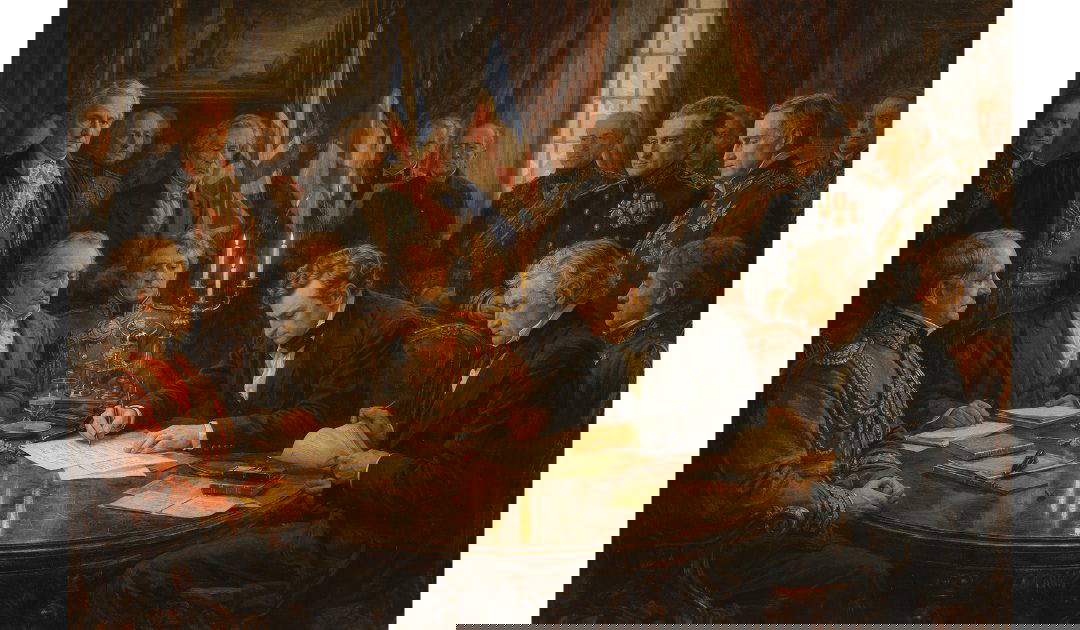
After Napoleon’s defeat in 1815, the Congress of Vienna created the United Kingdom of the Netherlands, uniting the former Dutch Republic with the southern provinces to form a buffer state against France. However, deep religious, cultural, and economic differences between the Protestant north and Catholic south led to growing tensions. In 1830, inspired by revolutionary movements elsewhere in Europe, an uprising in Brussels led to the Belgian Revolution. Belgium declared independence and, in 1831, became a constitutional monarchy under King Leopold I. On the 19th of April, 1839, the Treaty of London established Belgium as a Kingdon and guaranteed its neutrality.
The new state faced challenges in forging unity among its French-speaking elite and Dutch-speaking population. French dominated politics, education, and culture for much of the 19th century, even in Flemish areas. Meanwhile, Belgium became one of the first countries on the European continent to industrialise, particularly in coal, steel, and textiles. Cities like Liège and Charleroi became industrial powerhouses.
In the late 19th century, King Leopold II embarked on a controversial colonial venture. He personally acquired the Congo Free State in central Africa, ruling it as his private possession. The regime became notorious for brutality and exploitation. International outrage eventually forced the Belgian government to take over the territory in 1908, creating the Belgian Congo.
Belgium’s strategic location made it a key battlefield in both World Wars. In 1914, Germany invaded Belgium as part of its plan to attack France, violating Belgian neutrality. The invasion brought devastation and international sympathy. Again in 1940, German forces swept through Belgium during the Second World War, leading to occupation until liberation in 1944. These wars left deep scars but also reinforced Belgium’s importance in European affairs.
After 1945, Belgium became a founding member of key international organisations, including NATO and the European Economic Community, the forerunner of the European Union. Brussels emerged as a major centre of European governance.
Domestically, the 20th century saw increasing tensions between the Dutch-speaking Flemish community and the French-speaking Walloons. Language disputes, economic differences, and political movements led to a gradual transformation of Belgium from a unitary state into a complex federal system. Today, Belgium is divided into regions and communities with significant autonomy, reflecting its dual cultural heritage.
In the late 20th and early 21st centuries, Belgium has been known for political complexity, sometimes taking many months to form governments, yet maintaining stability and prosperity. It remains a constitutional monarchy, a centre of European diplomacy, and a country defined by diversity.
Belgium’s history is one of continual negotiation between larger powers and internal differences. From Roman province to medieval trading hub, from Habsburg possession to independent nation, and from battleground to European capital, Belgium’s past reflects its unique position at the heart of Europe.