
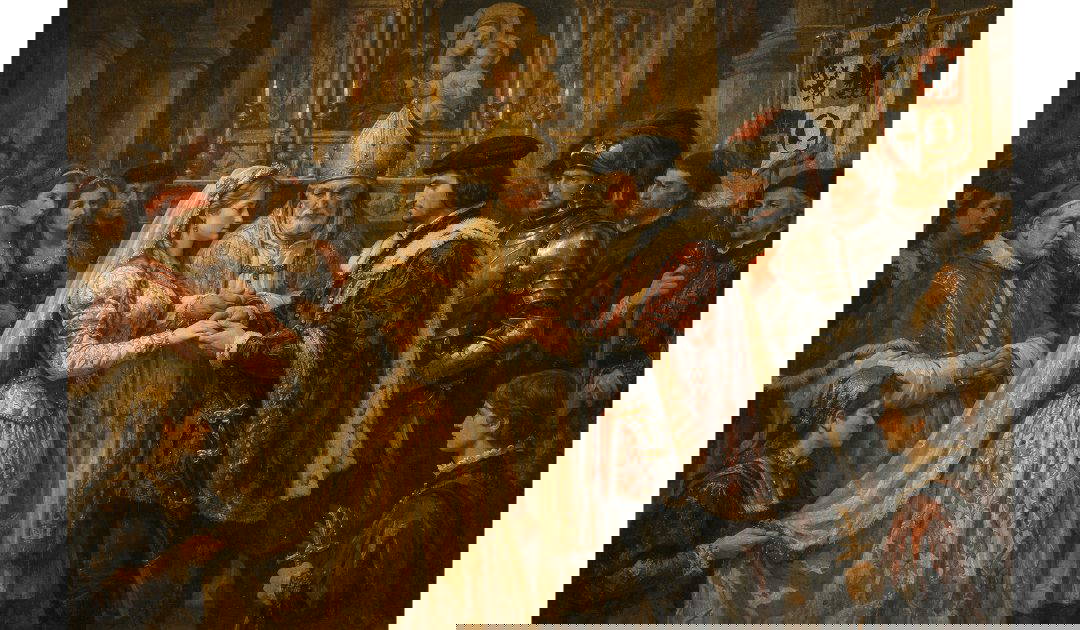
Lucrezia Borgia was born on the 18th of April, 1480, in Subiaco near Rome. I don’t know much about Lucrezia Borgia other than she was supposed to be rather inclined to poisoning. She predates Sir Anthony Standen so I haven’t previously researched her.
She was the illegitimate daughter of the Spanish cardinal Rodrigo Borgia and his long-term mistress Vannozza dei Cattanei. Rodrigo, who would later become Pope Alexander VI, acknowledged his children openly, an unusual but not unheard-of practice among Renaissance clerics of high rank. Lucrezia grew up in Rome in an atmosphere of privilege, education, and political calculation. She received a refined education for a woman of her time, learning languages, music, poetry, and courtly manners, preparing her not for a quiet domestic life but for a role in her father’s diplomatic strategies.
In 1492 Rodrigo Borgia became Pope Alexander VI, and Lucrezia’s importance increased overnight. The Borgias, as a Spanish family ruling in Italy, needed alliances among the fractious Italian states. Lucrezia, still a teenager, became a key instrument of this policy. In 1493, at the age of thirteen, she married Giovanni Sforza, Lord of Pesaro and a member of the ruling family of Milan. The marriage was purely political, designed to cement ties between the papacy and the Sforza.
When the alliance with Milan ceased to be useful, the marriage became inconvenient. In 1497 the Borgias sought an annulment, claiming the marriage had never been consummated. Giovanni Sforza, humiliated and under pressure, eventually agreed but retaliated by spreading scandalous rumours that Lucrezia had an incestuous relationship with her father and brother Cesare. These allegations, entirely unsupported by evidence, became the seed of the dark legend that would cling to her for centuries.
Shortly after the annulment, Lucrezia bore a child, Giovanni, known as the Infans Romanus. His parentage was never publicly clarified. Some claimed he was Cesare’s son, others the pope’s, and some believed he was Lucrezia’s illegitimate child. In fact, documentary evidence suggests he was probably an illegitimate son of Alexander VI, whom Lucrezia helped raise. The episode added to the air of mystery surrounding her.
In 1498 Lucrezia was married again, this time to Alfonso of Aragon, Duke of Bisceglie, an illegitimate son of the King of Naples. This alliance suited papal interests as France and Spain competed for influence in Italy. By this time, Cesare Borgia had begun his ruthless campaign to carve out territories in central Italy. When political winds shifted again and Naples became an obstacle rather than an ally, Alfonso became expendable. In 1500 he was attacked on the steps of St Peter’s and later strangled in his bed by men widely believed to be acting on Cesare’s orders. Lucrezia reportedly nursed him devotedly before his murder, suggesting she had developed genuine affection for him.
Her third and final marriage, in 1502, proved very different. She married Alfonso d’Este, heir to the Duchy of Ferrara. Now Ferrera is a location in Fire and Earth, the second book in the Sir Anthony Standen Adventures. The Este family were initially reluctant to accept a Borgia bride because of her reputation, but the alliance went ahead after heavy negotiation. Lucrezia moved to Ferrara and began a new phase of her life, one that would define her historical legacy far more than the intrigues of Rome.
As Duchess of Ferrara, Lucrezia demonstrated administrative skill, cultural refinement, and personal dignity. She quickly won the respect of the Ferrarese court and people. She acted as regent during her husband’s absences, governed competently, and patronised poets, artists, and scholars. Among those drawn to her court was the poet Pietro Bembo, with whom she exchanged famous, affectionate letters that reveal her intelligence and emotional depth.
The fall of the Borgias after her father’s death in 1503 could have ruined her, but by then Lucrezia had firmly established herself in Ferrara, separate from her family’s political fortunes. Cesare’s downfall and eventual death in Spain in 1507 removed the last shadow of her earlier life. In Ferrara she became known for her piety, charity, and patronage. She founded convents, supported religious houses, and lived with increasing devotion.
Lucrezia bore several children to Alfonso d’Este, securing the succession of the duchy. Her later years were marked by repeated pregnancies and declining health. In 1519, after giving birth to a stillborn daughter, she developed a fever and died on 24 June at the age of thirty-nine. She was buried in the convent of Corpus Domini in Ferrara, where she had often worshipped.
The sensational image of Lucrezia as a poisoner and seductress owes far more to political propaganda and later romantic imagination than to historical fact. Her enemies found it convenient to blacken the Borgia name, and writers of later centuries embellished the tales. In reality, Lucrezia was a woman used by the men around her for political ends, who nevertheless carved out a respected role for herself as a Renaissance duchess, administrator, and patron of culture.
Her life illustrates both the brutality and the sophistication of Renaissance Italy. She was born into scandal, married for strategy, surrounded by intrigue, yet ended as a symbol of grace and learning. Lucrezia Borgia remains a compelling figure not because she was a villain, but because she survived the most notorious family of her age and emerged with her reputation, at least among those who knew her, largely restored.