
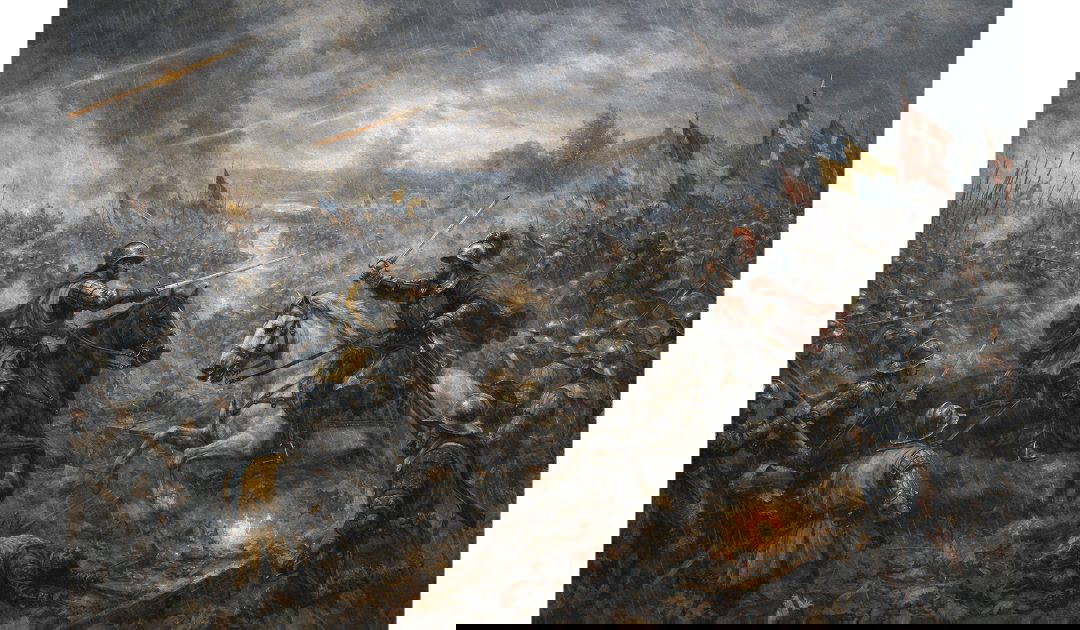
The Battle of Rain was fought on the 15th of April, 1632. I have written about the Miracle of the Rain so let’s delve into the Battle of Rain. Rain is a town in the Donau-Ries district, in Bavaria, Germany. It is situated on the river Lech, close to its confluence with the Danube, 11 km east of Donauwörth. The Battle of Rain was a significant engagement in the Thirty Years’ War and marked a major turning point in the Swedish campaign in southern Germany. It was here that King Gustavus Adolphus of Sweden outmanoeuvred and defeated the veteran Imperial commander Count Johann Tserclaes von Tilly, opening the road into Bavaria and fatally wounding one of the Holy Roman Empire’s most experienced generals.
By 1632, the Thirty Years’ War had already raged for fourteen years. What had begun in 1618 as a Bohemian revolt against Habsburg authority had expanded into a continent-wide conflict involving religious, dynastic, and political rivalries. The Swedish intervention in 1630, led personally by Gustavus Adolphus, had dramatically altered the balance of the war. After his decisive victory at the Battle of Breitenfeld in September 1631, the first major Protestant triumph of the conflict, Gustavus had marched his army across Germany, steadily dismantling Imperial control over central territories.
In early 1632, Gustavus turned his attention southwards toward Bavaria, the heartland of the Catholic League and the base of power for Maximilian I, Elector of Bavaria. The Catholic League’s army, under the command of Count Tilly, had been forced onto the defensive after Breitenfeld but still remained a formidable force. Tilly sought to block the Swedish advance by holding the line of the River Lech, a natural defensive barrier east of Augsburg. The town of Rain, situated near a key crossing point, became the focal point of this defensive effort.
Tilly’s strategy was straightforward. He entrenched his forces on the eastern bank of the Lech, fortifying the high ground overlooking the river. Earthworks, artillery placements, and field fortifications made any direct crossing extremely dangerous. The river itself, swollen by spring rains, was difficult to ford. Tilly believed that Gustavus would either be forced into a costly frontal assault or be unable to cross at all.
Gustavus Adolphus, however, was renowned for his tactical flexibility and innovative use of artillery and engineering. Arriving at the Lech in mid-April, he carefully reconnoitred the Imperial positions. Rather than attempt an immediate crossing, he began a deliberate artillery bombardment of Tilly’s entrenchments from the opposite bank. Swedish guns, lighter and more mobile than their Imperial counterparts, were brought forward and concentrated on specific targets, harassing the defenders and masking Swedish preparations.
At the same time, Swedish engineers and soldiers began constructing a pontoon bridge under cover of this artillery fire. Fascines and gabions were used to shield the workers from enemy shot. The bombardment was so intense and persistent that it prevented Tilly from effectively interfering with the bridge-building. For hours, Swedish guns raked the Imperial lines, while smoke and confusion obscured the true extent of Swedish activity.
On the 15th of April, the Swedes launched their crossing. A vanguard of infantry crossed first, establishing a foothold on the eastern bank. Gustavus personally supervised the operation, directing reinforcements across as soon as the bridge could support them. Despite heavy fire from the Imperial side, the Swedish troops maintained discipline and cohesion. Once sufficient numbers had crossed, they began to advance uphill against the Imperial positions.
The fighting that followed was fierce but relatively brief. The Swedish troops, hardened by previous campaigns and well-drilled in coordinated infantry and artillery tactics, pressed forward steadily. During the engagement, Tilly himself was struck by a cannonball fragment that shattered his leg. Severely wounded, he had to be carried from the field. His removal at a critical moment dealt a severe blow to Imperial morale.
Without Tilly’s leadership, the Catholic League army began to falter. Command devolved to subordinates who struggled to maintain order amid the Swedish assault. Gradually, the Imperial troops withdrew from their fortified positions and retreated inland toward Ingolstadt. The line of the Lech had been broken.
Although casualties at Rain were not exceptionally high compared to other battles of the war, the strategic consequences were immense. The Swedish victory opened Bavaria to invasion. For the first time in the war, the core territories of one of the Empire’s leading Catholic princes were exposed to a Protestant army. Gustavus marched unopposed into Bavaria, capturing key towns and eventually occupying Munich, the Bavarian capital, in May 1632.
The wounding of Tilly proved fatal. He died from his injuries shortly afterwards, depriving the Emperor and the Catholic League of one of their most experienced and loyal commanders. Tilly had served the Habsburg cause for decades and had been central to many earlier Imperial successes. His death created a leadership vacuum that would soon be filled by Albrecht von Wallenstein, recalled to command by Emperor Ferdinand II.
The Battle of Rain also highlighted Gustavus Adolphus’s strengths as a commander. His effective use of artillery, engineering, and combined arms tactics demonstrated the evolution of warfare during the Thirty Years’ War. Rather than relying solely on brute force, he employed careful preparation, technological advantage, and tactical deception to overcome a strong defensive position.
In a broader sense, Rain marked the high point of Swedish success in southern Germany. It showed that even well-prepared natural defensive lines could be breached by innovative methods. The psychological effect on both sides was considerable. Protestant allies were encouraged by the continued Swedish advance, while Catholic princes were alarmed by the vulnerability of their territories.
However, this success was also part of the chain of events that led Gustavus deeper into the war in Germany, culminating later that year in the Battle of Lützen in November 1632, where he would be killed despite winning the field.
The Battle of Rain was a pivotal moment in the Thirty Years’ War: a demonstration of Swedish military skill, the end of Tilly’s long career, and the gateway to the Swedish occupation of Bavaria. It exemplified how engineering, artillery, and leadership could overcome even the strongest defensive positions and reshape the strategic map of the conflict.