
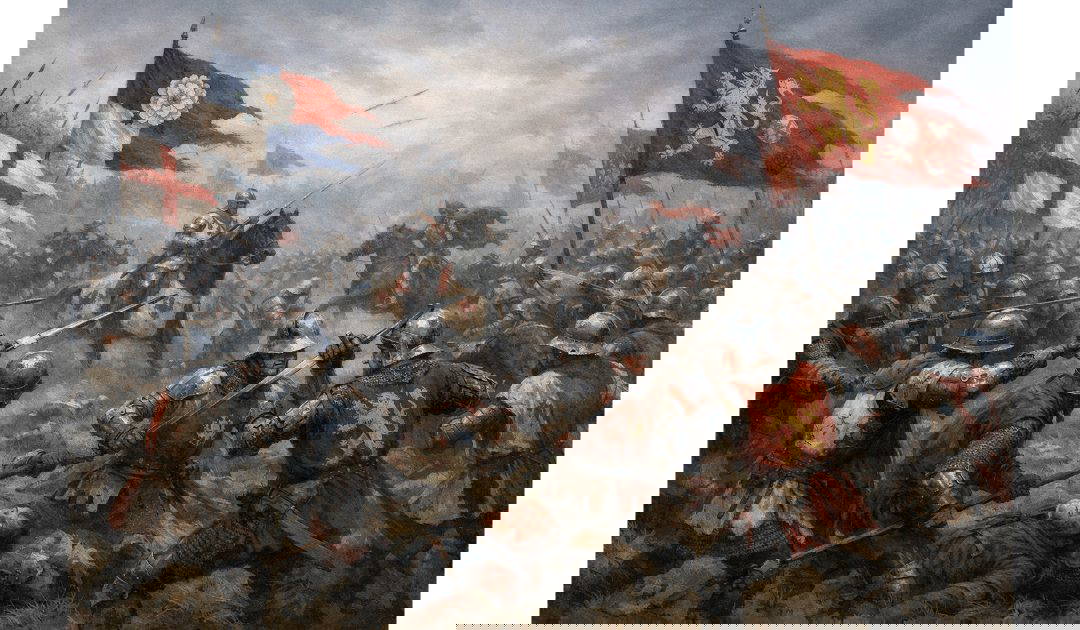
The Battle of Barnet was fought on the 14th of April, 1471. Barnet got a fleeting mention in my post on Malmsey wine, but let’s delve into the detail. The Battle of Barnet was one of the decisive engagements of the Wars of the Roses and a turning point in the struggle between the houses of York and Lancaster. Taking place in thick fog just north of London, the battle not only restored Edward IV to the English throne but also led to the death of Richard Neville, Earl of Warwick—“the Kingmaker”—whose shifting loyalties had shaped English politics for over a decade.
The background to Barnet lies in the turbulent politics of the 1460s. Edward IV of York had seized the throne from the Lancastrian Henry VI in 1461 after a series of bloody battles, most notably Towton. Central to Edward’s rise had been the support of the powerful Neville family, especially Richard Neville, Earl of Warwick. Warwick was the wealthiest magnate in England and possessed extensive lands, military resources, and political influence. For years he had been Edward’s chief ally and diplomatic agent, earning his sobriquet by helping to “make” the Yorkist king.
However, relations between Edward and Warwick deteriorated sharply. Edward’s secret marriage in 1464 to Elizabeth Woodville, a Lancastrian widow of comparatively modest status, offended Warwick, who had been negotiating a French marriage alliance for the king. The growing influence of the Woodville family at court further alienated him. By the late 1460s, Warwick had allied himself with Edward’s discontented brother, George, Duke of Clarence. In 1469–70, Warwick rebelled against Edward, briefly capturing him and attempting to rule in his name. When this failed, Warwick fled to France.
In a remarkable reversal of allegiance, Warwick reconciled with his old enemy, Queen Margaret of Anjou, wife of Henry VI. Brokered by Louis XI of France, this alliance saw Warwick agree to restore Henry VI to the throne. In late 1470, Warwick invaded England. Edward IV, taken by surprise, fled to Burgundy, and Henry VI was briefly restored in what is known as the “Readeption.”
Yet Edward’s exile was short-lived. With Burgundian support, he landed in Yorkshire in March 1471. Claiming at first that he sought only to recover his dukedom, Edward gathered supporters as he marched south. Clarence, ever opportunistic, abandoned Warwick and rejoined his brother. Edward entered London on 11 April, secured the city, and took the feeble Henry VI into custody once more. Warwick, who had been positioned north of London, hurried south to intercept him. The armies converged near the town of Barnet.
The battlefield was a gently undulating area of heath and fields, and the night before the battle was marked by confusion and poor visibility. Both armies numbered perhaps between 10,000 and 15,000 men. Edward’s forces were arranged in three divisions under his own command in the centre, with his brother Richard, Duke of Gloucester (the future Richard III), commanding the right, and Lord Hastings the left. Warwick’s army was similarly divided, with Warwick in the centre, his brother John Neville, Marquess of Montagu, commanding one wing, and the Earl of Oxford the other.
A thick fog lay over the field on the morning of Easter Sunday. This fog played a critical role in the unfolding battle. Due to misalignment during the night, the opposing lines were not directly facing each other. As the battle commenced, Oxford’s Lancastrian wing overlapped and drove back Hastings’s Yorkist division. Oxford’s men pursued the fleeing Yorkists toward Barnet, looting as they went. Meanwhile, in the centre and on the opposite flank, the fighting was fierce and confused, with soldiers often unable to distinguish friend from foe in the murk.
When Oxford’s men attempted to return to the main battlefield, disaster struck. In the fog, Warwick’s troops mistook Oxford’s badge—a silver star with rays—for Edward’s sun emblem. Believing they were being attacked from behind, they shouted “treason!” and opened fire on their own allies. Panic spread rapidly through the Lancastrian ranks. The cry of betrayal was especially damaging in an army held together by a fragile alliance of former enemies.
Edward, a bold and experienced commander, seized the moment. He rallied his men and pressed the attack. The Lancastrian line began to crumble. Warwick, fighting on foot, attempted to reach his horse to flee the field but was overtaken and killed. His brother Montagu was also slain. The deaths of these two experienced leaders shattered any remaining cohesion in the Lancastrian army, which broke and fled.
The death of Warwick was of enormous significance. For years he had been the central figure in English politics, a man capable of toppling kings. His fall removed the most powerful and independent noble in the realm, allowing Edward IV to rule with far greater authority. It also marked the collapse of the Lancastrian attempt to regain power through Warwick’s leadership.
Although Barnet was a Yorkist victory, the war was not yet over. Queen Margaret and her son, Edward of Westminster, had landed in England on the very day of the battle. Unaware of Warwick’s defeat, they began gathering forces in the west. Edward IV moved swiftly to intercept them, leading to the Battle of Tewkesbury on 4 May 1471. There, the Lancastrians were decisively defeated, and Prince Edward was killed. Shortly afterwards, Henry VI died in the Tower of London, almost certainly murdered.
Barnet and Tewkesbury together effectively ended the Lancastrian cause. Edward IV’s second reign, from 1471 until his death in 1483, was comparatively stable. The great overmighty subject who had once dominated him was gone, and the Yorkist regime enjoyed a period of relative peace.
The Battle of Barnet is remembered not only for its political consequences but also for the dramatic role of chance and confusion. The fog, the misaligned lines, and the tragic friendly fire incident all shaped the outcome as much as strategy or numbers. It is a vivid example of how medieval battles could hinge on miscommunication and misidentification.
Today, the battlefield lies beneath suburban north London, but Barnet remains one of the most significant engagements of the Wars of the Roses. It marked the end of the Kingmaker and the restoration of Edward IV’s authority, setting the stage for the final Yorkist triumph later that spring.