
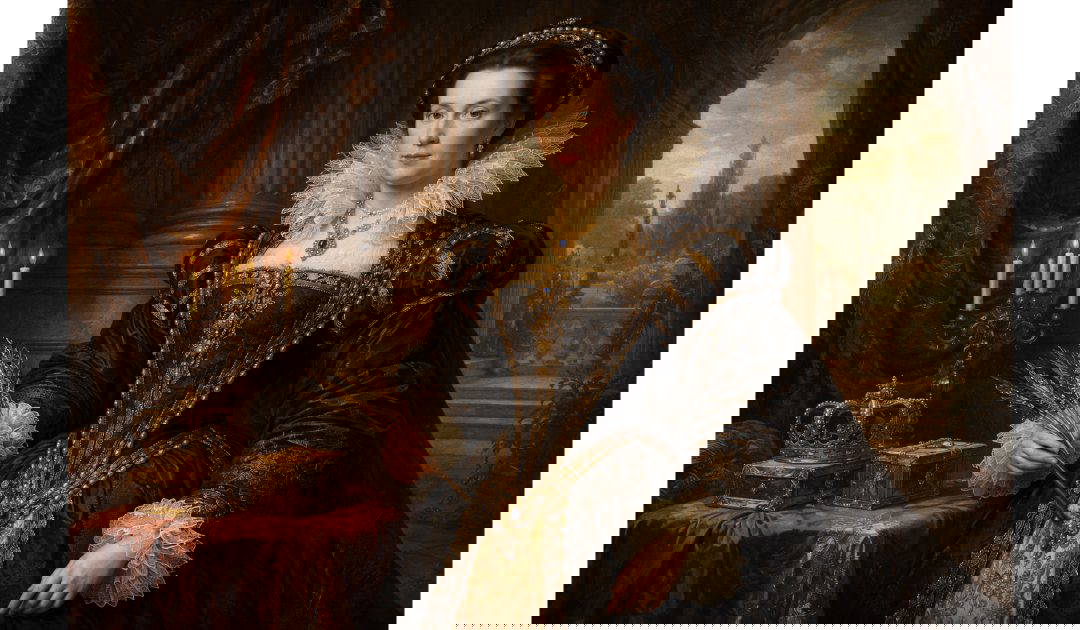
Catherine de Medici was born on the 13th of April, 1519, in Florence. She is a minor character in The Spy who Sank the Armada, the first book in the Sir Anthony Standen Adventures. I have mentioned her in a previous post, but let us look into her life in more detail.
Caterina Maria Romola di Lorenzo de’ Medici was the only child of Lorenzo II de’ Medici, Duke of Urbino, and Madeleine de La Tour d’Auvergne, a French noblewoman. Orphaned within weeks of her birth, she was raised amid the political instability of Renaissance Italy. The Medici family’s frequent expulsions from Florence meant that Catherine’s early life was marked by danger and uncertainty. She was at one point effectively a political hostage during anti-Medici uprisings. These formative experiences likely shaped her later political caution, resilience, and distrust.
In 1533, at the age of fourteen, Catherine married Henry, Duke of Orléans, the second son of King Francis I of France. The marriage was arranged by her uncle, Pope Clement VII, to strengthen ties between France and the papacy. At the French court, Catherine initially occupied a marginal position. Her husband was deeply attached to his mistress, Diane de Poitiers, who exercised considerable influence over him and the court. For nearly ten years Catherine failed to produce an heir, and her position was precarious. Eventually, however, she bore ten children, seven of whom survived infancy, including three future kings: Francis II, Charles IX, and Henry III.
When Henry became King Henry II in 1547, Catherine remained overshadowed by Diane de Poitiers. She played little overt political role, though she quietly cultivated alliances and observed court politics closely. Everything changed in 1559 when Henry II died unexpectedly after a jousting accident. Their eldest son, Francis II, aged fifteen, became king. Real power initially fell into the hands of the powerful Guise family, militant Catholics who were uncles to Francis’s young queen, Mary, Queen of Scots.
Francis II died in 1560 after a short reign, and the crown passed to his ten-year-old brother, Charles IX. Catherine now stepped decisively into power as regent. France was deeply divided between Catholics and a growing Protestant minority inspired by Calvinism. Noble factions used religious differences to pursue their own political ambitions, and the authority of the crown was weak.
Catherine’s primary objective was not ideological but dynastic: to preserve the Valois monarchy and maintain stability. She initially pursued a policy of religious moderation and compromise. She convened the Colloquy of Poissy in 1561 in an attempt to reconcile Catholics and Protestants and issued the Edict of January in 1562, granting limited toleration to Huguenots. However, this policy angered Catholic hardliners and failed to prevent violence.
The spark came in March 1562 with the Massacre of Vassy, when the Duke of Guise’s forces killed dozens of Protestant worshippers. This event ignited the first of a series of civil wars known as the French Wars of Religion. For nearly thirty years, France was periodically convulsed by armed conflict, assassination, and political intrigue.
Catherine navigated this chaos through a mixture of diplomacy, marriage alliances, calculated concessions, and occasional ruthlessness. She arranged marriages designed to reconcile factions, most notably the marriage of her daughter Marguerite (Margot) to the Protestant leader Henry of Navarre in 1572. This union was meant to symbolise reconciliation between Catholics and Huguenots.
Instead, it preceded one of the most infamous events in French history: the St Bartholomew’s Day Massacre. In August 1572, thousands of Huguenots in Paris and across France were killed in a wave of mob violence. The extent of Catherine’s responsibility remains debated. Many historians believe she supported a limited strike against Protestant leaders out of fear of a Huguenot coup, but that the violence spiralled beyond control. The massacre irreparably damaged her reputation, particularly among Protestant writers who portrayed her as a bloodthirsty conspirator.
After Charles IX’s death in 1574, her third son became Henry III. Catherine continued to advise him and remained influential until her death. By this time, a new threat had emerged: the Catholic League, led by the Guise family, which sought to exclude the Protestant Henry of Navarre from succession. Catherine spent her final years attempting to prevent the total collapse of royal authority as France drifted toward further chaos.
Beyond politics, Catherine was a significant patron of the arts and architecture. She commissioned grand building projects such as the Tuileries Palace and expanded the Château de Chenonceau. She promoted Italian artistic styles at the French court and helped shape the cultural splendour of the late Renaissance in France. Court festivals, pageantry, and artistic display were part of her strategy to reinforce royal prestige.
Catherine de Medici died on the 5th of January, 1589, just months before Henry III was assassinated. The Valois line ended, and Henry of Navarre eventually became King Henry IV, founding the Bourbon dynasty and bringing relative peace with the Edict of Nantes in 1598.
Catherine’s legacy is complex. Long vilified as the “Black Queen” and blamed for religious bloodshed, modern historians increasingly view her as a pragmatic ruler confronting impossible circumstances. She was neither a fanatic nor a visionary reformer but a determined political survivor attempting to preserve her dynasty in a time of fragmentation and fanaticism. Her life illustrates the immense difficulties of ruling a divided nation and the precarious position of a woman wielding power in a deeply patriarchal age.