
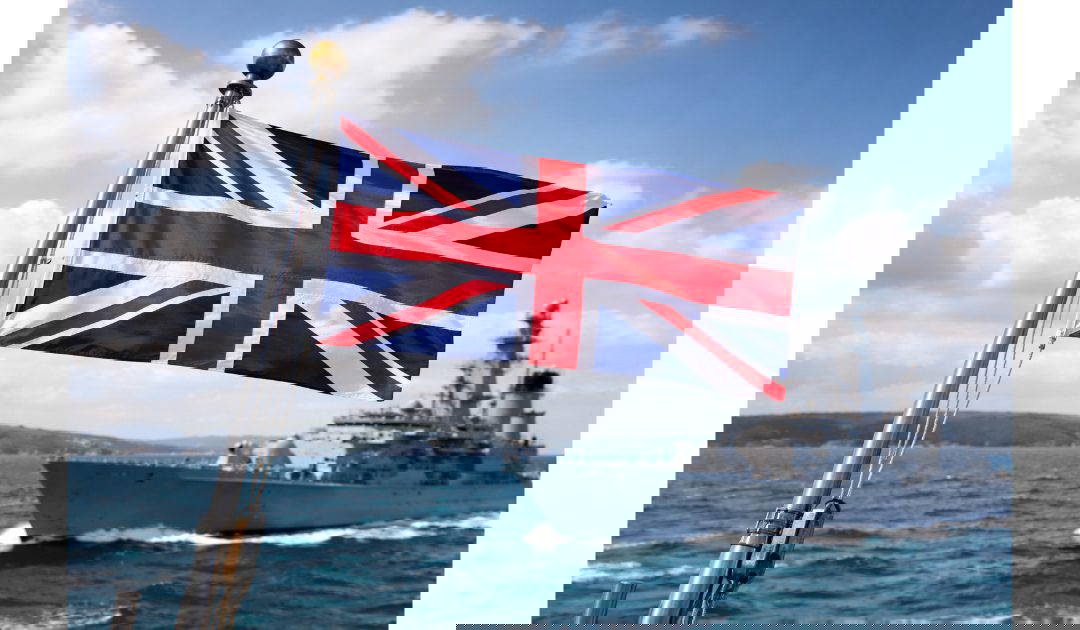
On the 12th of April, 1606, the Union Flag was adopted as the flag of English and Scottish ships. I’m going to say straight away that I consider the Union Flag to be the Union Jack when it is flown at the jackstaff of one of His Majesty’s ships. It’s controversial but as an ex Royal Naval Reservist I side with the Admiralty rather than the Flag Institute. I should say that ChatGBT’s illustration looks more like the flag is being flown at the stern rather than the bow, which is where the jackstaff is. The flag later known as the Union Flag, or Union Jack, emerged directly from the political transformation created by the Union of the Crowns in 1603, when James VI of Scotland inherited the English throne as James I. For the first time, England and Scotland shared a monarch, though they remained legally and politically separate kingdoms. This personal union created immediate practical and symbolic problems, none more visible than the question of what ships at sea should fly.
Before 1603, English and Scottish vessels sailed under entirely different national flags. English ships commonly used the red cross of St George on a white field, while Scottish ships bore the white saltire of St Andrew on a blue field. At sea, flags were more than decoration: they were essential signals of identity, allegiance, and authority. They indicated which sovereign’s protection a vessel enjoyed and under what laws it sailed. With one king now ruling both realms, confusion and rivalry quickly arose over maritime symbolism.
James I was deeply interested in symbols of unity. He styled himself “King of Great Britain” almost immediately after his accession, though neither Parliament had yet sanctioned such a title. He sought visual expressions of this new reality, and the sea offered a particularly pressing arena. English and Scottish ships encountered each other frequently in home waters and abroad, and disputes soon broke out over precedence and honour. Each nation’s sailors were fiercely proud of their flag, and neither wished to concede superiority to the other.
The matter was brought formally to the king’s attention by complaints from both sides. English mariners objected to Scottish ships flying only the St Andrew’s Cross in waters now ruled by a common sovereign. Conversely, Scots resented the implication that the St George’s Cross represented the whole monarchy. James recognised that a single emblem for ships of both kingdoms would reduce conflict and underline his vision of unity.
In 1606 he referred the problem to the heralds and officers of arms of both realms. Their task was to devise a design that combined the national symbols without implying that one kingdom was subordinate to the other. Heraldry provided the solution: the “impalement” or combination of arms and emblems into a composite device. The result was a flag in which the red cross of St George was superimposed upon the white saltire of St Andrew, set against a blue background.
On the 12th of April, 1606, James issued a royal proclamation ordering the use of this new “Union” flag at sea. The proclamation specified that “all our subjects of this Isle and Kingdom of Great Britain” should bear the new flag at the main top of their ships. English and Scottish vessels were still permitted to fly their own national flags at the foremast, but the Union flag was to signify their shared allegiance to one sovereign.
This was not yet a national flag in the modern sense, but specifically a maritime one. Its purpose was practical as much as symbolic: to identify ships belonging to the dominions of the same king and to reduce disputes over precedence. The sea, where national identity was most visibly displayed to foreigners, became the testing ground for this early British symbol.
The design was not without controversy. Some Scots complained that the St George’s Cross appeared to dominate the composition, lying over the St Andrew’s Cross. Alternative Scottish versions were even produced in which the saltire was placed above the red cross. However, the king’s design prevailed, partly because England’s greater naval power meant English practice tended to set the standard.
Over time, the Union flag began to be seen as more than a maritime convenience. It symbolised the idea—still politically unrealised in 1606—of a single British identity. A century later, the Act of Union of 1707 would formally unite the kingdoms into Great Britain, and the flag already in use at sea provided a ready-made emblem for the new state.
Thus, the adoption of the Union Flag in 1606 arose from a practical need to manage rivalry between English and Scottish mariners after the Union of the Crowns. Yet it also reflected James I’s broader ambition to foster unity between his realms. What began as a solution to disputes over shipboard honours became one of the most enduring national symbols in the world.