
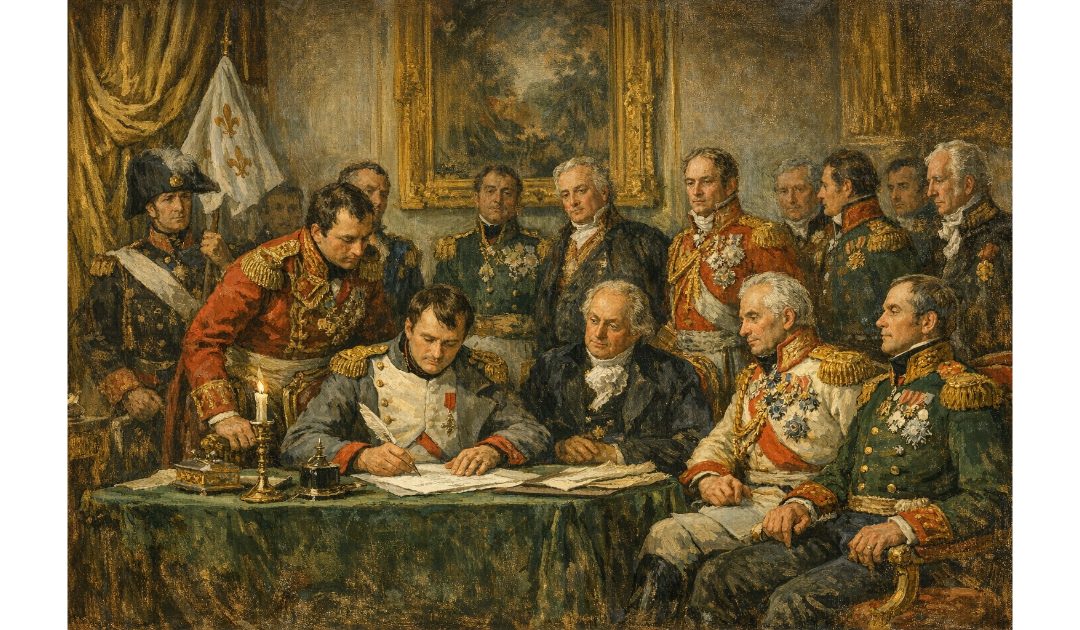
On the 11th of April, 1814, the Treaty of Fontainebleau was signed. It ended the War of the Sixth Coalition against Napoleon Bonaparte, and forced him to abdicate uncondionally for the first time. It does feel increasingly as though I’m running out of history I want to write about. I initially rubbed my hands with glee to see that the Battle of the Basque Roads was fought on this day in 1809. That involved Captain Lord Thomas Cochrane who was of course the inspiration for Jack Aubrey in Master and Commander. But I’d already done that. On the subject of the Jack Aubrey books, I can just add that I read a letter to Yachting Monthly many years ago. The writer said that he had been asked by Patrick O’Brian, author of the books, if he could join him on his yacht for a few days in the Mediterranean. According to the yachtsman, Patrick O’Brian new absolutely nothing about sailing, and had an absurd idea of the distance a yacht could travel in a day. But I digress.
The Treaty of Fontainebleau marked the formal end of Napoleon Bonaparte’s rule as Emperor of the French and brought to a close the first phase of the Napoleonic Wars. It was concluded at the Châteauon palace of Fontainebleau, southeast of Paris, after the allied armies of Britain, Russia, Austria, and Prussia had invaded France and forced Napoleon into an untenable political and military position. The treaty set out the terms of Napoleon’s abdication and exile, and it represented a remarkable moment in European history: the negotiated removal of a ruler who had dominated the continent for over a decade.
By early 1814, Napoleon’s empire was collapsing. The disastrous Russian campaign of 1812 had shattered the Grande Armée, and although Napoleon rebuilt his forces with astonishing speed, the War of the Sixth Coalition steadily pushed French armies back across Europe. The decisive defeat at the Battle of Leipzig in October 1813, often called the “Battle of Nations,” opened the way for the Allies to invade France itself. Throughout the winter and early spring of 1814, Napoleon fought a brilliant but ultimately hopeless defensive campaign on French soil. Despite several tactical victories, the numerical superiority of the allied forces proved overwhelming. On the 31st of March, 1814, Paris fell to the coalition armies.
Meanwhile, political developments in Paris undermined Napoleon’s authority. Influential figures such as Charles-Maurice de Talleyrand, once Napoleon’s foreign minister, began manoeuvring for a post-Napoleonic settlement. The French Senate declared that Napoleon had forfeited the throne. Facing abandonment by his marshals and the political elite, Napoleon initially attempted to abdicate in favour of his young son, Napoleon II. The Allies, however, rejected this proposal, insisting on his unconditional abdication.
The Treaty of Fontainebleau was the instrument that formalised this outcome. Negotiated between Napoleon’s representatives and the allied powers, it was unusually generous in its treatment of a defeated sovereign. Rather than imprisoning or executing him, the Allies agreed to allow Napoleon to retain the title of Emperor and to rule over the small Mediterranean island of Elba as his personal principality. He would be granted sovereignty over the island, along with a personal guard of several hundred men.
The treaty also provided financial arrangements. Napoleon was to receive an annual income of two million francs from the French government, intended to support himself and his household. His wife, Marie-Louise of Austria, and their son were to be granted the duchies of Parma, Piacenza, and Guastalla in Italy. Members of the Bonaparte family were also provided for, ensuring that Napoleon’s immediate relatives retained titles and incomes. These provisions reflected both a desire for stability and the influence of Austria, whose emperor, Francis I, was Marie-Louise’s father.
For the Allies, the treaty served several purposes. First, it removed Napoleon from the political scene without turning him into a martyr. Second, it avoided the uncertainty that might follow his execution or imprisonment. By granting him a small realm far from the centres of European power, they hoped to neutralise him as a threat. Finally, the arrangement allowed the Allies to proceed with restoring the Bourbon monarchy in France under Louis XVIII, which they believed would bring legitimacy and stability.
Napoleon signed the treaty reluctantly. Eyewitness accounts describe him as deeply distressed, even attempting suicide with poison he had carried since the Russian campaign. Ultimately, he accepted his fate. On the 20th of April, 1814, in a dramatic farewell at Fontainebleau, he addressed his Old Guard, thanking them for their loyalty before departing for exile. He travelled south under allied escort and arrived on Elba in early May.
The Treaty of Fontainebleau was significant not only for its immediate consequences but also for what it revealed about the nature of European diplomacy. It demonstrated a shift away from purely punitive settlements toward pragmatic arrangements designed to maintain balance and order. The Allied leaders, particularly Tsar Alexander I of Russia and Prince Metternich of Austria, were concerned with creating a stable Europe rather than exacting revenge.
However, the settlement contained a fatal flaw: it underestimated Napoleon’s resilience and ambition. Elba was too close to France, and Napoleon was allowed too much freedom. He retained contact with supporters and followed developments on the mainland closely. Discontent in France with the restored Bourbon monarchy, combined with Napoleon’s undiminished charisma, created the conditions for his dramatic return.
In February 1815, less than a year after the treaty, Napoleon escaped from Elba and landed in southern France, beginning the period known as the Hundred Days. His return ended only with his final defeat at Waterloo in June 1815 and a second, far harsher exile to the remote island of Saint Helena.
Thus, while the Treaty of Fontainebleau temporarily ended Napoleon’s rule, it did not end his influence. It stands as a fascinating example of diplomatic leniency toward a fallen ruler and a reminder that political settlements must account not only for present circumstances but also for the enduring force of personality and ambition.