
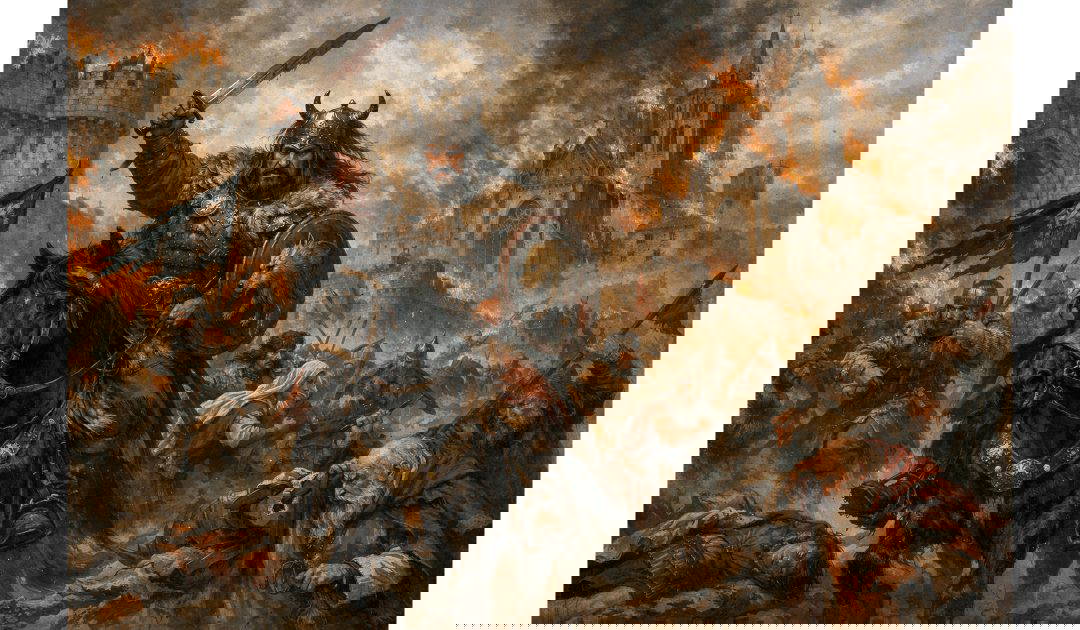
On the 7th of April, 451, Attila the Hun captured Metz, slaughtered most of its inhabitants, and burnt the town. I’ve written about some bad dudes, Hitler and Mussolini to name but two, but Attila the Hun is the bad dude that all others are compared to.
Attila the Hun, who died in 453 AD, was one of the most feared and formidable figures of late antiquity. To the Romans he was Flagellum Dei — the “Scourge of God” — a relentless warlord whose name became synonymous with devastation. Yet behind the legend was a shrewd political leader, an effective organiser of a vast confederation of tribes, and a man whose career reshaped the balance of power in Europe during the final century of the Western Roman Empire.
The Huns themselves were a nomadic people who had migrated westward from the Eurasian steppe during the late fourth century. Their sudden appearance on the borders of Europe triggered a chain reaction of migrations among Germanic tribes, which in turn destabilised the Roman frontiers. By the early fifth century the Huns were settled in the Great Hungarian Plain, from where they exerted influence over a wide range of subject peoples, including Ostrogoths, Gepids, and Alans. Their mastery of mounted warfare, particularly horse archery, gave them a decisive advantage over many settled armies.
Attila was born into the ruling family of the Huns, probably around 406. His uncle, King Rugila (or Rua), had already established the Huns as a major power that the Eastern Roman Empire treated with caution and bribery. When Rugila died in 434, Attila and his brother Bleda inherited joint rule. Early in their reign they negotiated the Treaty of Margus with the Eastern Roman Empire, extracting substantial annual tribute in gold in exchange for peace. This arrangement reveals an important aspect of Attila’s strategy: he understood that intimidation and diplomacy could be as profitable as warfare.
By 445 Attila had eliminated Bleda—almost certainly murdered on his orders—and became sole ruler. From that point his campaigns intensified. He repeatedly invaded the Balkans, ravaging Roman cities and forcing Emperor Theodosius II to increase the tribute payments dramatically. Cities such as Naissus (modern Niš) were sacked, and Roman defensive lines along the Danube were shattered. The Eastern Empire, though wealthy, found itself repeatedly humiliated, buying peace at enormous cost.
Attila’s ambitions were not confined to the east. In 451 he turned his attention to Gaul (modern France). The immediate pretext was a complicated political intrigue involving Honoria, the sister of the Western Roman Emperor Valentinian III, who had sent Attila a ring and a plea for help in escaping an unwanted marriage. Attila claimed this as a proposal of marriage and demanded half the Western Empire as her dowry. Whether he believed this claim or merely used it as justification, it provided a convenient excuse for invasion.
His campaign through Gaul was devastating. Cities such as Metz were sacked, and panic spread throughout the region. However, Attila met his match at the Battle of the Catalaunian Plains (also called the Battle of Châlons). There, a coalition of Roman forces under the general Aetius and Visigothic troops under King Theodoric I confronted the Huns. The battle was indecisive but halted Attila’s advance. For the first time, his aura of invincibility had been challenged.
Undeterred, Attila invaded Italy the following year, 452. He sacked several northern cities, including Aquileia, whose destruction was so complete that it reportedly never recovered. Refugees fled into the lagoons of the Adriatic, contributing to the eventual rise of Venice. Yet Attila did not march on Rome. Tradition holds that Pope Leo I met him and persuaded him to withdraw, though practical concerns—famine, disease, and the approach of Eastern Roman forces—were likely more decisive.
Attila ruled not a unified nation but a loose confederation of tribes bound by loyalty, fear, and the promise of plunder. His court, described by the Roman diplomat Priscus who visited it, was surprisingly ordered. Priscus noted Attila’s personal simplicity: he dressed plainly compared to his richly adorned followers and ate from wooden plates while others used silver. This cultivated image of austerity may have reinforced his authority among warrior elites.
In 453, at the height of his power, Attila died suddenly on his wedding night after marrying a young woman named Ildico. According to later accounts, he suffered a severe nosebleed and choked in his sleep. His death led to the rapid disintegration of the Hunnic Empire. Without his personal authority, subject tribes revolted, and within a few years the Huns had ceased to be a dominant force in Europe.
Attila’s legacy is complex. To Christian chroniclers he was a divine punishment sent to chastise a sinful world. In Germanic and Scandinavian legend he appears as Etzel, a more nuanced and even noble figure. Historically, he played a crucial role in accelerating the decline of Roman power in the west, destabilising regions already under strain and contributing to the reshaping of Europe in the post-Roman era.
Though his empire was short-lived, Attila’s impact was profound. He embodied the volatile meeting of steppe nomadism and settled civilisation, and his career marked one of the last great shocks delivered to the Roman world before its final transformation.