
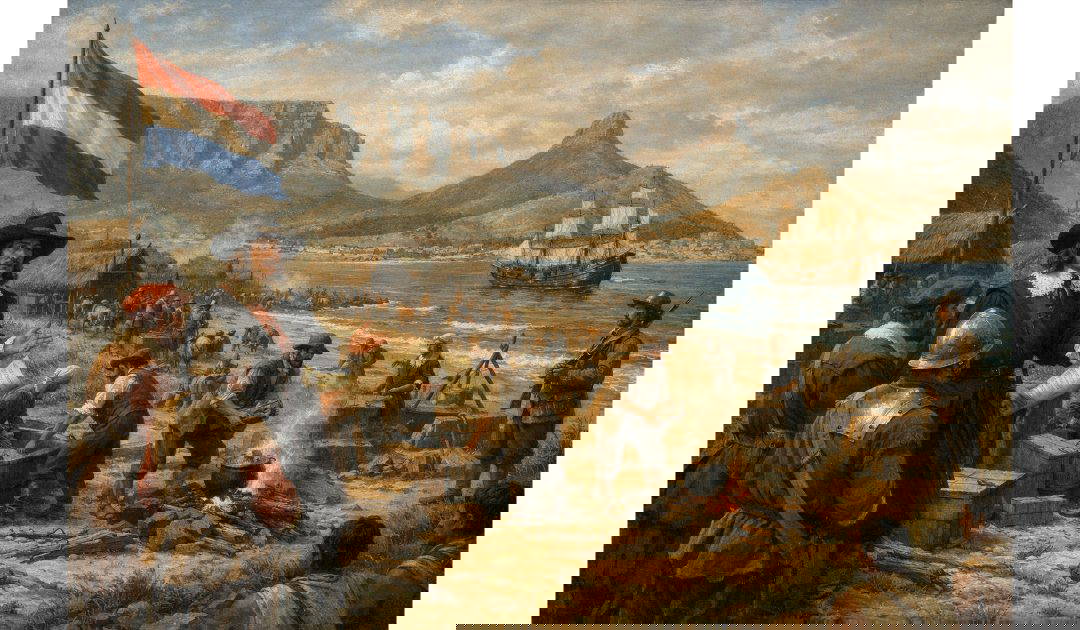
On the 6th of April, 1652, Jan Van Riebeeck established a resupply camp at the Cape of Good Hope that eventually became Cape Town. During World War II my father’s troop ship put into Cape Town and the troops were billeted with local people for a few days. My father was quite taken with Cape Town and tried after the war to persuade his fiance, later his wife and my mother to emigrate to Cape Town. She wouldn’t move away from her family. If she had I might have been writing this from Cape Town. I bet the weather would be better.
Cape Town’s history is a layered story of geography, trade, empire, conflict, and cultural exchange, shaped above all by its position at the meeting point of two oceans beneath the looming mass of Table Mountain. Long before Europeans arrived, the region was inhabited by Khoikhoi pastoralists and San hunter-gatherers, collectively known today as the Khoisan. They lived in small, mobile communities, moving with their cattle and seasonal resources, and had well-established trade networks along the southern African coast. Their knowledge of the land and sea would be crucial to the earliest European visitors, though their societies would later be profoundly disrupted by colonisation.
Portuguese mariners were the first Europeans to round the Cape in the late fifteenth century. In 1488 Bartolomeu Dias sailed past what he called the “Cape of Storms,” later renamed the Cape of Good Hope by King João II of Portugal, who recognised its importance as a gateway to the riches of the Indian Ocean. Vasco da Gama followed in 1497 on his voyage to India. Yet the Portuguese never settled there; the Cape was a difficult, windswept anchorage, useful as a navigational landmark but not as a colony.
Permanent European settlement began only in 1652, when the Dutch East India Company (VOC) established a refreshment station under the leadership of Jan van Riebeeck. The aim was practical rather than imperial: to provide fresh food, water, and medical care for ships sailing between Europe and Asia. A fort was built, gardens were planted, and livestock was obtained through barter with the Khoikhoi. Over time, however, the settlement expanded beyond its original purpose. Company servants were released to become “free burghers,” farming the surrounding land to supply the station. This expansion led to increasing conflict with the Khoikhoi, whose grazing lands were encroached upon, and whose communities were devastated by European diseases such as smallpox.
The Dutch colony developed into a multicultural society. Enslaved people were brought from East Africa, Madagascar, India, and the Indonesian archipelago, especially Batavia (Jakarta). Their descendants, together with the indigenous population and European settlers, formed the roots of what would later be known as the Cape Coloured and Cape Malay communities. Islam took root at the Cape through exiles and slaves from Southeast Asia, leaving a lasting cultural and architectural imprint, particularly in the Bo-Kaap district. Dutch became the dominant European language, evolving over time into Afrikaans.
In the late eighteenth century, European wars brought new rulers. During the French Revolutionary Wars, Britain occupied the Cape in 1795 to prevent it falling into French hands. Although briefly returned to the Dutch, the colony was permanently ceded to Britain in 1806 after the Battle of Blaauwberg. Under British rule, Cape Town grew as an administrative and military centre of the expanding British Empire in southern Africa.
British policies reshaped society. The abolition of the slave trade in 1807 and slavery itself in 1834 transformed labour relations, though formerly enslaved people often remained economically marginalised. The introduction of English law and language, and new systems of land ownership, contributed to tensions between Dutch-descended settlers (later known as Boers or Afrikaners) and the British authorities. These tensions helped spur the Great Trek in the 1830s and 1840s, as many Boers moved inland to establish their own republics.
Throughout the nineteenth century, Cape Town flourished as a port city. The discovery of diamonds in Kimberley in 1867 and gold in the Witwatersrand in 1886 increased its importance as a gateway to the interior. Railways and modern docks were constructed, and the city became a cosmopolitan hub of commerce, attracting migrants from Europe, Asia, and elsewhere in Africa.
Politically, the Cape Colony was distinctive. It developed a non-racial, though limited, franchise based on property and income rather than race. Known as the Cape Qualified Franchise, it allowed some people of colour to vote, a rare feature in the colonial world. However, this relatively liberal system was gradually eroded after the formation of the Union of South Africa in 1910, when power shifted to a white minority government dominated by Afrikaner and British interests.
The twentieth century brought the harsh realities of apartheid. From 1948, racial segregation became official state policy. Cape Town’s communities were forcibly reorganised along racial lines. The most notorious example was District Six, a vibrant, multiracial neighbourhood near the city centre, whose residents were removed in the 1960s and 1970s and relocated to distant townships such as the Cape Flats. Homes were demolished, and communities fractured. Table Mountain, once a shared backdrop to a diverse urban life, now looked down on a deeply divided city.
Cape Town also became a symbol of resistance. Robben Island, just offshore, was used as a prison for political dissidents. Nelson Mandela and many other anti-apartheid leaders were held there for decades. The city’s universities, churches, and civic groups were active in opposing apartheid, and protests, boycotts, and political activism were common.
The end of apartheid in the early 1990s marked a new chapter. Mandela was released from Victor Verster Prison near Cape Town in 1990, and the first democratic elections in 1994 ushered in a new era. Cape Town became the legislative capital of South Africa, home to Parliament, and an important symbol of the nation’s transformation.
Today, Cape Town is renowned for its natural beauty, cultural diversity, and historical depth. Its architecture reflects Dutch, British, and Cape Malay influences. Its population speaks multiple languages and embodies a blend of African, European, and Asian heritage. Yet the legacy of its past remains visible in patterns of inequality and spatial division that date back centuries.