
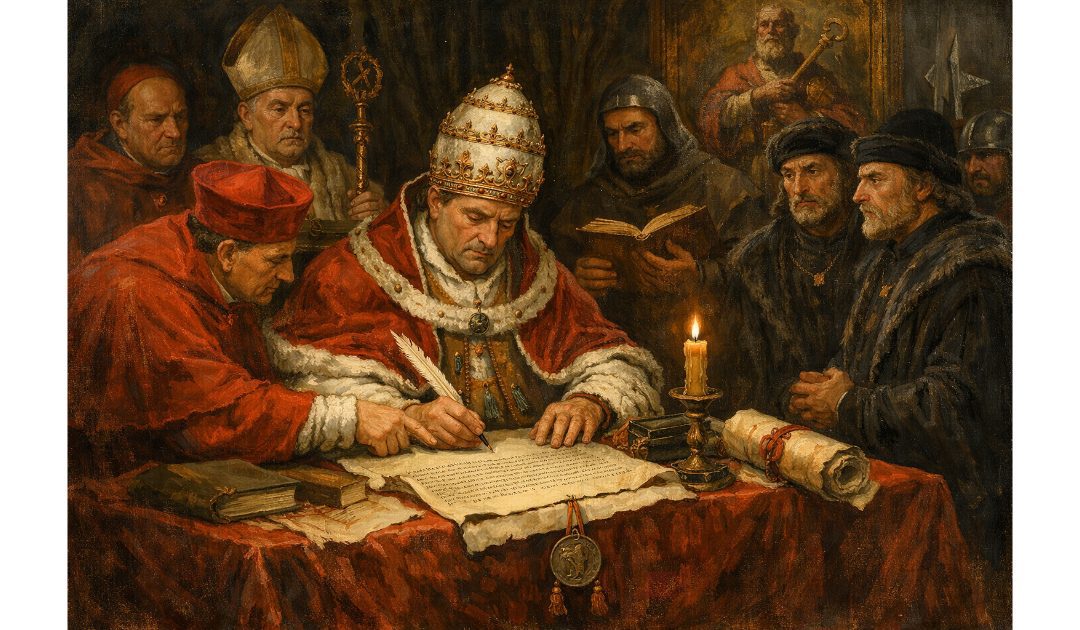
On the 27th of March, 1309, Pope Clement V imposed excommunication and interdiction on Venice, and a general prohibition on all commercial transactions with the city, following the seizure of Ferrara which was a papal fiefdom by Venice. Both Venice and Ferrara feature in Fire and Earth, the second book in the Sir Anthony Standen Adventures. However that was around three hundred years after this excommunication.
Pope Clement V (r. 1305–1314), born Bertrand de Got in Gascony, is best remembered as the first of the Avignon popes, the pontiff who moved the papal court out of Rome and into southern France. His pontificate unfolded at a time when the authority of the papacy was under strain from powerful monarchs, assertive city-states, and internal Church tensions. Among the most serious of his political confrontations was his bitter and protracted conflict with the Republic of Venice, culminating in the dramatic excommunication and interdict placed upon the Venetian state in 1308–1309. This episode reveals much about Clement’s view of papal sovereignty, Venice’s fierce independence, and the changing political landscape of early fourteenth-century Europe.
Clement V came to the papacy after the turbulent reign of Boniface VIII and the brief pontificate of Benedict XI. Boniface’s clashes with King Philip IV of France had exposed the vulnerability of papal claims to supremacy over secular rulers. Clement, elected largely through French influence, inherited a Church seeking stability but also anxious to reassert its authority. He was cautious, diplomatic, and often politically pragmatic, but he did not abandon the medieval papal conception that the pope possessed ultimate jurisdiction over Christendom, including temporal matters in territories claimed as papal fiefs.
One such territory was Ferrara, a city in northern Italy that had long been regarded as lying within the Papal States. Although ruled in practice by the Este family, Ferrara’s status as a papal possession was deeply embedded in canon law and papal diplomacy. When Azzo VIII d’Este died in 1308 without legitimate heirs, a succession crisis erupted. The House of Este fractured, and the city became vulnerable to external interference. The Republic of Venice, ever alert to opportunities to expand its influence on the mainland (the terraferma), intervened militarily.
Venice justified its action as a stabilising intervention in a power vacuum, but to Clement V this was nothing less than the illegal seizure of papal territory. Venice was not merely occupying a city; it was challenging the legal and symbolic authority of the papacy in Italy. Clement saw this as a test case. If Venice could annex Ferrara without consequence, papal territorial claims elsewhere would become meaningless.
In March 1309 Clement issued a bull excommunicating the Doge, the Venetian government, and all who supported the occupation. He also placed the entire republic under interdict. This meant that throughout Venetian territory the sacraments were suspended: churches were closed, marriages could not be celebrated, and the dead could not be buried in consecrated ground. In medieval society, such spiritual sanctions were not merely symbolic; they struck at the heart of communal life and salvation.
Venice, however, was not a typical medieval polity. It was wealthy, self-confident, commercially powerful, and accustomed to negotiating with popes from a position of strength. The Venetians responded not with submission but with defiance. They expelled clergy who attempted to enforce the interdict, forbade publication of the papal bulls, and continued religious services under state control. In effect, Venice subordinated ecclesiastical authority to civic authority, an extraordinary step that foreshadowed later tensions between Church and state in Europe.
Clement escalated the conflict. He declared a crusade against Venice, authorising military action by neighbouring powers to enforce papal rights. This was a remarkable development: a crusade not against Muslims or heretics, but against a Christian republic. Papal forces, supported by allies such as the Este claimants and various Italian lords, moved against Venetian positions in Ferrara. Warfare followed, marked by sieges and shifting alliances in the Po valley.
The struggle was costly and inconclusive at first, but Venice found it difficult to sustain a prolonged land war far from its maritime strengths. At the same time, the spiritual and political pressure of excommunication began to weigh more heavily. Venetian trade networks depended on good relations across Christendom, and the stigma of papal condemnation was damaging diplomatically and economically.
By 1310 Venice began to seek a way out. Negotiations were opened, and Clement, while firm, was also willing to accept submission rather than pursue endless conflict. In 1311 Venice formally renounced its claims to Ferrara and withdrew its forces. Clement lifted the interdict and excommunication, restoring the republic to communion with the Church.
The episode left lasting impressions on both sides. For Clement V, it was a vindication of papal authority at a time when the papacy’s prestige had been shaken by its dependence on France and its removal to Avignon. He had demonstrated that even a powerful and wealthy republic could be brought to heel through spiritual and political pressure combined. The recovery of Ferrara strengthened papal control in northern Italy and reinforced the idea that papal territorial rights were not merely theoretical.
For Venice, the conflict was a sobering lesson in the limits of its power when confronted by united ecclesiastical and political opposition. Yet it also revealed Venice’s remarkable resilience and its willingness to challenge papal authority when its interests demanded. The Venetian government’s handling of the interdict—continuing religious life under civic control—showed a pragmatic, almost secular approach to religion that was unusual for the time.
Clement’s relationship with Venice was therefore not one of simple hostility but of mutual testing of limits. The pope insisted on the supremacy of papal law and territorial rights; Venice asserted its independence and refused to be cowed easily by spiritual sanctions. Their confrontation was emblematic of a broader shift in medieval Europe, where emerging states and city-republics were increasingly willing to contest papal claims to universal authority.
In the end, Clement V’s victory over Venice was real but qualified. He restored papal control over Ferrara and upheld the principle of papal jurisdiction, yet the episode also showed that such authority required negotiation, force, and political calculation. The balance between spiritual power and secular independence was changing, and the clash between Clement V and Venice is one of the clearest illustrations of that transformation in the early fourteenth century.