
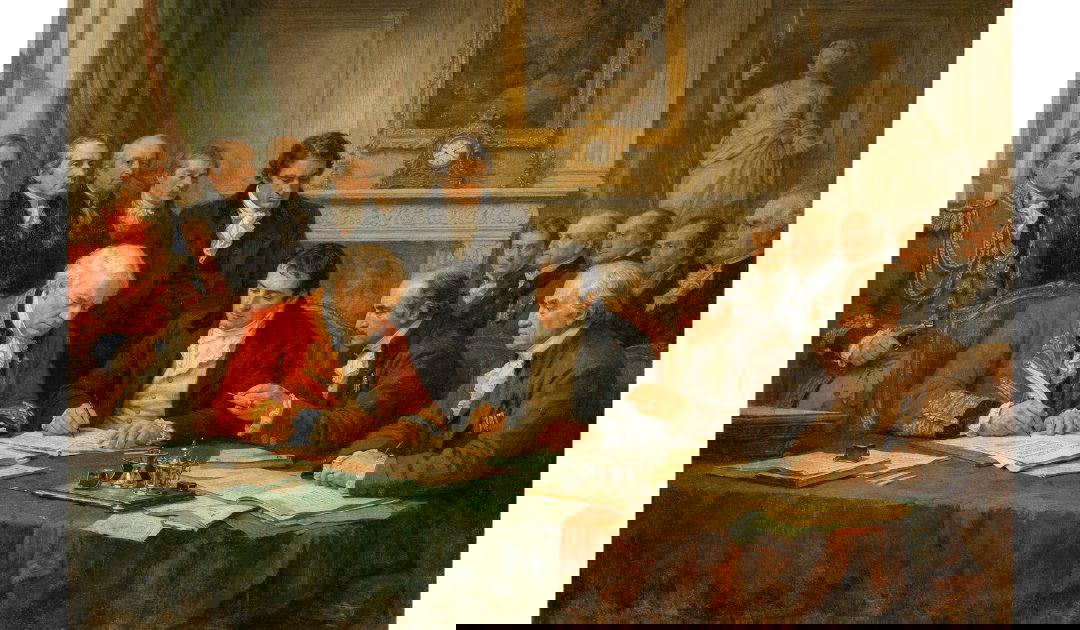
The Treaty of Amiens was signed on the 25th of March, 1802, ending hostilities between France and the United Kingdom. It can’t have been a great success because the Battle of Trafalgar was in 1805. Let’s look into it.
The Treaty of Amiens was one of the most remarkable pauses in the long struggle between Revolutionary France and Great Britain. It brought to an end, albeit briefly, nearly ten years of continuous war that had convulsed Europe since 1793. For a moment it seemed that a genuine and durable peace might emerge between the two great rivals. Instead, the treaty proved to be little more than an armed truce, collapsing within fourteen months and clearing the way for the Napoleonic Wars.
By 1801 both sides were exhausted. Britain had maintained naval supremacy and protected its trade routes, but the war had been financially draining and politically divisive. France, under the leadership of First Consul Napoleon Bonaparte, had achieved a series of astonishing military victories on the continent but faced economic strain and internal instability. Napoleon’s victory at Marengo in June 1800 and General Moreau’s triumph at Hohenlinden later that year forced Austria out of the war in the Treaty of Lunéville (February 1801). With the Second Coalition broken, Britain stood alone against France. Yet British hopes of rebuilding a continental alliance had failed, and there was growing public and political pressure for peace.
Negotiations began in earnest in 1801. The British government, now led by Henry Addington after the resignation of William Pitt the Younger, was more inclined toward settlement than its predecessor. On the French side, Napoleon was eager to consolidate his power, stabilise France, and gain time to rebuild its economy and navy. Preliminary talks took place in London, culminating in the signing of preliminary articles in October 1801. The final treaty was concluded at Amiens, a town in northern France chosen for its relative neutrality and convenience.
The principal negotiators were Joseph Bonaparte, Napoleon’s elder brother, representing France, and Charles Cornwallis, the British diplomat and general best known for his surrender at Yorktown during the American War of Independence. Also involved were representatives of Spain and the Batavian Republic (the Netherlands), both French allies.
The treaty’s terms were extensive and attempted to resolve the colonial and territorial disputes that had arisen during the war. Britain agreed to return most of the colonial conquests it had made since 1793. These included territories in the West Indies and elsewhere, although it retained the strategically vital island of Trinidad, taken from Spain, and Ceylon (Sri Lanka), seized from the Dutch. These concessions reflected Britain’s determination to maintain its maritime and imperial strength even while seeking peace.
France, for its part, agreed to evacuate Naples and the Papal States and to recognise the independence of Portugal and the Ottoman Empire. Crucially, the treaty provided for the evacuation of French troops from the Kingdom of Naples and the Papal territories, gestures intended to reassure European powers that French expansion would not continue unchecked. The independence of the Batavian Republic and other French-aligned states was implicitly recognised.
One of the most contentious issues concerned Malta. The island had been captured by the British from the French in 1800 after a prolonged siege. Under the treaty, Britain agreed to return Malta to the Knights of St John, with its neutrality guaranteed by the great powers. A Neapolitan garrison would replace the British forces. This clause would later become a central point of dispute and a key cause of the treaty’s breakdown.
The Treaty of Amiens was greeted with widespread relief and even celebration. In Britain, church bells rang, and crowds rejoiced at the end of war. For the first time in nearly a decade, Britons could travel to France, and many did so out of curiosity to see the country that had been their enemy for so long. French visitors likewise crossed the Channel. Trade resumed, and there was genuine hope among ordinary people that peace might last.
Napoleon used the breathing space provided by the treaty to strengthen his regime. In 1802 he secured a plebiscite making him First Consul for life. He reformed French administration, education, and finance, and continued to reorganise territories under French influence in Italy, Switzerland, and Germany. To British observers, these actions suggested that France had no intention of moderating its ambitions. British newspapers and politicians grew increasingly suspicious of Napoleon’s intentions.
At the same time, Britain delayed evacuating Malta, arguing that conditions on the island were not yet suitable for the Knights’ return. Napoleon regarded this as a clear violation of the treaty. Tensions mounted as both sides accused the other of bad faith. British concerns were heightened by French moves in the Mediterranean and the Caribbean, particularly the attempt to reassert control over Saint-Domingue (Haiti) and the re-establishment of French influence in Switzerland through the Act of Mediation in 1803.
Diplomatic relations deteriorated steadily. Napoleon complained bitterly about the British press, which criticised him freely, and demanded restrictions that the British government could not constitutionally impose. Meanwhile, British ministers feared that French control of continental ports would threaten British security and trade.
By May 1803 the fragile peace collapsed. Britain declared war on France, citing French violations of the treaty and the unresolved Malta issue. Napoleon responded by preparing for an invasion of Britain, assembling the Grande Armée at Boulogne. The brief Peace of Amiens was over, and Europe entered a new and even more destructive phase of conflict.
In retrospect, the Treaty of Amiens appears less as a genuine settlement than as a pause between wars. Both sides used the peace to regroup and prepare for further struggle. Yet for a brief period it offered a glimpse of what a negotiated end to the revolutionary wars might have looked like. Its failure underscored the deep mistrust between Britain and Napoleonic France and demonstrated how difficult it was to reconcile Britain’s maritime empire with France’s continental ambitions.